NDP’s Royalty Review Czar Dave Mowat Is a Climate Change Propagandist Trained by Al Gore

I knew I smelled a rat when Notley’s NDP chose ATB President and CEO Dave Mowat to head the royalty review board.

In a process that will surely revolve around “fairness” and other uneconomic nonsense, why would the NDP pick a banker of all things to head the review?

Well, now we know.

mowatandgore

algorelies

http://www.canada.com/edmontonjournal/story.html?id=5371ac3d-3b2d-4825-a158-45fd0c3978bb&k=18066

Hmm, do you think his thinking might be a bit clouded by Algore’s lies?

Al Gore’s documentary is one of the most deceitful pieces of trash ever created. Rather than provide a thorough critique, it is sufficient to show this:

al_gore_graph

The x-axis there is supposed to be time. How does the data go backwards in time? That doesn’t make any sense!

I know Algore created the internet with his bare hands and all that, but did he invent a way to break the laws of space-time too? This is total nonsense — climate change propaganda at its worst.

Can Dave Mowat explain this magical graph? Was that part of his propaganda training with Algore?

Heck, the famous Algore graph shows CO2 increases preceding the temperature rise. You fail automatically at science if you observe that A precedes B and therefore conclude that B causes A.

Algore is a shameless liar and anyone trained to spread his lies should not be running a royalty review for Alberta’s oil industry.

It’s seems fair enough to say that Dave Mowat is biased. So he is the perfect guy to push the NDP’s agenda.

Politicians Are Bad for Your Health

In politics, a classic strategy for dealing with legitimate criticism is to ignore the real issue and just whine about “personal attacks.”

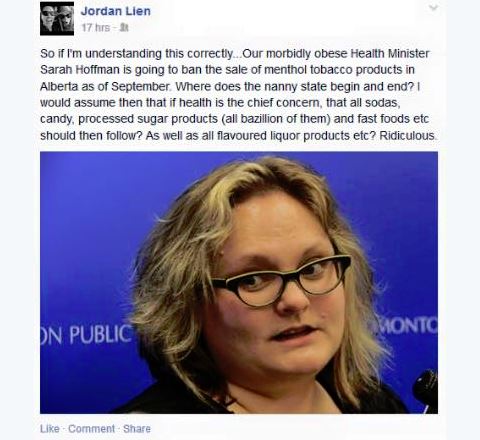
This is a common tactic relied upon by both the right and the left. We see this in the reaction to Conservative Party VP Jordan Lien’s criticism of Alberta Health Minister Sarah Hoffman’s ban of menthol cigarettes.

According to the internet, the following Facebook comment is very bad:

bigboned

The reaction to this was extremely unfavorable to Lien. People called it “dumb,” “sexist,” “insensitive,” “irrelevant,” “misogynistic” (!), and so forth. One PC party drama queen named Warren Mitchell even declared he was ripping up his membership card in disgust. “I’m done with this *$@%^ party.”

Well, it is a *$@%^ party. But seriously, let’s look at this issue in some detail.

Lien actually raises a completely legitimate point that is lost amidst the chorus of inauthentic outrageHere is the issue:

If it is justified to ban menthol cigarettes for the sake of “public health,” shouldn’t we ban other tasty but unhealthy things? Obesity, like smoking, also uses up resources in the health care system. A 2010 report estimated that direct costs of overweight and obesity represented $6 billion — which is 4.1 % of Canada’s total health care budget.

Serious money.

So, following the logic of Health Minister Hoffman and the Alberta government, perhaps things like candy, soda, fast food, and other wonderful treats that make life worth living should be banned as well.

If not, why not?

A wannabe social engineer like Hoffman cannot provide a reasonable answer. The problem with social engineers, whether they are on the left or right, is that there is no limiting principle to their philosophy. Once a person accepts intervention as an acceptable policy, then any limitation to the intervention is essentially arbitrary. So why not ban everything that is unhealthy, and force everyone to be healthy? Wouldn’t that be wonderful?

To be consistent, Sarah Hoffman should want to ban all the things that have made her obese on the same grounds as her ban on menthol cigarettes. Otherwise, we will have a less healthy society.

“Every Albertan should be able to enjoy a life free of preventable tobacco related disease,” Hoffman pontificated as she announced her government’s menthol cigarettes ban.

“Every Albertan should be able to enjoy a life free of preventable tobacco obesity related disease,” she could be saying on the exact same grounds.

“These changes will help make smoking less attractive to youth,” she declared.

“These changes will make smoking eating too much less attractive to youth,” she could have said.

If not, why not?

Most people realize that it is absurd to ban everything that is unhealthy, but they lack principles and are happy to ban things they don’t like — but don’t ban anything unhealthy they like, oh no.

Sarah Hoffman may not smoke menthol cigarettes, but her variety of unhealthy lifestyle is also subsidized by taxpayers and also unpleasant for other people.

The only justified solution to this problem is the government should neither ban menthol cigarettes nor unhealthy foods. This is the only consistent and sane conclusion.

Behavior controls are a type of socialism where the negative effects on society are often neglected. Yet it is irrefutable that such controls lead to economic impoverishment. However, even most economists fail to understand this.

Firstly, behavior controls directly concern the use one can make of his or her own body. If the government imposes restrictions on how one can use one’s body, then one will value one’s body less than otherwise. It is important to understand the incentive here: if the government restricts the ways in which one can use one’s own body, it reduces the degree of ownership one has over oneself. Real ownership means exclusive use and control. One way to think of it is like leasing one’s body from the government, and not owning it oneself. You can use the body for approved activities only.

The actual consequence of this is that people will be less likely to invest in themselves, and they will be more likely to “consume their human capital” — in other words, a person will tend to treat his body less well than if one had “full ownership” of it. It is this economic truth that underlies the idea that giving people freedom makes them more responsible (something many find counter-intuitive).

Secondly, and in a more general sense, as with all forms of political interference, this form of regulation hurts one group and benefits another. The group that can no longer perform certain (non-aggressive) activities is worse off than before, while the group that does not want to tolerate the objectionable behavior (like smoking or eating too much fast food) is better off. More specifically, the producers and users of the things whose consumption is now restricted are the ones who suffer. The ones who benefit are the non-producers and non-users of the goods in question. This encourages people to allocate their efforts towards non-productive activities and discourages productive activities. This makes society poorer.

And it is not a good argument to say we need to ban something because it costs the health care system more money. The very nature of socialized health care is to subsidize unhealthy lifestyles. It is impossible for socialized health care not to do this. So you must either accept that this is an inherent feature of your precious public health care or you must reject public health care. Either way, one must reject banning unhealthy choices for this reason.

At this point, someone might even accept this basic economic argument but protest, “Hey, that’s fine but he shouldn’t have said she was morbidly obese! That’s not nice!”

If a woman said the same thing but health minister was a fat man, the outrage would be virtually nonexistent. People would probably think it was funny. But that’s not the point.

Lien could have made his point with no reference to her physique, that is true. Rhetorically, it was very effective to do so. No one would actually deny that the health minister is obese. Obviously, Sarah Hoffman is a rather large woman. It even seems highly plausible that she is morbidly obese if we use the roughest definition, which is simply 25% above a woman’s “ideal weight.”

His comment simultaneously highlighted the arbitrariness of the law and the hypocrisy of a person with one unhealthy tax-subsidized lifestyle banning someone else’s tax-subsidized unhealthy lifestyle. A reasonable person who is not desperate to be as offended as humanly possible should understand this. So it is good to point out the inconsistent principle to illustrate the point.

It’s like people who like to drink alcohol for whatever reason and want snorting coke to be illegal, or vice versa. Such principles are arbitrary, cruel, and hypocritical. “So let me get this straight,” someone says, “this coke-snorting politician wants to ban alcohol? Give me a break.”

The nature of socialist health care is that it functions as mandatory medical insurance where everyone is pooled together, so people acting in healthy ways will always be pooled with people acting in unhealthy ways. If you want socialist health care, you need to shut up and deal with it.

Anyway, the whole incident reminds me of the classic South Park episode, “Butt Out,” where the comically compulsive over-eater Rob Reiner campaigns fanatically against smoking.

Jordan Lien should have stood up for himself, but instead he gave a pathetic apology like a whiny loser.

If people were serious about public health and justice, they would focus on the substance of the issue. Instead, they are complaining about evil conservative men trying to “keep women down” and “fat shaming.” A dumb politician guy said something mean… on the internet. The horror! And everyone is in a competition to be more and more offended than everyone else, which is how one gets street cred in the attention-seeking world of social media. Apparently, that’s all that matters.

“Resolve to serve no more, and you are at once freed.”

I recently reread Étienne de la Boétie’s The Politics of Obedience: A Discourse on Voluntary Servitude. By far it is one of the greatest pieces of political theory ever written. It was composed in the 16th century but it speaks to the prevailing struggle in all eras of human civilization. It’s good Sunday reading to go with your coffee or your scotch.

How does the state, a tiny minority of people, achieve domination over the far more powerful majority? La Boétie argues that rulers depend upon the consent of the ruled — the tyrant has “nothing more than the power that you confer upon him to destroy you.” This consent can be withdrawn to end the oppression without violence.

Excerpt from Part I:

Poor, wretched, and stupid peoples, nations determined on your own misfortune and blind to your own good! You let yourselves be deprived before your own eyes of the best part of your revenues; your fields are plundered, your homes robbed, your family heirlooms taken away. You live in such a way that you cannot claim a single thing as your own; and it would seem that you consider yourselves lucky to be loaned your property, your families, and your very lives.

All this havoc, this misfortune, this ruin, descends upon you not from alien foes, but from the one enemy whom you yourselves render as powerful as he is, for whom you go bravely to war, for whose greatness you do not refuse to offer your own bodies unto death. He who thus domineers over you has only two eyes, only two hands, only one body, no more than is possessed by the least man among the infinite numbers dwelling in your cities; he has indeed nothing more than the power that you confer upon him to destroy you.

Where has he acquired enough eyes to spy upon you if you do not provide them yourselves? How can he have so many arms to beat you with if he does not borrow them from you? The feet that trample down your cities, where does he get them if they are not your own? How does he have any power over you except through you? How would he dare assail you if he had not cooperation from you? What could he do to you if you yourselves did not connive with the thief who plunders you, if you were not accomplices of the murderer who kills you, if you were not traitors to yourselves?

You sow your crops in order that he may ravage them; you install and furnish your homes to give him goods to pillage; you rear your daughters that he may gratify his lust; you bring up your children in order that he may confer upon them the greatest privilege he knows — to be led into his battles, to be delivered to butchery, to be made the servants of his greed and the instruments of his vengeance; you yield your bodies unto hard labor in order that he may indulge in his delights and wallow in his filthy pleasures; you weaken yourselves in order to make him the stronger and the mightier to hold you in check. From all these indignities, such as the very beasts of the field would not endure, you can deliver yourselves if you try, not by taking action, but merely by willing to be free.

Resolve to serve no more, and you are at once freed. I do not ask that you place hands upon the tyrant to topple him over, but simply that you support him no longer; then you will behold him, like a great Colossus whose pedestal has been pulled away, fall of his own weight and break into pieces.

Once you grasp the power of la Boétie’s argument, there is a visceral moment of realization that has almost a mystical quality. Suddenly the world makes more sense, the same way it did when you really “got” how the free market works, or how you “got” why liberty is just.

— Read the rest of the book — 

Lessons in Secession for the Quebec Election

Separatism was a hot topic for the latest Quebec election. Quebec’s separatist party was defeated, but regardless of the outcome secession will remain one of the most important controversies underlying Canadian confederacy.

Hoppe writes:

Secession increases ethnic, linguistic, religious, and cultural diversity, while in the course of centuries of centralization hundreds of distinct cultures were stamped out.

There are also economic reasons to favor secession. Although Quebec receives transfer payments from Ottawa, these ultimately make Quebec’s economy weaker. This kind of provincial welfare creates an environment where people have stronger incentives to get money from the government (because there is more loot up for grabs), either through welfare or cronyism, rather than serving one’s fellow man in the market and truly benefiting society.

Furthermore, smaller countries have a stronger incentive to favor free trade, and reject protectionism. It is surely correct that if Quebec maintained its same economic policies post-separation, it would be a disaster for the citizens. But there would be far greater pressure to actually liberalize the economy if there was less subsidization available. Additionally, any of Quebec’s wealth that is currently sucked into the black hole of Ottawa would remain in Quebec.

It would be an advance in Canadian civilization for the country to split. But it would not be enough to stop there — there should be hundreds, or thousands of Canadas, which would create a land of amazing prosperity and happy coexistence. There can still be a “Canada” — but Canada should be a coalition of cooperating territories, not a exploitative system where some groups use Ottawa to rip off other groups.

A Different Take on the Rob Ford “Crack Mayor” Story

Rob Ford should resign, but not for the reasons that are very popular right now.

Claim #1: Rob Ford smoked crack, so he should resign.

The tendency of government is always to grow. It is an insatiable beast that becomes bloated by feeding upon the wealth of its subjects. Anything that distracts politicians from trying to pass new laws, new taxes, and new regulations should be welcomed.

Weirdly, that includes smoking crack. The more time a politician spends smoking crack, the less time they can spend trying to do “serious work” like using the law to take more of the peoples’ wealth.

If the entire city council of Toronto was high on crack all the time, they would be high on crack all the time. So they would be pulsing with inflated confidence and sensory stimulation, but they would be unable to do their normal job — which is exercising power over their subjects, generally making their lives worse.

Look at how much energy is being expended to deal with a mayor who apparently smoked crack one time. Instead, they would be working on “fixing problems” in Toronto (read: making Toronto worse).

Normally, crackheads don’t have jobs because they can’t keep a schedule, they can’t concentrate on anything, and they are always desperate to smoke more crack. That would be a far less threatening politician.

Wouldn’t you rather have politicians smoking drugs instead of raising property taxes or creating exploitative regulations that make life difficult?

Claim #2: Rob Ford lied, so he should resign.

I am sure you’ve heard this joke before:

Q: How do you know a politician is lying?

A: His lips are moving.

The term “lying politician” is completely redundant. Politicians lie all the time. If they were actually elected, it is guaranteed that they lied profusely to achieve office. The best politicians are the best liars. The entire premise of democratic politics is people competing against others with one outlandish deception after another.

Mencken said of politicians:

They will all promise every man, woman and child in the country whatever he, she or it wants. …. They will all be curing warts by saying words over them, and paying off the national debt with money that no one will have to earn. When one of them demonstrates that twice two is five, another will prove that it is six, and six and a half, ten, twenty, n. In brief, they will divest themselves from their character as sensible, candid, and truthful men and becomes simply candidates for office, bent only on collaring votes. They will all know by then, even supposing that some of them don’t know it now, that nonsense, and they will apply themselves to the job with a heart yo-heave-ho. Most of them, before the uproar is over, will actually convince themselves. The winner will be whoever promises the most with the least probability of delivering anything.

If people were less selective with their outrage and instead demanded that all politicians resign if they lie, they would seriously require all politicians to pack up their stuff and retreat from public office immediately.

Which would probably make the world a much better place. But people aren’t demanding anything like that at all. So their whining about how Rob Ford lied to them seems extremely contrived and arbitrary.

Read more at CTV.ca —

Politicians are “Obsessive Megalomaniacal Do-gooders”

The following interview with Hans-Hermann Hoppe first appeared in the German weekly Junge Freiheit on November 2, 2012, and was conducted by Moritz Schwarz. It has been translated here into English by Robert Groezinger.

—————–

Are taxes nothing but protection money? The state a kind of mafia? Democracy a fraud? Philosopher Hans-Hermann Hoppe is not only considered one of the most prominent pioneering intellectuals of the libertarian movement, but also perhaps the sharpest critic of the Western political system.

Professor Hoppe, in your essay collection “Der Wettbewerb der Gauner” (“The Competition of Crooks“) you write that “99 percent of citizens, asked if the state was necessary, would answer yes.” Me too! Why am I wrong?

Hoppe : All of us, from childhood, have been moulded by state or state-licensed institutions—preschools, schools, universities. So the result you quoted is not surprising. However, if I asked you whether you said yes to an institution having the last word in each conflict, even in those it is itself involved in, you would certainly say no—unless you hoped to be in charge of this institution yourself.

Er … correct .

Hoppe : Of course, because you know that such an institution cannot only mediate in conflicts but also cause them, you can recognize that it can then resolve them to its own advantage. In the face of this I, for one, would live in fear of my life and property. However, it is precisely this, the ultimate power of judicial decision-making, that is the specific characteristic of the institution known as the state.

Correct, but on the other hand the state is based on a social contract, which provides the individual with protection and space for personal fulfilment, which without the state he would not have—in a struggle of all against all.

Hoppe : No, the state is anything but the result of a contract! No one with even just an ounce of common sense would agree to such a contract. I have a lot of contracts in my files, but nowhere is there one like this. The state is the result of aggressive force and subjugation. It has evolved without contractual foundation, just like a gang of protection racketeers. And concerning the struggle of all against all: that is a myth. Of course the racketeer protects his victims on “his” territory from other racketeers, but only so he can conduct his own racket more successfully. Moreover, it is states that are responsible for the deaths of hundreds of millions of people and immeasurable destruction in the 20th century alone. Compared to that, the victims of private crimes are almost negligible. And do you seriously believe that conflicts between the inhabitants of the tri-border region [of France, Germany and Switzerland] near Basle, who are living together in a condition of anarchy, are more numerous than conflicts between the inhabitants of Dortmund and Düsseldorf, who are citizens of one and the same state [Germany]? Not that I know of.

Why in your view is democracy just a “competition of crooks”?

Hoppe : All highly-developed forms of religion forbid the coveting of someone else’s property. This prohibition is the foundation of peaceful cooperation. In a democracy, on the other hand, anyone can covet anybody else’s property and act according to his desire—the only precondition being that he can gain access to the corridors of power. Thus, under democratic conditions, everybody becomes a potential threat. And during mass elections what tends to happen is that the members of society who attempt to access the corridors of power and rise to the highest positions are those who have no moral inhibitions about misappropriating other people’s property: habitual amoralists who are particularly talented in forging majorities out of a multitude of unbridled and mutually exclusive demands.

“Politicians: lazy and spongers!” Aren’t you afraid you might be reproached for complaining on the level of the “Bild” tabloid newspaper?

Hoppe: So what? Up until the 20th century there was hardly an important political thinker who didn’t speak disparagingly about democracy. The key word was: “mob rule.” The populist criticism of democracy, as can be found in Bild or at the water cooler, is all very well. But it is not fundamental enough, nor does it go far enough—to date Bild hasn’t asked me for an interview either. Of course politicians are spongers; they live off money extorted from other people with the threat of violence—which is called “taxation.” But unfortunately, politicians are not lazy. It would be nice if all they did was squander their booty. Instead they are obsessive megalomaniacal do-gooders, who in addition make life difficult for their victims with thousands of laws and regulations.

Democracy is only one possible variety of statehood. Would a different form of state be more acceptable to you?

Hoppe: In a monarchist state everyone knows who the ruler is and who the ruled are, and accordingly there is resistance against any attempt to increase state power. In a democratic state this distinction becomes blurred, and it becomes all the easier to expand state power.

Just a moment: that’s what courts, laws and the constitution are for, to limit and control the state—government as well as parliament.

Hoppe : The mafia also has “executive”, “legislative” and “judicial” branches. Just go and watch the movie “The Godfather” again!

Another objection: What about the new internet-based detractors of the state, such as “Occupy” or the “Pirates,” who demand transparency and participation, without immediately condemning the state and democracy in their entirety?

Hoppe : The “Occupy” movement consists of economic ignoramuses who fail to understand that the banks’ dirty tricks, which they rightly deplore, are possible only because there is a state-licensed central bank that acts as a “lender of last resort,” and that the current financial crisis therefore is not a crisis of capitalism but a crisis of statism. The “Pirates,” with their demand for an unconditional basic income, are well on the way to becoming another “free beer for all” party. They have a single issue: criticism of “intellectual property rights” (IP rights), which could make them very popular—and earn them the enmity in particular of the music, film and pharmaceutical industries. But even there they are clueless wimps. They just need to google Stephan Kinsella. Then they’d see that IP has nothing to do with property, but rather with state privileges. IP allows the inventor (I) or ‘first maker’ of a product—a text, picture, song or whatever—to forbid all other people to replicate this product, or to charge them license fees, even if the replicator (R) thereby uses his own property only (and does not take away any of I’s property). This way, I is elevated to the status of co-owner of R’s property. This shows: IP rights are not property but, on the contrary, are an attack on property and therefore completely illegitimate.

In “The Competition of Crooks” you outline as an alternative the model of a “private law society.” How does it work?

Hoppe: The basic concept is simple. The idea of a monopolistic property protector and law keeper is self-contradictory. This monopolist, whether king or president, will always be an expropriating property protector and a law-breaking law keeper—who will characterize his actions as being in “the public interest.” In order to guarantee the protection of property and safeguard the law there has to be free competition in the area of law as well. Other institutions apart from the state must be allowed to provide property and law protection services. The state then becomes a normal subject of private law, on an equal footing with all other people. It can’t raise taxes any more or unilaterally enact laws. Its employees will have to finance themselves just the same as everybody else does: by producing and offering something that freely engaging customers consider value for money.

Wouldn’t that quickly lead to a war between these “providers?”

Hoppe: War and aggression are costly. States go to war because they can, via taxes, pass on the cost to third parties who are not directly involved. By contrast, for voluntarily-financed companies, war is economic suicide. As a private law subject the state too will, like all other security providers, have to offer its customers contracts that can only be changed by mutual agreement, and which in particular regulate what is to be done in the case of a conflict between itself and its customers, or between itself and the customers of other, competing security providers. And for that there is only one solution acceptable to everyone: that in these sorts of conflicts not the state, but an independent third party decides—arbitrators and judges who in turn compete with each other, whose most important asset is their reputation as keepers of the law, and whose actions and judgments can be challenged and, if need be, revised, just as anyone else’s can be.

Who should be such a “third party?” And with what instruments of power should it assert the interests of an individual citizen against his contractual partner—the private state, which of course is much more powerful?

Hoppe: In local conflicts, in a village or a small town, these will very often be universally respected “natural aristocrats.” Or else, arbitrating organisations and courts of appeal, which insurers and insured have contractually agreed on from the start. Whoever then does not abide by the judgments will not only be defaulting, he will become a pariah in the world of business. Nobody will want to have anything to do with him, and he will immediately lose all his customers. This is no utopian idea. This is already the usual practice in international—anarchical—business transactions today. And another question for you: How should the individual citizen assert his interests in the face of a monopolistic tax-state? It is much more powerful—and always has the last word!

Do you understand the continuing scepticism with regard to your proposition?

Hoppe : Of course, as most people have never heard of this idea, let alone thought about it seriously. I am only unsympathetic towards those who yell out at the top of their voices when they hear this idea and demand the condemnation of its representatives, without having the least knowledge of economics and political philosophy.

It is hardly likely that a majority of citizens will ever support such an unfamiliar model. But what parts of it at least could be adopted, in order to achieve at least partial improvements of our current system, without a complete abandonment of state and democracy?

Hoppe : There is an interim solution. It’s called secession and political decentralization. Small states must be libertarian, otherwise the productive people will desert them. Desirable therefore is a world made up of thousands of Liechtensteins, Singapores and Hong Kongs. In contrast, a European central government—and even more so a world government—with a “harmonized” tax and regulation policy, is the gravest threat to freedom.

For that too you will probably not find a majority. Therefore how will state and democracy develop in future? Where will we finally end up?

Hoppe : The Western “welfare state model,” “socialism light,” will collapse just like “classical” socialism—of course, I can’t say whether in five, ten or 15 years. The key words are: state bankruptcy, hyperinflation, currency reform and violent distribution battles. Then it will either come to a call for a “strong man” or—hopefully—a massive secession movement.

— From Mises.org

What the Middle East Really Needs

The West likes to say it stands with the Egyptians and the Syrians and so forth in their “fight for democracy.”

The conventional wisdom which says the Middle East needs more “democracy” is, like a lot of conventional wisdom, nothing but nonsense.

Democracy is not freedom.

What the 380 million Arabs need are property rights, not the right to cast a useless ballot every four or so years. If America and Europe insisted on only this, it would make millions of Arabs who hate us today love us overnight.

Read more at Taki’s Magazine

Canada Needs Its Own “IRS Scandal”

While Canada is abuzz with the “Duffy Scandal,” the American news has been making a big deal about the “IRS scandal.”In this case, the IRS targeted groups with “conservative”-sounding names for special scrutiny.

Canada needs to have a scandal like this.

One of the most interesting parts of the IRS scandal is how the outrage is not divided along the lines of partisanship, as expected. Not only “right-wingers” are unhappy. Even diehard Obama-loving “leftists” like Chris Matthews, who would normally leap to defend “their guy” at any opportunity, are displeased.


Another high-profile leftist, Jon Stewart, is also extremely annoyed.


Why would leftists care if some goofy right-wing organization received extra scrutiny at the IRS?

The answer to this question is very important. The existence of the modern welfare state depends on the American public’s tolerance of the IRS’ privacy and property invasions. If this tolerance is ever substantially compromised, the massive state apparatus itself would be in jeopardy.

This is why Canada needs its own “IRS scandal” with the Canada Revenue Agency. The CRA is the most feared government agency in Canada. It is a huge part of our lives. People who yearn for big government know that the CRA must be perceived as “fair.” Otherwise, the modern welfare/warfare system would be threatened.

A big “unfairness” scandal at the CRA would really damage the image of Canada’s federal government. If a few cases were exposed where the CRA demonstrated systematic unfairness, those cases would be seen as representative of the agency’s activities. A large part of the public would doubt the wisdom and justice of the government. Their tolerance of the CRA would be diminished.

Some may recall the CRA bribery scandal. As far as scandals go, this probably didn’t do Canada much good. The “scandal” was about “corrupt auditors” taking bribes to help people pay lower taxes. As a scandal, it assumes the validity of the CRA rather than posing a challenge to it.

The CRA exists to extract wealth from Canadians with the threat of force. To the extent that scandals, large or small, call into question the validity of the government’s incredible taxing power, they are good.

That the only security men can have for their political liberty, consists in their keeping their money in their own pockets, until they have assurances, perfectly satisfactory to themselves, that it will be used as they wish it to be used, for their benefit, and not for their injury.

Lysander Spooner

Politics Is the Lowest Form of Human Activity

PROOF.

Harper: Free Trade is a Tax Break for China

Harper was criticized the other day for wanting to increase taxes on various imported consumer goods.

There is no defense for raising taxes ever. This is even more important when Canada will be soon in recession. So what is Harper thinking? He rightly pointed out that the Liberals had voted against budgets in which there were some tiny tax cuts. Okay, sure, the Liberals lack any principled objection to higher taxes. What was his rebuttal to their criticism on the tariff issue?

“What the Liberal Party seems to stand for, Mr. Speaker, is that somehow we should give tax breaks to emerging economies like China.”

OMG, my brain just exploded from the unbelievable stupidity of that statement. I love a good cheap shot at a Canadian political party as much as the next guy, but Harper’s statement is just dumb.

So not taxing imports is a tax break to the countries from which we are buying those imports. So a free trade policy is a tax break for our trading partners.

That is incoherent, protectionist nonsense. First of all, the importer pays the tax, not the exporter. So China is not getting the tax break, per se. It is the one importing Chinese stuff.

But then this is kind of like saying it’s a “tax break” if the government taxes anything less than 100% of your income. The meaning of “tax break” is clearly being twisted. A “tax break” is meant to be a means of reducing a tax liability that already exists. The absence of a tax is not a tax break. Adding new taxes is not the same as taking away tax breaks. The underlying philosophy revealed in Harper’s words is that the government rightfully owns everyone else’s wealth, and letting people keep anything is a tax break. The whole notion is economically utterly perverse.

The case against protectionism is logically irrefutable. Harper, like virtually all politicians, is a mercantilist who thinks protectionism is good (for his friends), meaning he is no ally of capitalism and free trade. He is a classic Canadian crony prime minister.

— Read more at CBC News. —