The US Stock Market Seems Like a Bad Joke
September 26, 2016 Leave a comment
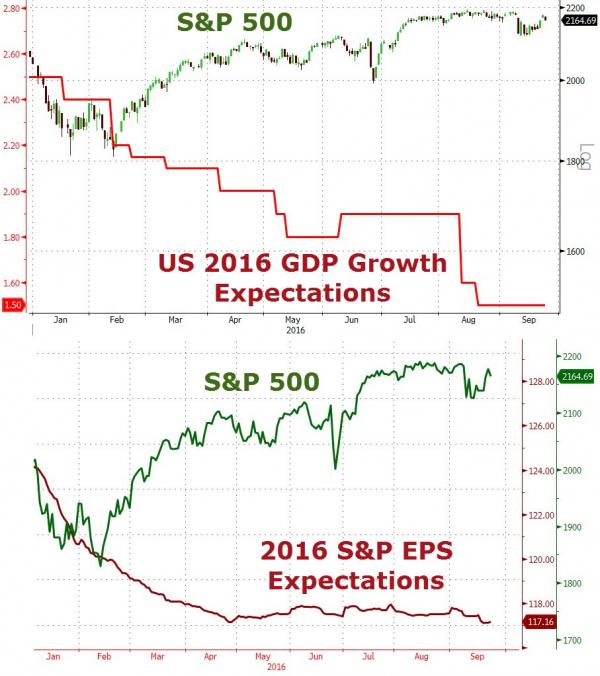
Thanks to David Stockman.
Markets, Freedom, and Truth
September 26, 2016 Leave a comment
Thanks to David Stockman.
September 26, 2016 Leave a comment
Another company discouraged by political uncertainty — Centrica is selling natural gas assets at a likely loss to get out of Canada.
September 21, 2016 Leave a comment
Some people have a confused idea of what counts as a subsidy.
In the minds of anti-oil radicals, not collecting more taxes from fossil fuel producers and consumers is a subsidy to fossil fuels.
That’s like saying the government subsidizes you unless it taxes 100% of your income.
David Yager writes:
The notion that Canadian governments in some way subsidize the cost of the final product to consumers – as per the dictionary definition – is preposterous. According to PetroCanada the taxes on a liter of gasoline in Canada in 2015 above and beyond the cost of petroleum, refining and distribution included a federal excise tax of $0.10 per liter, GST/HST ranging from 5% to 15%, a $0.667 per liter carbon tax in B.C., and provincial fuels taxes ranging from $0.13 to $0.192 per liter. Similar direct fuel cost levies exist for diesel fuel. These can total 25% or more of the total cost or more depending on crude prices and where you live. It is estimated these fuel levies provide Ottawa and the provinces with $15 billion annually. This is on top of another $18 billion oil and gas producers paid to all levels of government in 2014 in the form of property taxes, income taxes, payroll taxes and producing royalties.
Some subsidy.
— Read more at EnergyNow —
September 19, 2016 Leave a comment
With its politically motivated ‘anti-dumping’ laws and tariffs.
September 19, 2016 1 Comment
So says says a university-employed tax-funded animal rights radical at Rutgers. “We ought to get rid of domestication altogether.”
According to this guy, pet owners are “oppressors.”
This is all pure confusion of course. Note first of all that, in the interview linked above, he is talking to to a human interviewer for an article to be read by humans. He is not talking to other animals about them ‘oppressing’ each other (like cats tormenting the birds in the yard).
Animals can’t be “not oppressed.” They can’t be “liberated” simply because they cannot be “free” the way humans can be.
That’s why it’s ok when we say, “I own this dog / this cat is my property,” but it’s not ok to own slaves and have humans as property. Humans have rights and animals don’t.
Obviously humans should take into account animal suffering for our actions. The burden of moral decisionmaking is entirely on humans in any case. But that is not the same as saying, “Animals have rights.”
There is certainly no justification for using the state’s guns and badges to restrict people from owning pets and eating animals. But this is what radicals like Gary Francione desire. The progressives have always hated the human use of animals (especially red meat).
September 18, 2016 Leave a comment
Costs $2 million per month.
But naturally he supports making it more difficult for regular people to get guns for protection.
Trudeau might not feel so scared and could save the taxpayers some money if he could only learn the forbidden arts of Cretien’s Shawinigan Handshake:
September 1, 2016 Leave a comment
The Alberta Advantage is gone, says David Yager.
Rising oil prices will help. And they will surely rise. It’s just nobody knows when, why and how much. But even if WTI returned to US$100 a barrel next year Alberta still won’t the same because every other oil producing jurisdiction will enjoy the same benefit but without Alberta’s new tax increases, carbon taxes, investment concerns, government policy uncertainty and the continuing lack of low-cost international market access through additional pipelines.
— Read more at Energy Now —
August 22, 2016 Leave a comment
Today AIMCo announced that it is investing $500 million in an American company called Howard Energy Partners.
AIMCo is an Alberta crown corporation that manages money for government pensions and endowments. They have $90 billion under management. Virtually all of that money is derived from taxation.
What does Howard Energy Partners do?
Howard Energy Partners is an independent midstream energy company, owning and operating natural gas gathering and transportation pipelines, …
Alberta can’t get pipelines, in part because it is viciously opposed by US-backed opponents.
Meanwhile, the US continues building pipelines — lots of pipelines — and even has the pleasure of getting Alberta taxpayer money invested in its own pipeline companies.
August 15, 2016 2 Comments
The Facebook page of Conservative Party leadership aspirant Maxime Bernier posted the following image with the question “Which of these economists do you prefer?”:
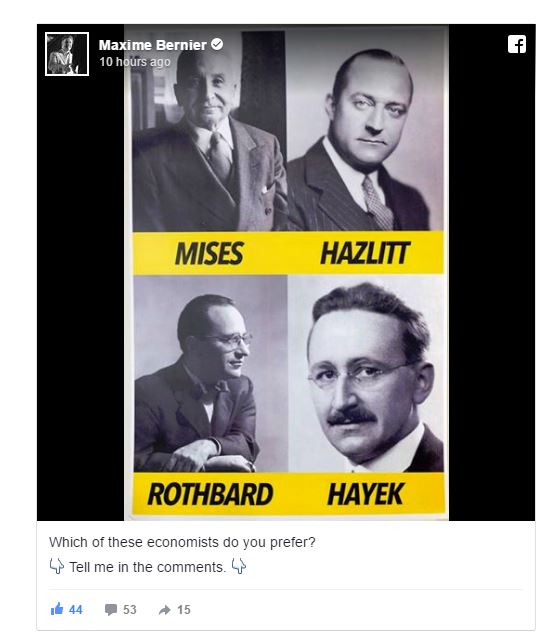
WHOA, wait a minute.
What is going on here? Have we entered the Bizarro World? Does Spock have a beard?
The four economists in the picture are amongst the hardest of the hardcore free market economists in history.
The mere fact that this multiple choice question was posed with these four options makes us kind of like Maxime Bernier’s style. The fact that Murray Rothbard is in this list at all is frankly shocking. In a good way.
So here’s what you need to know:
Someone who seems to like the Austrian School of Economics is running for leadership of a major Canadian political party. This is almost too wonderfully weird to believe.
Bernier has already proposed abolishing the CRTC, ending monopolistic supply chain management, having a more laissez-faire approach to air travel, privatizing Canada Post, and replacing corporate welfare with lower taxes for all corporations. Bernier is showing that he will attack sacred cows in Canada’s reflexively progressive political discourse.
Now comes this Facebook post, intimating that underlying these consumer-friendly proposals is at least some solid classical liberal economic foundations.
Honestly, as far as Canadian politics goes, that might be the best we’ve seen in the last century. Maybe we will see someone approximating a real classical liberal leading one of Canada’s main political parties.
July 21, 2016 Leave a comment
Without public schools forcing students to read excruciatingly awful novels like The Stone Angel on a massive scale, Canadian authors like Margaret Atwood would probably sell far fewer books.
We should remember this when we read stories about Margaret Atwood’s approval of a new Ontario government policy that will force public school students to read even more boring books by Canadian authors.
Assuming no more than self-interest, artists, like most people, will tend to welcome subsidies that benefit themselves. It’s the model of corporate welfare applied to the artistic world. When they say it will “strengthen arts and culture,” remember there is no reason to believe that “good” arts and culture will prevail as the new learning material for children. Likewise in the corporate welfare scenario, subsidies to, say, the auto industry will be claimed to “strengthen the economy and domestic industry” even though economics tells us the opposite is true.
To the extent it survives on government money, art is a welfare program. The entire process of deciding what novels should be studied in public schools is completely political and thus likely to produce bad outcomes. Sometimes you get lucky and a real treasure comes out of the system, but the results tend to be bad. By relying on the government to “strengthen arts and culture”, you can be assured the arts and culture will be get worse while kids consider drinking bleach to avoid being forced to read books like The Stone Angel.
 CANADIAN MARKET REVIEW