Alberta’s NDP, Unions, and the Minimum Wage

When analyzing public policy, one must typically ignore stated goals and understand the economic incentives that make groups favor certain forms of economic intervention.

Unions, as a group, tend to favor market restrictions that prop up their higher wage rates.

Alberta’s NDP, led by Rachel Notley, favors unions.

evilnotley

This an important factor in the NDP arguing for a 50% increase to Alberta’s minimum wage, despite protests from the business community and anyone with an understanding of basic economic law. NDP goal to hike minimum wage has nothing to do with helping less productive workers make more income, regardless of what their stated objectives are.

Minimum wage laws are a classic form of monopolistic grants of privilege that benefit some groups at the expense of others. Despite the proclaimed objective of minimum wage laws, which is to increase incomes of the most marginal workers, the actual effect is the exact opposite — it makes them unemployable because they are not sufficiently productive to be employed at the legal wage rates. This means that minimum wages will always cause more unemployment than otherwise — any economist who denies this is either a liar or a fool who doesn’t even understand the basic principles of price controls.

Who benefits from such laws? Certainly not the marginal workers, for it becomes illegal to hire them at the wage justified by their productivity. On the other hand, anyone employed above the minimum wage benefits because their competition is reduced. In particular, unions benefit from minimum wage laws. Unions despise cheaper labor competition. Minimum wage laws remove competition of less productive workers by forcing them to be unemployed.

And there is another reason why unions love minimum wage hikes — it is a devious way to increase their own wages. This can work in many ways depending on the labor agreement. Some agreements trigger mandatory wage hikes when statutory minimum wages increase (because wages are based on a percentage above minimum wage). Others have provisions to open wage negotiations if minimum wages go up.

I am not making this up. Economic theory informs us that we should expect nothing less. But consider also a 2004 study in the Journal of Human Resources by economists William Wascher, Mark Schweitzer and David Neumark. They clearly showed that lower-wage union workers usually see a boost in employment and earned income following a mandated wage hike. And those non-union wage workers who are now unemployed or unemployable? Who cares! The union members already have higher wages and protected jobs. So what if this cruel policy leaves in its wake desperate workers who can no longer legally work?

As for the NDP, there should be no doubt that Premier Rachel Notley is a union hack. Most of her career has been in the service of unions. Consider a few facts from her personal history:

She is married to Lou Arab, a communications and public relations staffer for the Canadian Union of Public Employees[2] and a campaign strategist for the party. She lives with him and their two children in the historic district of Old Strathcona located in south-central Edmonton.[17]

After law school, Notley articled for Edmonton labour lawyer Bob Blakely, and went on to work for the Alberta Union of Provincial Employees representing members with Workers’ Compensation cases.

She worked for a short time for the National Union of Public and General Employees (NUPGE),[20] worked at Athabasca University,[21] acted as volunteer co-ordinator for the Friends of Medicare “Romanow Now” campaign, and finally as a labour relations officer for the United Nurses of Alberta.[1]

Can there be any doubt that Notley will seek to benefit her union friends at the expense of other groups in society? Of course not.

Rachel Notley and the NDP are looking to empower unions. They don’t care if they hurt society’s least productive workers, like teenagers, people with disabilities, workers with language barriers, anyone without much experience for any reason, and ethnic or racial groups that may face discrimination.

Some will argue that forcing minimum wages higher makes employers invest in more equipment and develop new technology and this will increase productivity of labor. Therefore, this improves the economy. But this is a silly argument. Capitalists are always seeking ways to increase productivity, so to think they are just sitting around waiting for the government to force price floors on labor to do so is a joke.

But even assuming the employer doesn’t just reduce his quantity of labor demanded, his investment in new capital is limited by savings in the economy. Increasing minimum wage does not increase the total supply of capital available. If anything, capital will merely be shifted from some industries to others in an attempt to offset an artificially higher cost. Capital is not being reallocated because of a market requirement, and so this is not an economic improvement.

Don’t be fooled by anyone who says they want to increase the minimum wage to help the poorest workers. The main concern motivating the NDP to increase the minimum wage is helping unions.

Anyone advocating a higher minimum wage should be ridiculed and shamed out of public office on account of sheer ignorance.
Politicians Are Bad for Your Health

In politics, a classic strategy for dealing with legitimate criticism is to ignore the real issue and just whine about “personal attacks.”

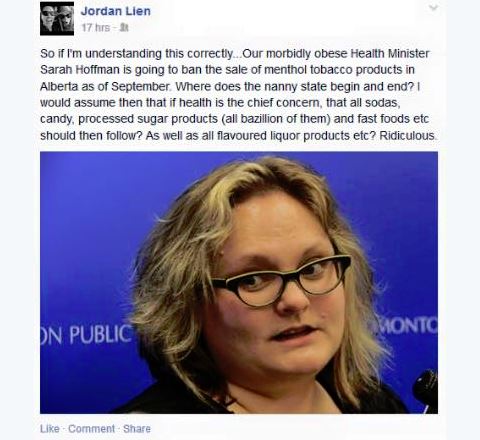
This is a common tactic relied upon by both the right and the left. We see this in the reaction to Conservative Party VP Jordan Lien’s criticism of Alberta Health Minister Sarah Hoffman’s ban of menthol cigarettes.

According to the internet, the following Facebook comment is very bad:

bigboned

The reaction to this was extremely unfavorable to Lien. People called it “dumb,” “sexist,” “insensitive,” “irrelevant,” “misogynistic” (!), and so forth. One PC party drama queen named Warren Mitchell even declared he was ripping up his membership card in disgust. “I’m done with this *$@%^ party.”

Well, it is a *$@%^ party. But seriously, let’s look at this issue in some detail.

Lien actually raises a completely legitimate point that is lost amidst the chorus of inauthentic outrageHere is the issue:

If it is justified to ban menthol cigarettes for the sake of “public health,” shouldn’t we ban other tasty but unhealthy things? Obesity, like smoking, also uses up resources in the health care system. A 2010 report estimated that direct costs of overweight and obesity represented $6 billion — which is 4.1 % of Canada’s total health care budget.

Serious money.

So, following the logic of Health Minister Hoffman and the Alberta government, perhaps things like candy, soda, fast food, and other wonderful treats that make life worth living should be banned as well.

If not, why not?

A wannabe social engineer like Hoffman cannot provide a reasonable answer. The problem with social engineers, whether they are on the left or right, is that there is no limiting principle to their philosophy. Once a person accepts intervention as an acceptable policy, then any limitation to the intervention is essentially arbitrary. So why not ban everything that is unhealthy, and force everyone to be healthy? Wouldn’t that be wonderful?

To be consistent, Sarah Hoffman should want to ban all the things that have made her obese on the same grounds as her ban on menthol cigarettes. Otherwise, we will have a less healthy society.

“Every Albertan should be able to enjoy a life free of preventable tobacco related disease,” Hoffman pontificated as she announced her government’s menthol cigarettes ban.

“Every Albertan should be able to enjoy a life free of preventable tobacco obesity related disease,” she could be saying on the exact same grounds.

“These changes will help make smoking less attractive to youth,” she declared.

“These changes will make smoking eating too much less attractive to youth,” she could have said.

If not, why not?

Most people realize that it is absurd to ban everything that is unhealthy, but they lack principles and are happy to ban things they don’t like — but don’t ban anything unhealthy they like, oh no.

Sarah Hoffman may not smoke menthol cigarettes, but her variety of unhealthy lifestyle is also subsidized by taxpayers and also unpleasant for other people.

The only justified solution to this problem is the government should neither ban menthol cigarettes nor unhealthy foods. This is the only consistent and sane conclusion.

Behavior controls are a type of socialism where the negative effects on society are often neglected. Yet it is irrefutable that such controls lead to economic impoverishment. However, even most economists fail to understand this.

Firstly, behavior controls directly concern the use one can make of his or her own body. If the government imposes restrictions on how one can use one’s body, then one will value one’s body less than otherwise. It is important to understand the incentive here: if the government restricts the ways in which one can use one’s own body, it reduces the degree of ownership one has over oneself. Real ownership means exclusive use and control. One way to think of it is like leasing one’s body from the government, and not owning it oneself. You can use the body for approved activities only.

The actual consequence of this is that people will be less likely to invest in themselves, and they will be more likely to “consume their human capital” — in other words, a person will tend to treat his body less well than if one had “full ownership” of it. It is this economic truth that underlies the idea that giving people freedom makes them more responsible (something many find counter-intuitive).

Secondly, and in a more general sense, as with all forms of political interference, this form of regulation hurts one group and benefits another. The group that can no longer perform certain (non-aggressive) activities is worse off than before, while the group that does not want to tolerate the objectionable behavior (like smoking or eating too much fast food) is better off. More specifically, the producers and users of the things whose consumption is now restricted are the ones who suffer. The ones who benefit are the non-producers and non-users of the goods in question. This encourages people to allocate their efforts towards non-productive activities and discourages productive activities. This makes society poorer.

And it is not a good argument to say we need to ban something because it costs the health care system more money. The very nature of socialized health care is to subsidize unhealthy lifestyles. It is impossible for socialized health care not to do this. So you must either accept that this is an inherent feature of your precious public health care or you must reject public health care. Either way, one must reject banning unhealthy choices for this reason.

At this point, someone might even accept this basic economic argument but protest, “Hey, that’s fine but he shouldn’t have said she was morbidly obese! That’s not nice!”

If a woman said the same thing but health minister was a fat man, the outrage would be virtually nonexistent. People would probably think it was funny. But that’s not the point.

Lien could have made his point with no reference to her physique, that is true. Rhetorically, it was very effective to do so. No one would actually deny that the health minister is obese. Obviously, Sarah Hoffman is a rather large woman. It even seems highly plausible that she is morbidly obese if we use the roughest definition, which is simply 25% above a woman’s “ideal weight.”

His comment simultaneously highlighted the arbitrariness of the law and the hypocrisy of a person with one unhealthy tax-subsidized lifestyle banning someone else’s tax-subsidized unhealthy lifestyle. A reasonable person who is not desperate to be as offended as humanly possible should understand this. So it is good to point out the inconsistent principle to illustrate the point.

It’s like people who like to drink alcohol for whatever reason and want snorting coke to be illegal, or vice versa. Such principles are arbitrary, cruel, and hypocritical. “So let me get this straight,” someone says, “this coke-snorting politician wants to ban alcohol? Give me a break.”

The nature of socialist health care is that it functions as mandatory medical insurance where everyone is pooled together, so people acting in healthy ways will always be pooled with people acting in unhealthy ways. If you want socialist health care, you need to shut up and deal with it.

Anyway, the whole incident reminds me of the classic South Park episode, “Butt Out,” where the comically compulsive over-eater Rob Reiner campaigns fanatically against smoking.

Jordan Lien should have stood up for himself, but instead he gave a pathetic apology like a whiny loser.

If people were serious about public health and justice, they would focus on the substance of the issue. Instead, they are complaining about evil conservative men trying to “keep women down” and “fat shaming.” A dumb politician guy said something mean… on the internet. The horror! And everyone is in a competition to be more and more offended than everyone else, which is how one gets street cred in the attention-seeking world of social media. Apparently, that’s all that matters.