Will “tougher mortgage rules” hurt the economy? Don’t listen to the shills for the mortgage industry.

The folks in Canada who sell mortgages are complaining about the federal government reducing the subsidy to its business.

From the Financial Post:

The Canadian Association of Accredited Mortgage Professionals says since new rules went into effect in July, 2012, resale housing activity is 8% lower between August and October than a year earlier. Among the changes instituted by the government was a lowering of allowable amortization from 30 years to 25 years for consumers borrowing with mortgage default insurance which is backed by the federal government.

Let us think about this for a moment. By providing insurance against default, the Federal government provides a huge benefit to the mortgage industry. It insulates them against potential losses. This causes them to extend loans to to submarginal borrowers who would not be otherwise creditworthy. I can tell you I would make much riskier investments if someone would pay me back for any money I lose.

Jim Murphy, chief executive from CMAAP, is not happy:

“My concern is that a policy-induced housing market downturn creates unnecessary risk that directly affects not just housing but job creation and the economy as a whole.”

This guy really is clueless. First of all, what is this about “a policy-induced housing market? The “policy-induced” aspect of the housing market is, clearly, the availability of government backed loans for houses and the inflationary policies of central banks, not the reduction in the subsidy to his friends.

More importantly, it is simply false that reducing this subsidy will hurt the economy.

A great deal of resources are shifted into the housing industry that would otherwise be used in a different way because of federally backed mortgage loans. If you are a mortgage lender, a 30-year amortization increases the amount of interest you will take in. On an $375,000 house, you are talking about an extra $65,000 in interest. If more loans are made, housing prices will be bid up. Money flows into the financial industry and the construction industry. More people will be employed at banks, mortgage brokerages, and home-builders, and related businesses.

As resources shift into some sectors, they are necessarily shifted away from others. Everyone now has to pay more for houses than they would without so many buyers, who are effectively subsidized to a greater or lesser extent. But beyond the price of the home itself, for the guy buying a house, he is paying an extra $65,000 in interest to the bank. Assuming that is about equal to his annual salary, he basically has to devote an extra year of his life to pay the bank. He likes this, because “Pay less now, more later” is the mantra of our age, but he would pay less overall with the shorter amortization. $65,000 is not chump change — it would buy his wife a new car and send his kid through university. More money and jobs goes into housing, but less money and jobs are produced elsewhere as a result.

So we can understand the impact of this sort of intervention in the mortgage market. Resources are allocated not according to how the market would most efficiently allocate them, but rather are diverted to profit from the government’s protection of the financial industry. Therefore, the elimination of this subsidy would represent a favorable change to the overall economy. This means that some people would be unable to get low mortgage rates that are backed by the taxpayers. Housing prices would fall. It means homebuilders would have fewer homes to build. Lenders would make less money.

To some people, these consequences are bad. To the economist, these consequences must be considered good, because they represent the economy re-allocating resources according to efficiency, rather than government intervention. Resources will have a greater tendency to shift to uses consumers actually need.

Unfortunately, the insurance still exists. It has not been eliminated. The government will merely provide less of a subsidy than they did before. Therefore, the market will be distorted relatively less than it was previously. The economy will be slightly better, because fewer resources will be shifted to inefficient uses (i.e. housing and Jim Murphy’s summer home).

The best thing that could happen would be for the Canadian government to eliminate taxpayer backed mortgage insurance completely, which would do a great deal to restore a free market in housing.
Setting the Record Straight on the Fed and “Zero-Interest Rate Policy”

It’s entirely possible I don’t have the time to write this right now. Poor me. But this is important, so I must make the time.

So listen up people. Time for STRAIGHT TALK. It’s important to get the facts straight because it gives us a chance to understand something about economics and do some critical thinking.

What am I talking about? Well, a lot of folks of an anti-Fed persuasion, and even some Fed-lovers, say we have “artificially low interest rates.” Among the generally economically literate folks who are my friends and acquaintances, I constantly hear “artificially low interest rates this” and “artificially low interest rates that.”

Is the interest rate distorted? Yes. But is the Fed the reason interests rates have remained so low?

The answer is no.

“But!” you say, “Bernanke is printing so much money! That money is used to buy bonds, which pushes down interest rates!”

Okay, I am going to blow your mind here: The Federal Reserve is not printing money. They have not added made any net additions to their balance sheet since the end of QE2.

In fact, the Fed has deflated! That’s right… they have sold debt, and reduced their balance sheet.

WHAT!

It is true. I will now proceed to show my evidence:

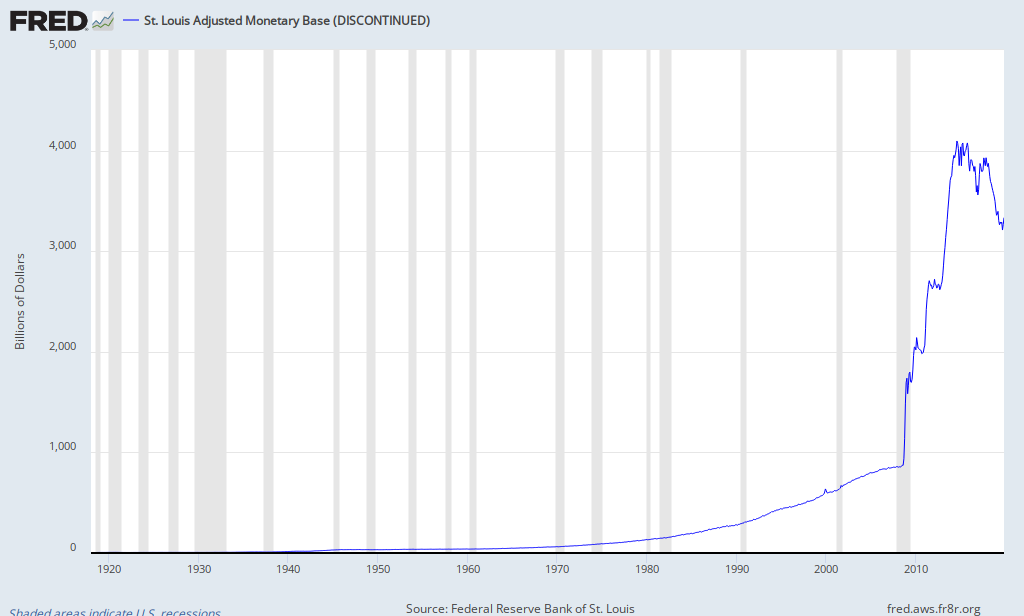
First, let us look at a long-term chart of the monetary base.

FRED Graph

Here we see the monetary base has skyrocketed since 2008. The first giant spike is what we retroactively call “QE1,” the massive purchasing of mortgage-backed securities during the financial crisis.

You’ll note there was a temporary reversal of such debt-buying just before the second huge spike: QE2, which spent $600 billion on US government debt. Again, following this spike there has been a reduction in the size of the Fed’s holdings.

Now let’s “zoom in” to the end of QE2.

FRED Graph

So from Summer 2011, we have not seen the monetary base increasing. The Fed has been jerking around the amount, but since the end of QE2 the total assets of the Fed has tended downward.

What about QE3? Well… what about QE3? As far as I can see, it either has not even started yet, or it is being offset by the sale of other Fed assets. In any case, the grinding weight of the American economy already has the recessionary momentum, and $40 billion a month isn’t going to matter.

That is why America is certainly entering a recession in 2013, and so Canada will also.

If this is true, and if it is also true that the Federal Funds rate has stayed the same the entire time, then something else must be keeping interest rates as low as they are. The contraction of the Fed’s balance sheet should cause the interest rates to rise. So what could it be?

It’s not actually a big shocker: the economy is extremely delicate. Extremely delicate. That’s because everything seems to depend on the whims of politicians and bureaucrats who will either:

  1. Pump more crack into the financial system and eke out a bit more cancerous economic ‘growth’, OR
  2. Let a depression come and bring the economy to its knees. Or another crisis will come and the economy will be brought to its knees anyway.

So what Robert Higgs calls “regime uncertainty” is at critical levels, forcing low growth and keeping unemployment high. Additionally, the huge banks don’t trust each other because they are all fundamentally broke and the financial system is such a twisted nightmare. Virtually all the money added by Bernanke has printed been packed into the banks excess reserves.

Graph of Excess Reserves of Depository Institutions

Could it be the case that if Bernanke were not paying interest on the banks’ excess reserves, that interest rates would rise? Probably not. They are already losing money by parking their reserves at the Fed. But they prefer to lose just a tiny bit of money, rather than a lot of money in a highly uncertain economy.

The same way investors will give their money to Geithner — GEITHNER, of all people! — for a negative real return. They would rather know they will gain nothing, or lose a percent or two, rather than lose 20% with some fund manager.

The Great Depression also saw record low interest rates, so the present state of affairs should surprise no one.

Now just to clarify, I am not defending Fed policy, I am not defending Bernanke. I loathe central banking in principle. Deflation, i.e. reducing the money supply, is not necessarily a good thing. Yes, falling prices are good. Yes, inflation is bad. But if you are going to have a central bank, then policy should be to maintain a stable money supply, and let the market determine the value of the currency. Reducing the money supply through open market operations is just as much of an intervention in the market as increasing the money supply, it just affects different people in different ways. For example, the debtor prefers inflation, the saver prefers deflation.

That being said, the money supply has been RELATIVELY flat now for over a year. When we’re talking about Ben Bernanke, isn’t that pretty much the best we can hope for? Much better than him flying around in his helicopter throwing trillions of dollars at the world’s problems, like he did up until mid-2011.

Don’t get me wrong. The Fed is still creating distortions, for example by buying up nearly all the 30-year Treasury bonds with the Twist program, and affecting prices of different assets. But… relatively speaking, the Fed is not causing too much trouble at the moment. Silver linings, I guess. If they let us go into a recession and come out of it the natural way, that would seriously be pretty swell.

I also believe that the Fed will print when they think they “need” to, but for the moment they are relying on PR and promises.

Remember, according to the Austrian theory of the business cycle, you can only maintain the “boom” phase by ever-increasing expansion of the money supply. You cannot raise then money supply and then stabilize it. You can’t even increase it at the same rate the entire time. Monetary policy must become more aggressive as the boom matures, and becomes more and more unwieldy. Otherwise, the bust inevitably comes.

Moving on, when the Fed announces it will maintain its target Federal Funds rate, it does not mean that their actions are determining what the actual rate is at the moment. That is the case now. They trick people into thinking they have it under control, but they don’t. The actual rate is determined by the overnight lending of the banks.

But when rates do start to rise, the Fed won’t need to print anymore money. They already did. The two trillion dollars they’ve added to the system will come flooding out, and by the magic of fractional reserve banking the entire universe will explode in 10 minutes in a reserve currency hyperinflationary apocalypse. The Fed won’t let that happen — if they still exist, they will crash the economy with Great Depression II to save the big banks. Remember, the Fed is there to protect the big banks. It is not there for “full employment” or “protecting the financial system” per se. Hyperinflation would destroy the big banks so it must be avoided from a central bank standpoint. High inflation on the other hand…

Anyway, hopefully CMR has been able to clear up this complex issue for some people.

Nothing can save Europe.

There is no way that Europe can bail itself out. This guy makes the case with four facts:

FACT #1: Europe’s entire banking system is leveraged at 25 to 1.

This is nearly two times the US’s leverage levels. With this amount of leverage you only need a 4% drop in asset prices to wipe out ALL equity.These are literally borderline-Lehman levels of leverage (Lehman was 30 to 1).

Mind you, these leverage levels are based on asset values the banks claimare accurate. Real leverage levels are in fact likely much MUCH higher.

KA-BOOM.

FACT #2: European Financial Corporations are collectively sitting on debt equal to 148% of TOTAL EU GDP.

Yes, financial firms’ debt levels in Europe exceed Europe’s ENTIRE GDP. These are just the financial firms. We’re not even bothering to mention non-financial corporate debt, household debt, sovereign debt, etc.

Also remember, collectively, the EU is the largest economy in the world (north of $16 trillion). So we’re talking about over $23 TRILLION in debt sitting on European financials’ balance sheets.

Oh, I almost forgot, this data point only includes “on balance sheet” debt. We’re totally ignoring off-balance sheet debt, derivatives, etc. So REAL financial corporate debt is much MUCH higher.

KA-BOOM.

FACT #3: European banks need to roll over between 15% and 50% of their total debt by the end of 2012.

That’s correct, European banks will have to roll over HUGE quantities of their debt before the end of 2012. Mind you, we’re only talking aboutmaturing debt. We’re not even considering NEW debt or equity these banks will have to issue to raise capital.

Considering that even the “rock solid” German banks need to raise over $140 BILLION in new capital alone, we’re talking about a TON of debt issuance coming out of Europe’s banks in the next 14 months.

And this is happening in an environment prone to riots, bank runs, and failed bond auctions (Germany just had a failed bond auction yesterday).

KA-BOOM

FACT #4: In order to meet current unfunded liabilities (pensions, healthcare, etc) without defaulting or cutting benefits, the average EU nation would need to have OVER 400% of its current GDP sitting in a bank account collecting interest.

This last data point comes from Jagadeesh Gokhale, Senior Fellow at the Cato Institute, former consultant to the US Treasury, and former Senior Economic Advisor to the Federal Reserve Bank of Cleveland.

This is a guy who’s worked at a very high level on the inside studying sovereign finance, which makes this fact all the more disturbing. And he knew this as far back as January 2009!!!

Folks, the EFSF, the bailouts, China coming to the rescue… all of that stuff is 100% pointless in the grand scheme of things. Europe’s ENTIRE banking system (with few exceptions) is insolvent. Numerous entire European COUNTRIES are insolvent. Even the more “rock solid” countries such as Germany (who is supposed to save Europe apparently) have REAL Debt to GDP ratios of over 200% and STILL HAVEN’T RECAPITALIZED THEIR BANKS.

If Europe is to get out of this disaster, the answer is not bailouts. The mammoth debt must be liquidated. Big banks who made bad loans to profligate governments need to take their losses and go bankrupt. Anyone who is holding out, expecting some kind of economic voodoo miracle, needs to take their head out of the sand and recognize that solving the European debt crisis with bailouts is impossible.

— Read more at Phoenix Capital Research — 

Geithner is an idiot, but he is right about at least ONE thing…

Geithner says:

“[S&P has] shown a stunning lack of knowledge about basic U.S. fiscal budget math.”

No kidding, Tim. If they really understood the US Treasury’s economics, they’d have downgraded it to junk in 2008. But I don’t think that’s what you mean…

WARNING – inverted yield curve appearing in emerging markets.

The inverted yield curve has appeared in various emerging nations’ economies recently. Examples: Brazil, India, China.

Read this, although keep in mind this guy’s economic understanding is demonstrably poor.

The yield curve is the most reliable predictor of recession. It’s not perfect — nothing is — but you could have used the yield curve to predict our last two recessions quite easily.

(In depth economic analysis on this can be found here at the Mises Institute. And note also that you cannot just watch yield curves and predict every recession like magic, as there are some exceptions as explained in this report — but you could have predicted each recession in the last 30 years. Not bad.)

Basically, when short-term rates are higher than long-term rates, it means businessmen see a slowdown in the rate of monetary growth — so they are desperate to borrow now at higher rates to complete ongoing capital projects.

Now is a good time to get out of emerging markets’ equities, if you have not already. I predicted last year that China would be entering recession this year. After the crash, buy foreign equities for cheap. But if you are smart, you don’t own any right now. Too risky.

Carney indulges fantasy about cause of housing bubble

Few things are more aggravating than these central bankers who come out with pabulum-fed bullshit observations about the economy while being treated like the Oracle of Delphi. as if mere words will decidedly shape economic outcomes.

So Mark Carney is warning about housing prices again. He alludes to nothing concerning interest rate policy, which is no surprise, but he does indulge in a fantasy about “greedy speculators and investors” and desperate families driving up prices such that there are “excesses” in some markets. And in this wacky bubble-fueled markets, like Vancouver,  home ownership creates special  “financial vulnerabilities.”

Oh come on. I understand the whole public perception issue, and how Carney cannot admit that he has any role in this housing bubble. Still, Carney’s statements are amazing in the way they must reveal either his ignorance of reality or how he simply pretends not to know. You see, in this world, there are always greedy speculators and investors. Always. By itself, the existence of greedy people does not account for asset bubbles.

No one has ever been able to show with real economic reasoning how greed systematically creates distortions. Neither does greed’s foil, fear, systematically create distortions. Greediness and fear are answers to the question of why people do things, which is an issue for psychology. When we wish to understand economic law, we build upon the fact that people do things as such, rather than why people do things.

What can be shown with economic reasoning is that manipulating the money supply causes interest rates to change. If the central bank expands the money supply, then interest rates will fall and more money will be lent than before. This new money is used to bid up the prices of goods and services, especially capital goods, to higher levels than would otherwise be the case.

Carney probably knows this, and thinks his mighty words alone will help assuage bubble. He does not want to raise interest rates. But the damage has been done. While the BoC’s balance sheet has contracted to pre-crisis levels and been relatively stable for some time now, Canada’s economy was not allowed to rebalance itself in a real recession and therefore myriad distortions remain.

Devastating financial collapse — and a complete implosion of housing prices — still to come, no matter how much Carney warns about distortions. What a fool.

Austrian economics in Mainstream Canadian Newspaper…!

I thought it was crazy enough to see the Canadian War Street Journal National Post to have a columnist calling out the Bank of Canada for its counterfeiting operations. The influence of Austrian economics hangs over this article like a halo.

Now shades of the Austrian School are back at National Post.

Peter Foster comes out citing Austrianism on the topic of monetary growth and inflation leading to malinvestment. Hayek’s name is dropped. Contra Keynesianism, which he calls a systemic failure, producing only debt and inflation and no real economic solutions. This is not too exciting by itself — this Peter Foster guy is nothing special as a commentator, other than his general favor of markets over governments. But the fact that it gets reference in a publication like this is interesting however.

I discovered Austrian economics in 1998, sort of by accident. You would have never, I mean NEVER seen a reference to Austrian economics in a mainstream paper back then. Austrianism was just … a complete non-issue. Fortunately, Austrian economics has become more mainstream, due in large part to the Mises Institute and Ron Paul’s 2008 presidential campaign in America, and outspoken fellow travelers of the Austrian school on the financial news networks, such as Peter Schiff and Marc Faber.

The more people discover the Austrian school of economics, the more people will become impervious to the dogmas and deceptions that have made them blind to how the market makes them free and the government enslaves and impoverishes them.

Ben Bernanke: 100% Wrong.

Bernanke made an appearance on “60 Minutes” the other night (Part 1, Part 2). This is a soft interview for Bernanke. There are no tough questions because the interviewer does not understand economic science or finance.

First, I would like to remark on what is apparently Bernanke’s profound nervousness — at least that is how I interpret his trembling voice and his quivering lips. I’ve seen a lot of Bernanke footage, albeit not often so close up on his bearded mug. He often sounds shaky, even back in 2006-2007 when his forecasts were all rosy, but not this shaky. This is not the look of a man who is 100% sure of his actions. But enough of my pop psychology, and on to a few matters of substance.

“This fear of inflation is overstated,” he says. Is it really? It looks like Bernanke did create lots of money, but has not yet translated into a rise in M1 — instead, it is stockpiled as excess reserves of commercial banks. The monetary base has been basically flat the last several months.

Yet, when the banks do start to lend and the magic of fractional reserve banking kicks in, prices will be bid up to epic proportions. Export economies such as Canada will in turn have to inflate so they can push up the US dollar and push down their own currencies. That is why QE2 is a big concern to many people. What Bernanke says in defense of QE2 is important:

“We are not printing money,”

This comment drew a few snickers from my peers, but I think this might be a rare case of Bernanke speaking the truth. The “QE2” announcement did not actually mention quantitative easing at all, it merely said the Fed would buy long-term Treasuries. Since then, it has increased its holdings of Treasuries but sold other assets. Net effect – no real change in the base. I suspect this will continue into the near future.

The purpose of the Fed is to protect the big banks. Bernanke can handle 10% unemployment so long as the big banks are happy. When the banks get in trouble, then he will be forced expand. I think this arises from his complete failure to understand the business cycle. His ideas about the Great Depression are not reassuring.

The mainstream likes to make Bernanke out to be a great sage on the subject of the Great Depression, and that is the case here. I guess the logic is something along the lines of: if Bernanke believes something about the Great Depression, it must be true. It’s Bernanke, he’s smart and he studied the Great Depression, how could he be wrong? (hmm…) Well, I have a big chip on my shoulder about this. This is one of the most baleful ideas in the realm of economic inquiry. Bernanke is totally wrong on this issue.

Bernanke’s thesis is that the Great Depression was caused by the Fed’s contraction of the money supply and the failure to inflate. The Fed did not reduce the monetary base after the crash. After a period of keeping it flat, they expanded the monetary base slightly in 1932 then dramatically from 1933 onward.

The money supply did collapse, but only because so many banks went bankrupt. This came to an end in 1934 when the FDIC was created. From here on the money supply rose. The Great Depression did not end until after World War II. Bernanke’s theory is not supported by evidence.

(This chart was taken from here.)

With Bernanke running things, we are probably doomed. I believe his policies will eventually cause mass inflation, and nations where the economy is structured towards servicing American consumption will be forced to inflate as well. Canada sells the Americans $350 billion dollars worth of goods each year. Mark Carney thinks a strong Canadian dollar is bad for Canada’s economy.

China’s real estate bubble.

I am predicting that Asia will enter a recession in 2011.

Recessions are the necessary outcome of loose monetary policies that create bubbles. China has been inflating its economy at a rate of 20% or more per year for several years now.

Clear evidence of this is found in China’s real estate market. To really grasp the magnitude of this, I have embedded the video below. This is not a new video, but it is very worth watching. Sometimes seeing is believing.

The one thing you CAN say about China’s waste though… at least they are building STUFF. Whereas when you think about the pure waste created by America’s military which exists to blow things up and kill people, it doesn’t seem like such a bad misallocation in the end…

Jim Rogers, Andrew Schiff, and some economic ignoramus named Doug Henwood talk about TBTF and taxes.

Listening to this Doug Henwood fellow on taxes is truly unbearable. Have fun.

This is an entertaining discussion but it is pretty boisterous and a lot of cogent points get lost. The group talks about the Too Big To Fail policy as “socialism for the rich,” which is a legitimate given the policy of bailing out big, insolvent financial institutions. There is no dispute with any of this.

Socialism for the rich should be rejected, but Schiff makes a valid point that, insofar as bailing out financial institutions was intended to keep credit flowing liberally to borrowers whose credit-worthiness was otherwise inadequate, the TBTF policy was “socialism for the poor” as well. American consumers are addicted to debt and low interest rates.

Rogers and Schiff are apparently opposed to socialism in principle, but Henwood is only against “socialism for the rich.” He likes other forms of economic interference, such as that which distorts interest rates, or that which taxes the rich.

Henwood thinks it is perfectly justified to say that higher taxes can possibly help economic growth. This is untrue, and the economic case against it is probably irrefutable. I will summarize:

If economic actors exchange property voluntarily, then it is implied that both actors are better off than they would be in absence of this trade. If both did not expect to benefit from the trade, they would not take part. The matter is quite different in the case of taxation. With taxation, the producer’s supply of goods is reduced against his will to a level below what it would be absent the taxation. In addition to this reduction of present goods, the supply of future goods is reduced as well. For taxation is not unsystematic and random, but systematic and expected to continue in one form or another. Therefore, it implies a reduced rate of return on investment and produces an added incentive to engage in fewer acts of production in the future than one otherwise would. Overall incentive to be a taxpayer decreases, and incentive to become a tax-consumer increases.

This is always true. But Mr. Henwood would disregard economic science and make his inferences based on a shallow analysis of empirical data. Of the US, he says the Clinton years saw a period of great economic growth, and tax rates were higher than they are now. So, he infers, higher tax rates contribute to economic growth.

This doesn’t make any sense. If Henwood were an economist, I would call him a crank. But he is not an economist, he is an English major. He does not have a background in economics, but he likes to write about it. There is no evidence that he is capable of applying formal theory to reality and interpreting it.

In addition to being completely fallacious, the above argument for higher taxes is only credible on the most superficial analysis. If Austrian business cycle theory is correct, then one could easily argue that the much-heralded ‘growth’ of the Clinton years was just phony wealth created by economic bubbles brought about by artificially low interest rates.

When Reagan was elected in 1980, short-term rates were 11.4 percent. When Bush I lost to Clinton in 1992, the rate was 3.4 percent. Rates moves upwards over the course of the Clinton years, and in 2000 the average Treasury bill rate was 5.8. The manipulation of interest rates created economic dislocations — the dot-com bubble, among other things — and the inevitable crash.

Doug Henwood doesn’t know what he is talking about.