Setting the Record Straight on the Fed and “Zero-Interest Rate Policy”

It’s entirely possible I don’t have the time to write this right now. Poor me. But this is important, so I must make the time.

So listen up people. Time for STRAIGHT TALK. It’s important to get the facts straight because it gives us a chance to understand something about economics and do some critical thinking.

What am I talking about? Well, a lot of folks of an anti-Fed persuasion, and even some Fed-lovers, say we have “artificially low interest rates.” Among the generally economically literate folks who are my friends and acquaintances, I constantly hear “artificially low interest rates this” and “artificially low interest rates that.”

Is the interest rate distorted? Yes. But is the Fed the reason interests rates have remained so low?

The answer is no.

“But!” you say, “Bernanke is printing so much money! That money is used to buy bonds, which pushes down interest rates!”

Okay, I am going to blow your mind here: The Federal Reserve is not printing money. They have not added made any net additions to their balance sheet since the end of QE2.

In fact, the Fed has deflated! That’s right… they have sold debt, and reduced their balance sheet.

WHAT!

It is true. I will now proceed to show my evidence:

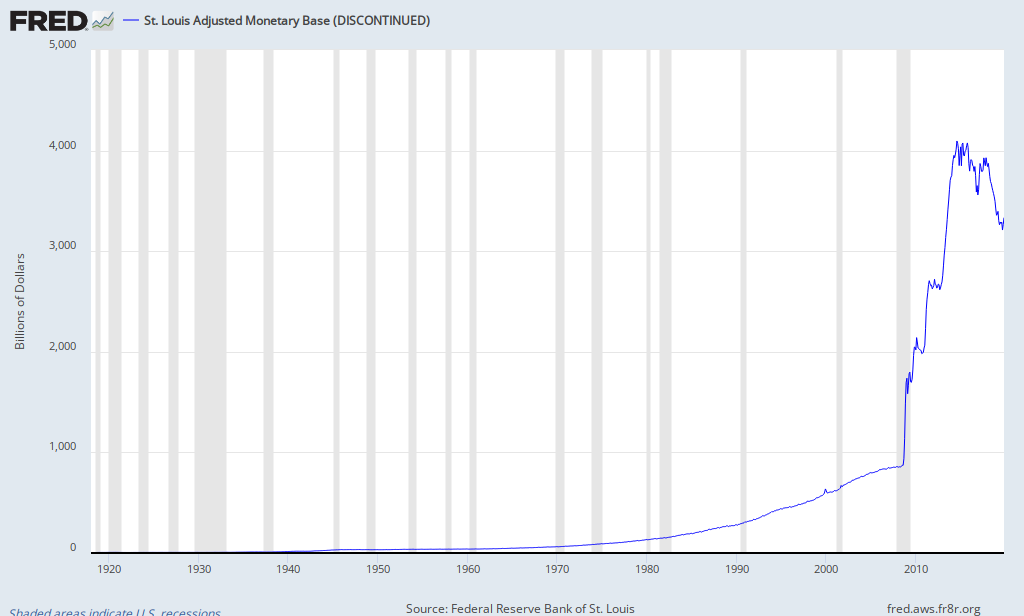
First, let us look at a long-term chart of the monetary base.
FRED Graph

Here we see the monetary base has skyrocketed since 2008. The first giant spike is what we retroactively call “QE1,” the massive purchasing of mortgage-backed securities during the financial crisis.

You’ll note there was a temporary reversal of such debt-buying just before the second huge spike: QE2, which spent $600 billion on US government debt. Again, following this spike there has been a reduction in the size of the Fed’s holdings.

Now let’s “zoom in” to the end of QE2.

FRED Graph

So from Summer 2011, we have not seen the monetary base increasing. The Fed has been jerking around the amount, but since the end of QE2 the total assets of the Fed has tended downward.

What about QE3? Well… what about QE3? As far as I can see, it either has not even started yet, or it is being offset by the sale of other Fed assets. In any case, the grinding weight of the American economy already has the recessionary momentum, and $40 billion a month isn’t going to matter.

That is why America is certainly entering a recession in 2013, and so Canada will also.

If this is true, and if it is also true that the Federal Funds rate has stayed the same the entire time, then something else must be keeping interest rates as low as they are. The contraction of the Fed’s balance sheet should cause the interest rates to rise. So what could it be?

It’s not actually a big shocker: the economy is extremely delicate. Extremely delicate. That’s because everything seems to depend on the whims of politicians and bureaucrats who will either:

  1. Pump more crack into the financial system and eke out a bit more cancerous economic ‘growth’, OR
  2. Let a depression come and bring the economy to its knees. Or another crisis will come and the economy will be brought to its knees anyway.

So what Robert Higgs calls “regime uncertainty” is at critical levels, forcing low growth and keeping unemployment high. Additionally, the huge banks don’t trust each other because they are all fundamentally broke and the financial system is such a twisted nightmare. Virtually all the money added by Bernanke has printed been packed into the banks excess reserves.

Graph of Excess Reserves of Depository Institutions

Could it be the case that if Bernanke were not paying interest on the banks’ excess reserves, that interest rates would rise? Probably not. They are already losing money by parking their reserves at the Fed. But they prefer to lose just a tiny bit of money, rather than a lot of money in a highly uncertain economy.

The same way investors will give their money to Geithner — GEITHNER, of all people! — for a negative real return. They would rather know they will gain nothing, or lose a percent or two, rather than lose 20% with some fund manager.

The Great Depression also saw record low interest rates, so the present state of affairs should surprise no one.

Now just to clarify, I am not defending Fed policy, I am not defending Bernanke. I loathe central banking in principle. Deflation, i.e. reducing the money supply, is not necessarily a good thing. Yes, falling prices are good. Yes, inflation is bad. But if you are going to have a central bank, then policy should be to maintain a stable money supply, and let the market determine the value of the currency. Reducing the money supply through open market operations is just as much of an intervention in the market as increasing the money supply, it just affects different people in different ways. For example, the debtor prefers inflation, the saver prefers deflation.

That being said, the money supply has been RELATIVELY flat now for over a year. When we’re talking about Ben Bernanke, isn’t that pretty much the best we can hope for? Much better than him flying around in his helicopter throwing trillions of dollars at the world’s problems, like he did up until mid-2011.

Don’t get me wrong. The Fed is still creating distortions, for example by buying up nearly all the 30-year Treasury bonds with the Twist program, and affecting prices of different assets. But… relatively speaking, the Fed is not causing too much trouble at the moment. Silver linings, I guess. If they let us go into a recession and come out of it the natural way, that would seriously be pretty swell.

I also believe that the Fed will print when they think they “need” to, but for the moment they are relying on PR and promises.

Remember, according to the Austrian theory of the business cycle, you can only maintain the “boom” phase by ever-increasing expansion of the money supply. You cannot raise then money supply and then stabilize it. You can’t even increase it at the same rate the entire time. Monetary policy must become more aggressive as the boom matures, and becomes more and more unwieldy. Otherwise, the bust inevitably comes.

Moving on, when the Fed announces it will maintain its target Federal Funds rate, it does not mean that their actions are determining what the actual rate is at the moment. That is the case now. They trick people into thinking they have it under control, but they don’t. The actual rate is determined by the overnight lending of the banks.

But when rates do start to rise, the Fed won’t need to print anymore money. They already did. The two trillion dollars they’ve added to the system will come flooding out, and by the magic of fractional reserve banking the entire universe will explode in 10 minutes in a reserve currency hyperinflationary apocalypse. The Fed won’t let that happen — if they still exist, they will crash the economy with Great Depression II to save the big banks. Remember, the Fed is there to protect the big banks. It is not there for “full employment” or “protecting the financial system” per se. Hyperinflation would destroy the big banks so it must be avoided from a central bank standpoint. High inflation on the other hand…

Anyway, hopefully CMR has been able to clear up this complex issue for some people.

Undercapitalized Scotiabank’s new acquisition.

Scotiabank is picking up a 51% stake in Banco Colpatria. I think it is pretty awful how big banks have their businesses essentially underwritten by the central banks and governments of the world, and then they scoop up acquisitions like these. Oh well. Scotiabank still has horrendously bad TCE numbers (under 3.5%, only CIBC and National Bank of Canada are worse), and in a lot of ways they look as bad as Lehman Brothers.

Interestingly, Scotiabank’s CFO says the bank will have 7-7.5% Tier 1 Capital ratio by 2013, as reaching that target puts them in good financial health. But this is still way too low. Canada’s banks remain among the world’s least capitalized. Getting new over-valued acquisitions like Banco Colpatria is not the best idea in my estimation. They should be aggressively strengthening their balance sheets.


Nothing can save Europe.

There is no way that Europe can bail itself out. This guy makes the case with four facts:

FACT #1: Europe’s entire banking system is leveraged at 25 to 1.

This is nearly two times the US’s leverage levels. With this amount of leverage you only need a 4% drop in asset prices to wipe out ALL equity.These are literally borderline-Lehman levels of leverage (Lehman was 30 to 1).

Mind you, these leverage levels are based on asset values the banks claimare accurate. Real leverage levels are in fact likely much MUCH higher.

KA-BOOM.

FACT #2: European Financial Corporations are collectively sitting on debt equal to 148% of TOTAL EU GDP.

Yes, financial firms’ debt levels in Europe exceed Europe’s ENTIRE GDP. These are just the financial firms. We’re not even bothering to mention non-financial corporate debt, household debt, sovereign debt, etc.

Also remember, collectively, the EU is the largest economy in the world (north of $16 trillion). So we’re talking about over $23 TRILLION in debt sitting on European financials’ balance sheets.

Oh, I almost forgot, this data point only includes “on balance sheet” debt. We’re totally ignoring off-balance sheet debt, derivatives, etc. So REAL financial corporate debt is much MUCH higher.

KA-BOOM.

FACT #3: European banks need to roll over between 15% and 50% of their total debt by the end of 2012.

That’s correct, European banks will have to roll over HUGE quantities of their debt before the end of 2012. Mind you, we’re only talking aboutmaturing debt. We’re not even considering NEW debt or equity these banks will have to issue to raise capital.

Considering that even the “rock solid” German banks need to raise over $140 BILLION in new capital alone, we’re talking about a TON of debt issuance coming out of Europe’s banks in the next 14 months.

And this is happening in an environment prone to riots, bank runs, and failed bond auctions (Germany just had a failed bond auction yesterday).

KA-BOOM

FACT #4: In order to meet current unfunded liabilities (pensions, healthcare, etc) without defaulting or cutting benefits, the average EU nation would need to have OVER 400% of its current GDP sitting in a bank account collecting interest.

This last data point comes from Jagadeesh Gokhale, Senior Fellow at the Cato Institute, former consultant to the US Treasury, and former Senior Economic Advisor to the Federal Reserve Bank of Cleveland.

This is a guy who’s worked at a very high level on the inside studying sovereign finance, which makes this fact all the more disturbing. And he knew this as far back as January 2009!!!

Folks, the EFSF, the bailouts, China coming to the rescue… all of that stuff is 100% pointless in the grand scheme of things. Europe’s ENTIRE banking system (with few exceptions) is insolvent. Numerous entire European COUNTRIES are insolvent. Even the more “rock solid” countries such as Germany (who is supposed to save Europe apparently) have REAL Debt to GDP ratios of over 200% and STILL HAVEN’T RECAPITALIZED THEIR BANKS.

If Europe is to get out of this disaster, the answer is not bailouts. The mammoth debt must be liquidated. Big banks who made bad loans to profligate governments need to take their losses and go bankrupt. Anyone who is holding out, expecting some kind of economic voodoo miracle, needs to take their head out of the sand and recognize that solving the European debt crisis with bailouts is impossible.

— Read more at Phoenix Capital Research — 

Bernanke’s “stealth bailout” of RBC and other foreign banks.

To follow up on our earlier post about QE2 simply padding the excess reserves of precariously bankrupt financial institutions, I want to call attention to ZeroHedge’s excellent reporting about  QE2 amounting to nothing more than a foreign bank rescue operation.

ZeroHedge rightly identifies European banks on the NY Fed’s list of primary dealers as being main beneficiaries of QE2. Although it is interesting to draw attention to the lone Canadian bank, RBC, in this list, far more interesting are the implications of this “stealth bailout” (which provide ample support to my contention that there will definitely be QE3):

… here is Stone McCarthy’s explanation of what massive reserve sequestering by foreign banks means: “Foreign banks operating in the US often lend reserves to home offices or other banks operating outside the US. These loans do not change the volume of excess reserves in the system, but do support the funding of dollar denominated assets outside the US….Foreign banks operating in the US do not present a large source of C&I, Consumer, or Real Estate Loans. These banks represent about 16% of commercial bank assets, but only about 9% of bank credit. Thus, the concern that excess reserves will quickly fuel lending activities and money growth is probably diminished by the skewing of excess reserve balances towards foreign banks.

More points of interest:

Furthermore the data above proves beyond a reasonable doubt why there has been no excess lending by US banks to US borrowers: none of the cash ever even made it to US banks! This also resolves the mystery of the broken money multiplier and why the velocity of money has imploded.

Instead of repricing the EUR to a fair value, somewhere around parity with the USD, this stealthy fund flow from the US to Europe to the tune of $600 billion has likely resulted in an artificial boost in the european currency to the tune of 2000-3000 pips, keeping it far from its fair value of about 1.1 EURUSD.

But implication #4 is by far the most important. Recall that Bill Gross has long been asking where the cash to purchase bonds come the end of QE 2 would come from. Well, the punditry, in its parroting groupthink stupidity (validated by precisely zero actual research), immediately set forth the thesis that there is no problem: after all banks would simply reverse the process of reserve expansion and use the $750 billion in Cash that will be accumulated by the end of QE 2 on June 30 to purchase US Treasurys.

Wrong.

The above data destroys this thesis completely: since the bulk of the reserve induced bank cash has long since departed US shores and is now being used to ratably fill European bank balance sheet voids, and since US banks have benefited precisely not at all from any of the reserves generated by QE 2, there is exactly zero dry powder for the US Primary Dealers to purchase Treasurys starting July 1.

This observation may well be the missing link that justifies the Gross argument, as it puts to rest any speculation that there is any buyer remaining for Treasurys. Alas: the digital cash generated by the Fed’s computers has long since been spent… a few thousand miles east of the US.

Which leads us to implication #5. QE 3 is a certainty. The one thing people focus on during every episode of monetary easing is the change in Fed assets, which courtesy of LSAP means a jump in Treasurys, MBS, Agency paper, or (for the tin foil brigade) ES: the truth is all these are a distraction. The one thing people always forget is the change in Fed liabilities, all of them: currency in circulation, which has barely budged in the past 3 years, and far more importantly- excess reserves, which as this article demonstrates, is the electronic “cash” that goes to needy banks the world over in order to fund this need or that. In fact, it is the need to expand the Fed’s liabilities that is and has always been a driver of monetary stimulus, not the need to boost Fed assets. The latter is, counterintuitively, merely a mathematical aftereffect of matching an asset-for-liability expansion. This means that as banks are about to face yet another risk flaring episode in the next several months, the Fed will need to release another $500-$1000 billion in excess reserves. As to what asset will be used to match this balance sheet expansion, why take your picK; the Fed could buy MBS, Muni bonds, Treasurys, or go Japanese, and purchase ETFs, REITs, or just go ahead and outright buy up every underwater mortgage in the US. This side of the ledger is largely irrelevant, and will serve only two functions: to send the S&P surging, and to send the precious metal complex surging2 as it becomes clear that the dollar is now entirely worthless.

Carney indulges fantasy about cause of housing bubble

Few things are more aggravating than these central bankers who come out with pabulum-fed bullshit observations about the economy while being treated like the Oracle of Delphi. as if mere words will decidedly shape economic outcomes.

So Mark Carney is warning about housing prices again. He alludes to nothing concerning interest rate policy, which is no surprise, but he does indulge in a fantasy about “greedy speculators and investors” and desperate families driving up prices such that there are “excesses” in some markets. And in this wacky bubble-fueled markets, like Vancouver,  home ownership creates special  “financial vulnerabilities.”

Oh come on. I understand the whole public perception issue, and how Carney cannot admit that he has any role in this housing bubble. Still, Carney’s statements are amazing in the way they must reveal either his ignorance of reality or how he simply pretends not to know. You see, in this world, there are always greedy speculators and investors. Always. By itself, the existence of greedy people does not account for asset bubbles.

No one has ever been able to show with real economic reasoning how greed systematically creates distortions. Neither does greed’s foil, fear, systematically create distortions. Greediness and fear are answers to the question of why people do things, which is an issue for psychology. When we wish to understand economic law, we build upon the fact that people do things as such, rather than why people do things.

What can be shown with economic reasoning is that manipulating the money supply causes interest rates to change. If the central bank expands the money supply, then interest rates will fall and more money will be lent than before. This new money is used to bid up the prices of goods and services, especially capital goods, to higher levels than would otherwise be the case.

Carney probably knows this, and thinks his mighty words alone will help assuage bubble. He does not want to raise interest rates. But the damage has been done. While the BoC’s balance sheet has contracted to pre-crisis levels and been relatively stable for some time now, Canada’s economy was not allowed to rebalance itself in a real recession and therefore myriad distortions remain.

Devastating financial collapse — and a complete implosion of housing prices — still to come, no matter how much Carney warns about distortions. What a fool.

Smoke and mirrors on interest rates at the Bank of Canada

For their sixth meeting in a row now, the Bank of Canada has decided to leave interest rates unchanged.

Some of suggested this latest press release suggests  higher rates ahead, and the stronger dollar that comes with it. I think this is flawed and superficial analysis.

Let’s consider the press release with the awareness that all central bankers are Keynsian-merchantilists.

The possibility of greater momentum in household borrowing and spending in Canada represents an upside risk to inflation. On the other hand, the persistent strength of the Canadian dollar could create even greater headwinds for the Canadian economy, putting additional downward pressure on inflation through weaker-than-expected net exports and larger declines in import prices.

So what would curb household borrowing and spending in Canada? Higher interest rates of course. But then that would create a stronger Canadian dollar, which the BoC regards as hazardous because it would hurt exports. To me, this does not suggest higher interest rates from the BoC anytime soon.

Reflecting all of these factors, the Bank has decided to maintain the target for the overnight rate at 1 per cent. To the extent that the expansion continues and the current material excess supply in the economy is gradually absorbed, some of the considerable monetary policy stimulus currently in place will be eventually withdrawn, consistent with achieving the 2 per cent inflation target. Such reduction would need to be carefully considered.

Now this sounds like they are leaning towards raising interest rates. Or does it? Earlier in the press release, they say the following:

While underlying inflation is relatively subdued, the Bank expects that high energy prices and changes in provincial indirect taxes will keep total CPI inflation above 3 per cent in the short term. Total CPI inflation is expected to converge with core inflation at 2 per cent by the middle of 2012 as excess supply in the economy is gradually absorbed, labour compensation growth stays modest, productivity recovers and inflation expectations remain well-anchored.

Here is where we get to the “smoke and mirrors.”

They were just quoted saying they would want to withdraw the monetary stimulus to aim for the 2% inflation target.

But in this last quoted paragraph, they just said that they expected inflation to hit 2% without raising interesting rates. So … what the heck is this all about? Basically, there is no chance interest rates will be going up any time soon.

The reality is this — Carney will not allow the Canadian dollar to appreciate too significantly relative to currency of this country’s primary consumer, which is America.

One must remember that central bankers behind major currencies work together — the key idea is to have major currencies devalue at roughly a steady rate vis-a-vis each other. It is not a counter-example to refer to hyperinflation in Zimbabwe or a like event, because that is a tiny country that means little to the world economy in the grand scheme of things.  The Canadian dollar will not strengthen dramatically against the US dollar, or any other major currency.

Why not? If you are a central banker, you have two conflicting goals:

For importers, you want a strong dollar, so that you can buy foreign goods more cheaply.

If you are an exporter, you favor a weak dollar, so that you can sell more goods to foreigners.

Exporters have traditionally been a more focused and successful interest group than the mass of faceless importers — the exporters are visible and politically active, but the importers are literally… everyone else. Their influence is spread out like too little peanut butter spread over too much bread. Therefore the tendency is always for a steady level of currency depreciation. For the BoC, that is a 2% inflation target.

Because of these conflicting agendas, the central bank behind a major currency cannot allow that currency to appreciate or depreciate too significantly relative to any other major currency. It is the classic problem with central planning — how do you decide what the magic number is? The level of depreciation must be just enough to keep everyone happy — or at least minimize their relative unhappiness.

To take out price distortions, one can consider how all currencies are down significantly from where they were one year ago, in terms of gold. The Canadian dollar is down 12%. So while it has lost purchasing power in terms of gold, it has gained purchasing power relative to the USD, which is down 20% in the last year. The euro and the yen have fared relatively better than the Canadian dollar (down 8% and 11% respectively, in terms of gold), and the American dollar has fared relatively worse. The important point is that they are all down in terms of gold.

This is to be expected. Although the CDN may rise or fall a bit relative to one major currency or another, depreciation of the Canadian dollar will continue relative to gold until Economic Judgment Day comes and Great Depression II hits us. Economic Judgment Day until the big American banks start to lend, and the Federal Reserve is forced to hike interest rates. Until then, Canadian currency is just another depreciating currency in a world of depreciating currencies.

Even ECB crank concedes that core inflation is a lame tool

Even a broken clock is right twice a day. Unless it’s a 24-hr digital clock, then it’s only correct once. Which is still better than an ECB crank like Bini Smaghi, who seems to have recently been right for the first time in his life, by disparaging the idea of core inflation (i.e. without food and energy prices) as a good measurement of monetary policy.

“For central banks around the world, this means that core inflation is no longer a very useful indicator for monetary policy, and should probably be abandoned,” Bini Smaghi said.

NO WAY. This is actually a shocking statement coming from someone like this. Of course, this would probably present itself as an opportunity for monetary authorities to devise statistical methods that are more arcane and obfuscating, rather than less so. I bet the next inflation measuring tool will be a basket of goods consisting 100% of iPads.

Goldman Sachs gets lucky on Libya

Goldman Sachs is getting a subpoena from the Manhattan DA about their role in the 2008 financial meltdown. That’s kind of a drag, I guess, but at least they don’t have to sell Gadaffi a piece of their firm.

Turns out Goldman invested $1.5 billion for Libya’s sovereign wealth fund back in 2008.

They lost 98% of that money.

To ameliorate this disaster with pissed off Libyan officials, Goldman offered to sell preferred shares in their firm.

But now that that Gadaffi is now on the “list of mini-Hitlers for Americans to fight”, Goldman can get out of that deal easily enough.

You kind of have to admire the sheer self-confidence of Goldman, offering to sell a stake in itself to Libya after losing so much of the country’s money. It’s like a used car dealer offering to let you loan money to the dealership after selling you a lemon.


As QE2 ends, let us consider where the money went.

Well QE2 is supposed to be ending soon. Or something. The cranks at the Federal Reserve kind of make things up as they go along. But for now the whole thing can safely be considered a classic disaster, as central planning is wont to produce.

For the moment, let’s take a moment and consider where the money went. Behold two wonderful graphs:

ADJUSTED MONETARY BASE

FRED Graph


EXCESS RESERVES

Graph of Excess Reserves of Depository Institutions

You can draw your own conclusions here.

It is obvious that there will be QE3, QE4, QE5… and so on, until either the entire monetary system collapses or until the central banks stop printing money and produce the Great Depression II (aka Greatest Depression).

Bank of Canada — engine of too much debt — warns about too much debt.

The Bank of Canada is warning Canadians about too much debt.

Experience suggests a long period of very low interest rates may be associated with excessive credit creation and undue risk-taking as investors seek higher returns, leading to the underpricing of risk and unsustainable increases in asset prices.

This is a remarkable statement, really — it reveals that the Bank of Canada’s economists either don’t know economics, or they pretend not to know. The issue should not be about how low interest rates “may” be associated with excessive credit and excessive risk. Rather, there is a direct causal relationship here.

Mises wrote:

If there is credit expansion [by the central bank], it must necessarily lower the rate of interest. If the banks are to find borrowers for additional credit, they must lower the rate of interest or lower the credit qualifications of would-be borrowers. Because all those who wanted loans at the previous rate of interest had gotten them, the banks must either offer loans at a lower interest rate or include in the class of businesses to whom loans are granted at the previous rate less-promising businesses, people of lower credit quality.

This is not rocket science. It is not a complex relationship to understand at all — if interest rates rise, there will be fewer risky loans than there would be otherwise; if interest rates falls, there will be more risky loans than there would be otherwise.

But if you have a PhD in economics, like our ex-Goldman central planner at the BoC, Mark Carney, you probably are incapable of understanding this, and would say something inane like, “In light of the high level of indebtedness of Canadian households, some caution in banks’ lending to households is warranted.”

Carney does not realize that lending standards are directly related to the ease with which credit is made available. Talk is cheap. If Carney jacked up interest rates to 10% tomorrow, that would have a dramatic impact on lending standards, much more so than his oracular admonitions about risky lending.

On the other hand, what would happen if Carney decided the economy was too weak, and he cut interest rates down to zero? Then we can rightly expect that more loans would be made to those businesses and individuals would have been previously deemed unworthy of credit. 

A lot of Canadians like to think we breezed through the financial crisis without too much pain and suffering — “our banks didn’t need a bailout,” and that we are leading the way out of economic ruin.

All is not well, however. The mammoth growth of consumer debt in this country, the worst of all OECD countries at about 140% debt-to-asset levels, is a very serious problem . With our housing market still in bubble territory, unemployment relatively low, and implausibly low interest rates, Canadians have been piling on more and more debt.

It’s so bad, even the banks — you know, the ones making all these questionable loans to Canadians mired in debt — are raising concerns. You have to acknowledge this is a bit rich — but don’t worry big Canadian banks — I am sure you can keep making your risky loans and if (when) things turn ugly, someone will bail you out.