Carney is off to the Bank of England — Pray for England

Bank of Canada Governor and ex-Goldman bankster Mark Carney was selected to become the next Governor of the Bank of England. He will now be overseeing a central bank with nearly ten times the assets of the Bank of Canada. That is a big promotion in the world of central planners! Carney will now be able to create even larger disturbances in economic systems.

Truly, the worst rise to the top.

Good riddance, I say. Not that I expect him to be replaced with anyone much better. But there is always a chance.

I feel bad for England, though. They have no idea what they are getting themselves into (from Bloomberg):

Carney, who holds an economics degree from Harvard and a doctorate from Oxford University, swaps oversight of an economy which bounced back from the global recession without witnessing a single bank bailout for one which slipped back into recession in the second quarter and required multiple bank rescues.

Did you see what they did there?

Carney … swaps oversight of an economy which bounced back from the global recession without witnessing a single bank bailout for one which slipped back into recession in the second quarter and required multiple bank rescues.

Carney … swaps oversight of an economy which bounced back from the global recession without witnessing a single bank bailout … 

an economy which bounced back from the global recession without witnessing a single bank bailout …

without witnessing a single bank bailout

Excuse me? The banks that pushed for Carney to be their man in England have surely put the shucks on the rubes.

Of all the deleterious myths that persist about the Canadian financial system, none are more harmful or obnoxious than the bogus story that its banks never needed and/or never got a bailout.

Anyone who says this is simply lying or has no idea what they are talking about. Those are the only real possibilities. We have covered this at CMR previously, but let us quickly review.

The mainstream news doesn’t even try to deny it anymore. The Canadian banks got a bailout. Now they simply try to play down the significance of it. Even though it is was much bigger than anyone was led to believe.

So is this “no bailouts in Canada” proposition challenged by anyone in the UK? Carney is being sold on the pretense that there were no bailouts?   

(Side note: We could also mention that Canadian banks received assistance from emergency Federal Reserve lending facilities, which by itself is very interesting. We could also mention that rather material fact that Canadian banks are basically in a state of “perma-bailout” by virtue of the Canadian Deposit Insurance Corporation. The existence of the CDIC amplifies the level of risk banks are willing to engage in — it is classic “moral hazard.”)

So it would seem one is more likely to see bank bailouts with Carney, rather than less. That is precisely why the UK banking cartel wants Carney in this position.

Yet that is not the only reason citizens of the UK should worry.

Mark Carney is not only a believer in bailouts — he is a believer in Keynesianism and mercantilism. This means nothing more than this: he sees a connection between depreciating the currency and growing the economy. This he shares with nearly all central bankers (except, perhaps, those in Singapore): he regards a strong currency as harmful to “the nation”. Because when he talks about “the nation,” he is not talking about the consumers (i.e. everyone) who use their stronger currency to buy and invest in more goods. For men such as Carney, “the nation” instead refers to politically-connected export industries that are benefited by making it cheaper for foreigners to buy their stuff.

That being the case, Carney will tend to increase the money supply by adding assets to the central bank’s balance sheet whenever he thinks it’s a good idea. But this means prices must rise and debts will deepen. Britain already has big problems in these areas.

This should be the last thing someone in the UK should desire. The British pound has plummeted in value the last five years against stronger currencies like the yen. Here in Canada, it seems Carney’s manipulations have been obscured by strong demand for Canadian commodities, yet with the slowdown in Asia, Europe, and soon the US, I doubt this will persist. The Bank of Canada has been growing its balance sheet for nearly two years now, since offloading some of its emergency acquisitions during the financial crisis.

Also, it should be known that Carney likes to troll citizens whose currency he manages by blaming them for behavior that is strongly encouraged by his own central bank policies. What a jerk.

I am happy to see Carney go. While I am happy he no longer oversees the Canadian dollar, I am apprehensive about who his replacement will be. Most of all, I must also bemoan the lack of justice. Carney should be serving a prison sentence for counterfeiting, rather than getting $1 million a year to manipulate huge economies.
Setting the Record Straight on the Fed and “Zero-Interest Rate Policy”

It’s entirely possible I don’t have the time to write this right now. Poor me. But this is important, so I must make the time.

So listen up people. Time for STRAIGHT TALK. It’s important to get the facts straight because it gives us a chance to understand something about economics and do some critical thinking.

What am I talking about? Well, a lot of folks of an anti-Fed persuasion, and even some Fed-lovers, say we have “artificially low interest rates.” Among the generally economically literate folks who are my friends and acquaintances, I constantly hear “artificially low interest rates this” and “artificially low interest rates that.”

Is the interest rate distorted? Yes. But is the Fed the reason interests rates have remained so low?

The answer is no.

“But!” you say, “Bernanke is printing so much money! That money is used to buy bonds, which pushes down interest rates!”

Okay, I am going to blow your mind here: The Federal Reserve is not printing money. They have not added made any net additions to their balance sheet since the end of QE2.

In fact, the Fed has deflated! That’s right… they have sold debt, and reduced their balance sheet.

WHAT!

It is true. I will now proceed to show my evidence:

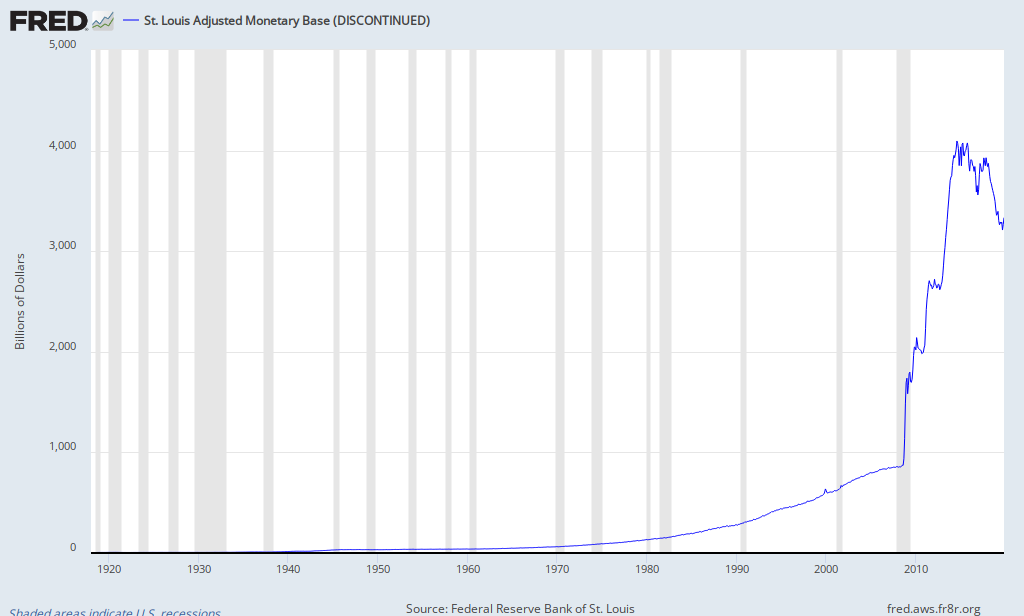
First, let us look at a long-term chart of the monetary base.

FRED Graph

Here we see the monetary base has skyrocketed since 2008. The first giant spike is what we retroactively call “QE1,” the massive purchasing of mortgage-backed securities during the financial crisis.

You’ll note there was a temporary reversal of such debt-buying just before the second huge spike: QE2, which spent $600 billion on US government debt. Again, following this spike there has been a reduction in the size of the Fed’s holdings.

Now let’s “zoom in” to the end of QE2.

FRED Graph

So from Summer 2011, we have not seen the monetary base increasing. The Fed has been jerking around the amount, but since the end of QE2 the total assets of the Fed has tended downward.

What about QE3? Well… what about QE3? As far as I can see, it either has not even started yet, or it is being offset by the sale of other Fed assets. In any case, the grinding weight of the American economy already has the recessionary momentum, and $40 billion a month isn’t going to matter.

That is why America is certainly entering a recession in 2013, and so Canada will also.

If this is true, and if it is also true that the Federal Funds rate has stayed the same the entire time, then something else must be keeping interest rates as low as they are. The contraction of the Fed’s balance sheet should cause the interest rates to rise. So what could it be?

It’s not actually a big shocker: the economy is extremely delicate. Extremely delicate. That’s because everything seems to depend on the whims of politicians and bureaucrats who will either:

  1. Pump more crack into the financial system and eke out a bit more cancerous economic ‘growth’, OR
  2. Let a depression come and bring the economy to its knees. Or another crisis will come and the economy will be brought to its knees anyway.

So what Robert Higgs calls “regime uncertainty” is at critical levels, forcing low growth and keeping unemployment high. Additionally, the huge banks don’t trust each other because they are all fundamentally broke and the financial system is such a twisted nightmare. Virtually all the money added by Bernanke has printed been packed into the banks excess reserves.

Graph of Excess Reserves of Depository Institutions

Could it be the case that if Bernanke were not paying interest on the banks’ excess reserves, that interest rates would rise? Probably not. They are already losing money by parking their reserves at the Fed. But they prefer to lose just a tiny bit of money, rather than a lot of money in a highly uncertain economy.

The same way investors will give their money to Geithner — GEITHNER, of all people! — for a negative real return. They would rather know they will gain nothing, or lose a percent or two, rather than lose 20% with some fund manager.

The Great Depression also saw record low interest rates, so the present state of affairs should surprise no one.

Now just to clarify, I am not defending Fed policy, I am not defending Bernanke. I loathe central banking in principle. Deflation, i.e. reducing the money supply, is not necessarily a good thing. Yes, falling prices are good. Yes, inflation is bad. But if you are going to have a central bank, then policy should be to maintain a stable money supply, and let the market determine the value of the currency. Reducing the money supply through open market operations is just as much of an intervention in the market as increasing the money supply, it just affects different people in different ways. For example, the debtor prefers inflation, the saver prefers deflation.

That being said, the money supply has been RELATIVELY flat now for over a year. When we’re talking about Ben Bernanke, isn’t that pretty much the best we can hope for? Much better than him flying around in his helicopter throwing trillions of dollars at the world’s problems, like he did up until mid-2011.

Don’t get me wrong. The Fed is still creating distortions, for example by buying up nearly all the 30-year Treasury bonds with the Twist program, and affecting prices of different assets. But… relatively speaking, the Fed is not causing too much trouble at the moment. Silver linings, I guess. If they let us go into a recession and come out of it the natural way, that would seriously be pretty swell.

I also believe that the Fed will print when they think they “need” to, but for the moment they are relying on PR and promises.

Remember, according to the Austrian theory of the business cycle, you can only maintain the “boom” phase by ever-increasing expansion of the money supply. You cannot raise then money supply and then stabilize it. You can’t even increase it at the same rate the entire time. Monetary policy must become more aggressive as the boom matures, and becomes more and more unwieldy. Otherwise, the bust inevitably comes.

Moving on, when the Fed announces it will maintain its target Federal Funds rate, it does not mean that their actions are determining what the actual rate is at the moment. That is the case now. They trick people into thinking they have it under control, but they don’t. The actual rate is determined by the overnight lending of the banks.

But when rates do start to rise, the Fed won’t need to print anymore money. They already did. The two trillion dollars they’ve added to the system will come flooding out, and by the magic of fractional reserve banking the entire universe will explode in 10 minutes in a reserve currency hyperinflationary apocalypse. The Fed won’t let that happen — if they still exist, they will crash the economy with Great Depression II to save the big banks. Remember, the Fed is there to protect the big banks. It is not there for “full employment” or “protecting the financial system” per se. Hyperinflation would destroy the big banks so it must be avoided from a central bank standpoint. High inflation on the other hand…

Anyway, hopefully CMR has been able to clear up this complex issue for some people.

Undercapitalized Scotiabank’s new acquisition.

Scotiabank is picking up a 51% stake in Banco Colpatria. I think it is pretty awful how big banks have their businesses essentially underwritten by the central banks and governments of the world, and then they scoop up acquisitions like these. Oh well. Scotiabank still has horrendously bad TCE numbers (under 3.5%, only CIBC and National Bank of Canada are worse), and in a lot of ways they look as bad as Lehman Brothers.

Interestingly, Scotiabank’s CFO says the bank will have 7-7.5% Tier 1 Capital ratio by 2013, as reaching that target puts them in good financial health. But this is still way too low. Canada’s banks remain among the world’s least capitalized. Getting new over-valued acquisitions like Banco Colpatria is not the best idea in my estimation. They should be aggressively strengthening their balance sheets.


Victory for poutine… for now.

Wanna-be social engineers in a small Quebec town tried to ban poutine and other “unhealthy” food at their arena. But you can’t mess with poutine lovers. I mean, I would fight to the death for a good poutine. Wendy McElroy writes:

A headline in the National Post (07/10) announced, “Hot dogs and poutine stage comeback after Quebec rink’s fans revolt.”

The story revolved around the town of Lac-Etchemin, Quebec that prided itself on being the first Canadian municipality to ban ‘unhealthy’ food from its arena. “Now, in an admission that paninis are outmatched against poutine, the town council has lifted the ban and French fries will return before the end of the month.”

You might chortle at the hubris of a Quebec town trying to ban the delicious French Canadian staple of french fries laden with cheese curds, smothered in gravy. You should applaud the victory of rebellious Canadiens against the Nanny State municipality. In doing so, however, it is important to realize that the attempted ban is neither humorous nor trivial. It is merely one instance of government’s creeping encroachment into what goes onto your dinner plate. In the ’80s, people protested under the slogan “Get government out of the bedroom,” meaning that the state had no proper business monitoring or punishing the consenting sexual choices of adults. Today, the protest should read “Get government out of the kitchen.”

FOOD AS SELF EXPRESSION

The governmental censoring of food choice is often viewed as a trivial matter or even a benevolent one. After all, what is one french fry more or less? And the goal, as stated, seems well-intentioned.

There is nothing benevolent, however, about state imposed control over one of the main ways in which human beings express themselves. Food choices are personal; they define our identity as surely as our choices in attire or reading material. “Food is love” is a hackneyed saying that conveys the basic truth that eating is about far, far more than sustaining life.

Food is an integral aspect of transmitting culture and ethnicity. From Italian pastas to Indian curries, from poutine to falafels,  a rich array of dishes form a part of your family’s history and the background of who you are. Often the mere smell of a dish as you walk by a restaurant can elicit a flood of childhood memories, including how recipes or cooking techniques were passed down from one generation to the next.

Food is also a form of cultural exchange through which diverse ethnic groups can automatically appreciate each other’s heritage. The appreciation happens spontaneously, without tax-funding, laws or government programs. It happens every time someone chooses a Chinese restaurant or expresses preference for a Jewish deli. During World War II, sauerkraut was widely banned in North America as “unpatriotic” because of the deep hostility toward anything German. Equally, the approval of ethnic food is a form of acceptance of a culture or, at least, of one significant aspect of it.

Food is also a moral choice as every vegan knows. It is a religious choice as Orthodox Jews will attest. Food is also a political statement as any farmer who produces raw milk will tell you.

One of the most important functions of food choice returns to the saying, “food is love.” When a spouse or mother celebrates your birthday, it is through making “a favorite meal” or baking a cake. When a man proposes, it is over a romantic meal at an expensive restaurant. When you express sympathy at a post-funeral gathering, you do so while holding a casserole that you’ve brought over. It is commonplace for those who are emotionally distressed to seek ‘comfort food’ that allows them to ‘feed themself’ when the world is not. How many women have recovered from a broken heart over tubs of ice cream?

Precisely because of its strong emotional pull and roots in culture, food choice has become one of the most important rituals in our society. From Thanksgiving to Christmas, from Hallowe’en candy to chocolates on Valentine’s Day, food and ritual are inextricably linked.

Ultimately, food is also one of the main forms of self-control you exercise over your own body. Through these choices, you express a personal judgment on what benefits your body and/or fits your lifestyle; for some, the judgment leads to an Atkins diet, for others it is organic lentils. Even people who make allegedly ‘bad’ choices are expressing themselves.

The bounty and diversity of food available in every grocery store and each passing street corners should cause joy because it demonstrates the richness of society itself – not merely in terms of prosperity but also in terms of choice.

Thus, when government dictates what you may or may not eat, it is restricting your heritage, your religious and political choices, the control over your own body; telling you that a choice every bit as personal as freedom of speech or the art you view is not yours to make. That decision is theirs.

Why? For your own good. Even as an adult, you cannot be trusted with choosing the food that goes into your own mouth at your own expense. That’s what government experts are for.

ARE THE EXPERTS CORRECT?

Politically-speaking, it does not matter whether the food ‘experts’ are correct about poutine any more than their opinion on a specific work of literature should matter…at least, politically-speaking. You have an inalienable right to read graphic novels about a dystopian future rather than be force-fed Ibsen’s writings on dysfunctional families. You have a similar right to eat food bought at your own expense.

Nevertheless, almost all discussion of government’s censorship of food choice revolves around whether or not the claims being made are true or false. This would be a fascinating and valuable discussion if it did not always seem to end at the conclusion “there ought to be a law.” Thus, otherwise interesting discussions about the value and risks of raw milk result in farmers being arrested and driven out of business by huge fines. Otherwise interesting discussions about the calorie-count or artery-impact of poutine end in the banning of a cultural choice. This is akin to banning literature because a government book reviewer finds the contents to be ‘unhealthy.’ Society should cease to have discussions that end in such conclusions.

Those who are in the “there ought not to a law” camp often encounter the following argument: we live in a society that offers (to varying degrees) free health care. This means that tax-payers bear the consequences of providing health care to those who are reckless with their bodies through drugs, alcohol, smoking or unhealthy diets. In short, your neighbor has a vested and financial interest in what goes into your body.

This line of reasoning – rather than justifying a Nanny State or a nosy neighbor dictating your personal choices – constitutes a powerful argument against socialized medicine. If socialized medicine had been ‘advertised’ decades ago as a government mandate to control the minutia of your daily life, then it would probably have never been implemented. If socialized medicine had announced itself as the right to usurp parental control over what to feed children, then it would have met the same ‘rink-revolt’ that occurred in Lac-Etchemin.

Tell the government that it is not a welcomed guest in your kitchen. There is no room for bureaucrats at your dinner table.

While this battle has been won, the war is not over. Denmark has passed the first “FAT TAX” which charges 16 kroner per kilogram of saturated fat in food when the saturated fat content exceeds a completely arbitrary number of 2.3%. Mark my words — wanna-be social engineers in Canada are dying to impose this kind of tax in Canada.

First of all, this is incredibly stupid from a health standpoint, as it is not saturated fat that makes you fat. But most importantly, this is terrible for business and the consumer. Making consumers pay more for their goods through government decree is just wrong, especially during a bad economy.  And although this is a form of consumption tax (targeting a certain class of goods), it ultimately taxes production and hurts business. Again, terrible idea anytime but especially when the economy is approaching absolute calamity.

But that’s not all. Once the principle behind these sorts of laws is accepted, nothing can be ruled out. Doug Hornig at Casey Research highlights the absurdity of these kinds of laws:

Why not meter Internet usage, so that addicts who log on more than a certain amount a week are taxed? Same with computer gamers; the number of minutes they play per day could be relayed to a central database in D.C. Obsessive collectors? Just monitor their eBay accounts and if they seem out of control, add a surcharge to PayPal transactions. Those who buy candy bars probably qualify as chocoholics by definition. They should pay extra. And don’t forget Netflix. If you’re ordering more than three movies a week, you’ve got a movie habit that ought to be taxed.

We can allow Hoppe to have the final and most decisive say on this kind of social engineering and its economic consequences:

Once again the effect of such a policy of behavioral controls is, in any case, relative impoverishment. Through the imposition of such controls not only is one group of people hurt by the fact that they are no longer allowed to perform certain nonaggressive forms of behavior but another group benefits from these controls in that they no longer have to tolerate such disliked forms of behavior. More specifically, the losers in this redistribution of property rights are the user-producers of the things whose consumption is now being hampered, and those who gain are nonusers/nonproducers of the consumer goods in question. Thus a new and different incentive structure regarding production or nonproduction is established and applied to a given population. The production of consumer goods has been made more costly since their value has fallen as a consequence of the imposition of controls regarding their use, and mutatis mutandis, the acquisition of consumer satisfaction through nonproductive, noncontractual means has been made relatively less costly. As a consequence, there will be less production, less saving and investing, and a greater tendency instead to gain satisfaction at the expense of others through political, i.e. aggressive, methods. And, in particular, insofar as the restrictions imposed by behavioral controls concern the use that person can make of his own body, the consequence will be a lowered value attached to it, and accordingly, a reduced investment in human capital.


So instead of people taking responsibility for themselves, these kinds of taxes and laws systematically cause people to think that they do not own their own bodies. If you don’t own something, you will take poorer care of it. As always, the way to make people more responsible is to make them free.


Nothing can save Europe.

There is no way that Europe can bail itself out. This guy makes the case with four facts:

FACT #1: Europe’s entire banking system is leveraged at 25 to 1.

This is nearly two times the US’s leverage levels. With this amount of leverage you only need a 4% drop in asset prices to wipe out ALL equity.These are literally borderline-Lehman levels of leverage (Lehman was 30 to 1).

Mind you, these leverage levels are based on asset values the banks claimare accurate. Real leverage levels are in fact likely much MUCH higher.

KA-BOOM.

FACT #2: European Financial Corporations are collectively sitting on debt equal to 148% of TOTAL EU GDP.

Yes, financial firms’ debt levels in Europe exceed Europe’s ENTIRE GDP. These are just the financial firms. We’re not even bothering to mention non-financial corporate debt, household debt, sovereign debt, etc.

Also remember, collectively, the EU is the largest economy in the world (north of $16 trillion). So we’re talking about over $23 TRILLION in debt sitting on European financials’ balance sheets.

Oh, I almost forgot, this data point only includes “on balance sheet” debt. We’re totally ignoring off-balance sheet debt, derivatives, etc. So REAL financial corporate debt is much MUCH higher.

KA-BOOM.

FACT #3: European banks need to roll over between 15% and 50% of their total debt by the end of 2012.

That’s correct, European banks will have to roll over HUGE quantities of their debt before the end of 2012. Mind you, we’re only talking aboutmaturing debt. We’re not even considering NEW debt or equity these banks will have to issue to raise capital.

Considering that even the “rock solid” German banks need to raise over $140 BILLION in new capital alone, we’re talking about a TON of debt issuance coming out of Europe’s banks in the next 14 months.

And this is happening in an environment prone to riots, bank runs, and failed bond auctions (Germany just had a failed bond auction yesterday).

KA-BOOM

FACT #4: In order to meet current unfunded liabilities (pensions, healthcare, etc) without defaulting or cutting benefits, the average EU nation would need to have OVER 400% of its current GDP sitting in a bank account collecting interest.

This last data point comes from Jagadeesh Gokhale, Senior Fellow at the Cato Institute, former consultant to the US Treasury, and former Senior Economic Advisor to the Federal Reserve Bank of Cleveland.

This is a guy who’s worked at a very high level on the inside studying sovereign finance, which makes this fact all the more disturbing. And he knew this as far back as January 2009!!!

Folks, the EFSF, the bailouts, China coming to the rescue… all of that stuff is 100% pointless in the grand scheme of things. Europe’s ENTIRE banking system (with few exceptions) is insolvent. Numerous entire European COUNTRIES are insolvent. Even the more “rock solid” countries such as Germany (who is supposed to save Europe apparently) have REAL Debt to GDP ratios of over 200% and STILL HAVEN’T RECAPITALIZED THEIR BANKS.

If Europe is to get out of this disaster, the answer is not bailouts. The mammoth debt must be liquidated. Big banks who made bad loans to profligate governments need to take their losses and go bankrupt. Anyone who is holding out, expecting some kind of economic voodoo miracle, needs to take their head out of the sand and recognize that solving the European debt crisis with bailouts is impossible.

— Read more at Phoenix Capital Research — 

Guest Piece: Is gold mining coming back to the Yukon?

Notes from the Field: Yukon
By Louis James

I’ve just returned from another trip to the Yukon. Details on the companies I saw I’ll have to keep for Casey International Speculator subscribers, but there is a broader observation I can share that I think is of value.

The Yukon has a long and famous history of exploration and mining – especially for gold – but currently there’s been little actual mining going on in recent years. Capstone Mining’s (T.CS) Minto mine was the first new hardrock mine built in the Yukon this millennium, with first concentrates shipped in 2007. Until Minto proved it could be done, the prevailing wisdom seemed to be that the Yukon was geologically interesting, but a remote and expensive place to work, as well as a difficult political environment that made the effort questionable. The success at Minto attracted a lot of exploration dollars, with Underworld Resources making a new discovery that was quickly snapped up by major gold miner Kinross Gold (KGC, T.K) in March of 2010. This really put the place high up on t he radar screen, and exploration dollars flooded in.

However, a couple of months later, Western Copper (WRN, T.WRN) was delivered a surprise setback when the final permit it needed for its Carmacks copper project was rejected by the Yukon Water Board. This decision is being appealed, but the company is also seeking to address the regulators’ concerns, hoping to finally get the project permitted one way or the other. This has not slowed exploration in the territory, but it does have people wondering if the Yukon is really such a great jurisdiction for mining after all.

One answer to this is that Alexco Mining (AXU, T.AXR) was able – post-Camracks – to permit its Bellekeno mine in the Keno Hills district of the Yukon; it just went into commercial production. Now, Bellekeno has a much smaller footprint, being a high-grade underground mine with ore milled in a plant, rather than Carmacks’ heap-leach operation that would be the size of a mountain (sprinkled with scary-sounding chemicals), so it was much easier to permit, but it still shows that the government is not opposed to mining.

Well, not opposed so far; there is an election coming up, and it seems too close to call.

However, while my plane was grounded in Whitehorse due to weather, I bumped into a consultant who has worked with both the regulators and the mining industry. We had, I believe, a very sincere conversation (on that day, I was there to see another company, not hers) and she explained to me that the permitting process actually changed during the efforts to permit Carmacks. She also told me that, unlike British Columbia, most of the First Nations land claims have been settled in the Yukon, so dealing with native populations is much simpler. That’s a great advantage that removes a lot of uncertainty. Also, the Yukon being a relatively small territory with the government concentrated in Whitehorse, the actual logistics of dealing with regulators are simpler, and there’s less turf conflict between regulators. There was and always is a lot of politics involved in such things, but her take is that the Yukon is definitely a place where miners can work.

This perception fits with information I’ve gathered over the years from other sources. Permitting is always a challenge everywhere, but I think the average Yukoner wants to see the territory benefit economically from responsible mining. And the rocks sure look good. I think we’ll see more discoveries coming from the Yukon soon and more mines being built. I’ll be looking for more opportunities to profit if I’m right… and I’m looking now, while prices are down.

[Louis circles the world, applying Doug Casey’s 8 Ps to promising companies so that only the best speculative plays are recommended in Casey International Speculator. You can put his expertise to work for you: a trial subscription is completely risk-free for ninety days.]

The worst financial reporting of all time, courtesy CTV Calgary local news

Take a look at this. It’s hilariously stupid. It will only take a minute of your time (seriously, the video is that short).


So apparently the US dollar is a paper currency that is good because it is backed by the Federal Reserve. And the Federal Reserve backs the US dollar with… paper currency. I guess. I cannot follow the tortured logic here. I am embarrassed on this reporter’s behalf. The whole point of fiat currency is that it isn’t backed by anything and that you can just print it if you want!

Gold not being “backed” by anything is meaningless — after all, paper currencies used to be backed by gold!

When Greenspan says something like, “World currencies are down,” he is saying they are down against something. That something is gold.

Oh hell I don’t even need to criticize this further. It’s just so unbelievably dumb. It makes me laugh. It makes me cry. I think they snatched the reporter from a hair commercial or something, because she demonstrably knows nothing about money.

Market performances since September 11, 2001

If someone were to ask you where the best place to put your money was the last 10 years, two particular items that might come to mind are oil and gold. While both have dramatically outperformed the stock markets, with returns of 568% and 225% respectively, it has in fact been silver which provided the best return as an asset.

From it’s September 10, 2001 price of a pitiful $4.16, at $41.57 it has produced a whopping 900% return.

Hopefully you didn’t buy and hold US Dollars while Greenspan and Bernanke have been cranking them out.

If we consider a few sectors in the S&P 500, we see that energy and materials performed the best. Consumer staples and consumer discretionary are next in the list. Utilities and healthcare have been essential flat, making them losers. Telecoms and especially financials are the worst performers of the last decade.

What was the best stock pick of the decade? Well, if you bought Apple on September 10, 2001, just a couple of months before they released the first iPod, you made a KILLING. A 4300% killing. Which is pretty good, but not as good as if you’d invested in soda and juice.

Because soda and juice maker Hansen’s Natural (HANS) made an earth-shattering 17,300% return, going from $0.49 to about $85 in 10 years. Honestly, I don’t even know anyone who’s ever heard of this company, but I would like to try their soda.

JP Morgan: Gold to hit $2500 by end of year.

Taken from TD Waterhouse:


JP Morgan says gold may jump to $2,500/oz by yr-end39 minutes ago by Thomson Reuters

BANGALORE, Aug 8 (Reuters) – JP Morgan said it now expects spot gold prices to climb to as much as $2,500 an ounce by year-end on very high volatility, following the downgrade of the U.S. debt.

“Before the downgrade, our view was that cash gold could average $1,800 per oz by year end. This view will likely now prove to be too conservative,” analysts Colin Fenton and Jonah Waxman said in a note to clients.

The analysts recommended investors own commodities geared toward Asia, investment and inflation, and underweight those anchored to the United States or consumption. (Reporting by Antonita Madonna Devotta)


This is just after yesterday’s revised target from Goldman – $1830 from $1735. JPM’s is is much more bullish. Other predictions will be no doubt be adjusted upwards as well. But here at CMR we have always been predicting a huge gold price — even at $1700/oz.

The question should not be, “How high can gold rise?” Instead, it should be, “How low can paper currencies fall?”

When you are watching gold prices, remember this chart.

A little while back Casey Research provided this chart:

Why do you care?

Maybe you don’t, because you don’t own gold and you think it’s a barbarous relic like that Roubini, so you would never want to buy it.

But if you aren’t like Roubini (and most other people), you should care.

Basically, this chart shows that during the last two years of gold fever in the 70s, there were seven corrections that averaged 10%. You have to remember that at this time, gold interest was really intense. At present, gold interest is still very low.

The important point is that although we are in a significant bull market for gold, volatility is not abnormal. I wouldn’t necessarily be alarmed if gold fell 15-20% — in fact, such a situation would present a great buying opportunity.

This doesn’t mean you should sit and wait for such a correction — it might not happen to that extent. The biggest correction we’ve seen in 2011 was 6.2% in January. Instead, the main point of this chart is that while we are in troubling economic times, there will be moments where weaker players are nervous and eager to sell their gold. Just don’t sell yours.