Is Now the Time to Get Out of the Stock Market?

Last week gold and silver got killed, especially after the rumor hit that Cyprus would sell gold to get a big fat bailout (honestly I doubt that will happen).

The slaughter continued today. I am writing this with gold at $1365. Margin calls are probably dropping left and right.

Other commodities have fallen, including oil. Bonds have rallied recently. The 30-year Treasury offers less than 3%, which is pretty much completely crazy. Meanwhile, Canada lost 54,000 jobs in March — the worst employment update in four years.

To me, these are pieces of data which imply an economic correction trying to work itself out, rather than a rippin’ recovery. If these developments justify concerns about a slowing economy, then you want to be careful about the mainstream coverage about this gold panic, and their general frenzy about  buying stocks.

US stocks, which are the hot ticket these days, seem to me dangerously high. Corporate earnings in the US are 70% above their historical average due to massive fiscal profligacy by government and citizenry, and aggressive cost-cutting post-2008. Periods of strong corporate profits are never permanent and eventually regress towards the mean. Therefore it should be expected that future earnings and dividends will disappoint.

The Fed is struggling to perpetuate the error cycle and keep the ‘recovery’ going.

Meanwhile, the TSX is not performing well this year, after being one of the world’s worst stock markets in 2012. And the TSX-V — which is where all the most exciting action is — is going to get smaller. The average level of cash held by TSX-V-listed stocks has fallen from $4.3 million in mid-2011 to about $2.8 million now. This might not sound too bad because it is still several times higher than pre-2008 levels, but on a per-share basis, it is terrible. TSX-V companies have only about 2.8 cents per share as of last quarter, a drop of more than 50% in two years. Remember, these companies don’t usually generate their own cash flows from any operations, and cash is frequently their only good asset. All the while, TSX-V companies have doubled their liabilities per share — so when the nearly 2.6 cents per share is paid off, they are basically broke. So while this says nothing about any individual companies, it suggests the junior resource sector is going to come up on some hard times.

I absolutely expect Canada and the US to join the other developed nations suffering from recession.

If you hold stocks at this time, you should seriously think about just selling most or all of them. Be ruthless about keeping only the absolute best ones. Keep the balance in cash and patiently await buying opportunities as prices fall.

If you are a long-term believer in gold, this is clearly a huge buying opportunity. Gold could still fall another 10-15% before hitting a bottom, and it could take a 6-12 months to recover. I would like to point out that during the previous gold market, there was a 20% price drop in late 1978.  We know how that turned out. Yet, if the fundamental argument for gold is still sound, then today’s prices are a godsend.

Ron Paul in Calgary

Last Friday, I attended the Ron Paul speech at the “Making Alberta Safe for Capitalism” summit.  This was at the Westin Ballroom in downtown Calgary. I was among approximately 300 attendees, which included financial professionals, publishers, IT nerds, engineers, students, neocons, and more.

I would like to note how this attracted virtually NO media attention. I do not think there is any “conspiracy” here — rather, it is simply due to Ralph Klein’s memorial service being held at the same time. We all know how the media loves to fill its time with the glorification dead politicians whenever the opportunity presents itself. This week, they’ve got Thatcher.

Besides, Ron Paul’s ideas make Canadians uncomfortable. Most people don’t want to talk about such things.

Ron Paul’s speech was basically what you would expect if you’ve been following him for the last few years. I’ve been watching Ron Paul’s political career since 1998, so I was very familiar with all the themes: personal responsibility, free markets, small government, anti-war, and anti-central banking. Still, it was great to pay respects to someone who is more than just an honorable statesman (a contradiction in terms when applied to anyone else), but a man whose efforts have done more for the liberty movement than anyone else in the modern era.

Having retired from politics, this was Ron Paul without any filter that might have previously been imposed by the realities of being in political office. Yet since his message has always been fundamentally radical, there was no difference with post-politics Ron Paul. The message is just as unfavorable to economic, social, and imperial intervention as ever.

At various points throughout the speech, I would look around to gauge the response to certain statements. How delightful to see various attending neocons squirm uneasily when Paul declared there should be no income tax. Some folks scowled at the suggestion to replace government welfare entirely with private charity. Otherwise, the ideas of less spending, less tax, less regulation, and more civil liberties were received favorably. Paul age and manner makes is a kind, wise grandfatherly figure — part of his great success is due to his ability to convey radical arguments in favor of liberty while making them seem completely non-controversial.

The biggest opportunity that was missed in Dr Paul’s speech was HEALTHCARE. If there is a sacred cow in Canadian politics, it’s definitely government healthcare. Without a doubt, government healthcare is a disaster, and Canadians need to learn why it will always be awful regardless of the huge piles of money thrown at it. Unfortunately, healthcare was not covered at all in Dr Paul’s remarks. Too bad. Huge missed opportunity, I think.

He is a medical doctor and an economist who can speak with authority on the failings of public healthcare. He is also old enough to speak about American healthcare system before the government became heavily involved. Before Medicaid, Medicare, the HMO Act of ’73, and so on, there was relatively little government intervention with the provision of healthcare. Basic medical services were cheap and plentiful, and a greater portion of the population had health insurance compared with now. The audience would have greatly benefited from hearing his insights on this subject. He has effectively explained the necessity of free markets in medical care — it is a message Canadians desperately need to hear from somewhere. Virtually no one will touch the issue of public healthcare in this country. We will all be worse off as long as this condition persists.

I would have also liked to hear more war-related remarks. Essentially, anything that applies to the US wasting lives and money on Afghanistan applies to Canada as well. Paul spoke about Iraq more than Afghanistan — which is fine in and of itself, but Canada was not seriously involved in Iraq. Our participation in Afghanistan is another story. Sadly, Afghanistan is an issue that people barely seem to care much about. If they do, it’s because they are dumb enough to think we have Canadian forces there “fighting for our freedom.” Yuck. The lack of interest is even more critical now, because Obama has declared he is “bringing the troops home” in 2014. This is typical government strategy: declare “victory!” and suddenly no one cares anymore. Just like Iraq, where there was never any “victory”, and as I write this the country continues tearing itself apart.

Ron Paul’s speech included a few “fanservice” parts for the Calgarian audience:

He said, “Ralph Klein sounds like a guy I might have liked.” Fair enough, given the memorial was that day, and Klein actually did cut spending at one point.  So that’s cool, whether or not Klein was a principled friend of liberty.

He also gave his support to the Keystone XL — with the important qualification that one can get the permission of property owners, the government should not stand in the way of pipeline construction. This is an rather critical proviso, because in reality pipeline construction does involve government takings/expropriations. Remember: in Canada, the Crown owns all the land as a matter of law.

Anyone who attended this event specifically for Ron Paul could be described as “cutting-edge.” Canadians are not generally ready for the radical Paulian message. For many Americans, there is the emotional connection to ideas of independence, revolution and decentralization, even these are not embraced in practice. The Paulian message can get its hooks in that. For Canadians, the state is endlessly glorified in subtle and not-so-subtle ways. There is no element within our culture that reinforces skepticism about state power. The closest thing to this is Albertans’ memories of the NEP, but that is a regional sentiment and it is being gradually overwhelmed with the pleas for more government.

I hope that the mere fact that Ron Paul has visited Canada to give pro-capitalism speeches indicates that there is a growing audience for the message of liberty in this country. Just as the 20th century demonstrated communism was a lie, the 21st century will show us that democracy is a lie. Democracy’s death throes will be earth-shattering. Liberty’s natural elite must spread and shine the light through dark times, so that a better age may yet emerge.

Is a minimum income “fairer” than a minimum wage?

The economic argument against the minimum wage is irrefutable. It hurts the most marginal workers by making it illegal to hire them at the market price. It helps larger, more established firms (who tend to pay more than minimum wage) at the expense of smaller, competing firms (who are more likely to pay lower wages).

Andrew Coyne, writing for the Financial Post, concedes the economic argument against the minimum wage. It hurts those it is professedly intended to help, and doesn’t help fight poverty. Yet he remains convinced that wealth must be reallocated with the government’s badges and guns — he just wants a more direct, efficient way of doing it.

He proposes a minimum income paid by the state, instead of a  minimum wage paid by employers.

This is a terrible idea.

First, we should note that nowhere in his article does Mr Coyne give a moral argument as to why the state should take property from some people and give it to those who cannot or will not take care of themselves. Anyone speaking of fairness should be expected to raise the moral issue. Economics is a technical discipline and its laws do not deal with fairness. Instead, fairness is an issue for ethics and moral philosophy.

Nor does Mr Coyne offer any economic reasons as to why charity should not handled by voluntary activities. The best case he can make is based on nothing more than a complete lack of imagination and a silly anti-capitalism cheap shot:

I think it is because people imagine the alternative is… nothing. Let people starve, that is, to sate some sadistic God of Laissez-Faire. But that is not the alternative. The alternative to the minimum wage is a minimum income: paid not by employers, but by the state.

So his only argument, if it can be called that, is that it’s fairer to have a minimum income, because minimum wages instead involve shunting off “our” responsibility for “distributional justice” onto others.

I am not sure how one tallies up the fair score for each side to see which one is fairer. Let us merely note that there is nothing positively fair about this proposal as such. For what is using the state to impose the “collective ideal” of distributional justice, other than completely unfair? Because a government taking money from one group to give to another group is a political issue — by definition, it is determined by who has the most power in a political system. That is always unfair.

A minimum income must be paid by the government, which acquires most revenue through taxation. But in democracy, the amount a person pays through taxation can only be decided with a ballot box and a gun. How is that ever fair? And “need” can never be objectively quantified, so there can never be a “correct” value for the minimum income.

Putting aside the issue of fairness, what would be the economic impact of a state-provided minimum income? It’s amazing that someone like Mr Coyne, clearly capable of following the steps in reasoning which show the failure of minimum wage laws, would yet propose something even worse.

Obviously, a state-provided minimum income is a subsidy to poverty and idleness. Therefore, this effort to combat poverty and idleness will increase poverty and idleness. As Thomas Mackay wrote more than 100 years ago, “the cause of pauperism is relief. . . . we can have exactly as many paupers as the country chooses to pay for.” Unemployment relief accomplishes the same thing by subsidizing unemployment. If you do not accept the law that subsidizing gives you more of it, then you might as well throw all of economics in the garbage.

Providing a minimum income for not working causes the labor market to be smaller than it would otherwise be — this causes the price of labor to rise. But because nothing has changed to increase the marginal productivity of labor, employers will simply hire fewer workers. One of the reasons unions support unemployment aid and minimum wage laws is to preserve their artificially high wage, below which they withhold their labor. So basically, a minimum income still has a distorting effect on wages. However, to benefit from a higher minimum wage you have or get a job at the new minimum wage. With a minimum income, you don’t have to go work — you can sit around with no pants on, playing Xbox instead.

Additionally, these social programs reduce the incentive to be a producer. All taxes imply a decrease in present and future goods, because not only are resources shifted away from the producer, but the producer’s incentive to add more value in the future is diminished . Therefore, as with all government transfer payments, such a minimum income program would systematically depress the utility of productivity and encourage the tendency to be nonproductive.  People will shift from productive, tax-paying efforts, to nonproductive, tax-consuming activities. With a minimum wage law, you still need to get a minimum wage paying job to see any benefit. With a minimum income, you can sit around with no pants playing Xbox all day. Nonproductive bureaucrats must also administer the minimum income. The entire economy would necessarily contract.

There is only one way to create “wealth” in society: to increase the marginal productivity of labor with capital investment. Shuffling existing wealth around with schemes like minimum wages and minimum incomes only aggravates the problem of poverty by encouraging people to be poor and unemployed. Men such as Mr Coyne need to consistently apply the principles that reject the minimum wage to all other forms of social welfare.

Inside the Mind of a Bureaucrat from the National Energy Board

The search function in email these days is pretty good. Most of one’s slack in email organization can be carried by the search tool.

Sometimes your email searches can pull up really OLD stuff along with whatever you were trying to find. Like an interesting exchange with a bureaucrat from the National Energy Board. Fun!

The exchange occurred on Facebook in 2010. It began when I said something to the effect of, “Bureaucrats are bad forecasters; almost no one cares about their predictions; and the NEB should be abolished.” That might have been considered rude, because I said it to a NEB bureaucrat with whom I went to high school! We exchanged a few arguments, and the bureaucrat was clearly outmatched, seeing his economic ignorance exposed at every turn. He ragequit the debate, then deleted the corresponding page to preserve whatever remained of his crumbling credibility.

Because the page was deleted, I cannot get Facebook screenshots or links. I can, however, take screenshots of email notifications I received from Facebook on the subject. These notifications contain the NEB bureaucrat’s replies in full. Unfortunately, this means we cannot produce my replies, which were pretty good from what I can remember. We can infer some details about my replies from the bureaucrat’s own comments.

So what I will proceed to do is use some of the bureaucrat’s quotes to reveal why his creed is comprised of pure economic ignorance. In doing so, I am sure I will rely on the same arguments I used before, but I am mainly going to provide commentary rather than systematic arguments. Most of what the bureaucrat says is so absurd it refutes itself. We will see how bureaucrats must rationalize their pernicious role in the economy. We will also be frightened by the reality that faulty economics guides government regulation. I will be courteous and take steps to conceal the bureaucrat’s identity.
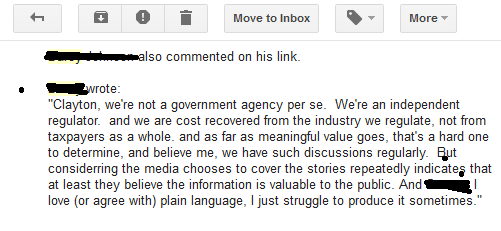
neb1

Oh wow. First of all, it is a joke to say that the NEB is an “independent regulator”. Although it is not admittedly clear what that even means. The NEB was created by the government of Canada to function as a cartelization device. There isn’t even a question.

Once upon a time, Western Canada’s independent oil producers wanted to build a pipeline to the East. Big international oil producers, who had far more political clout, preferred an arrangement whereby the east imported oil to be refined in Montreal, and Alberta oil would be exported to the US. How could this ever be settled?

The government did the only thing that could be done — it set up a commission, which later went on to create the NEB.

The conclusion regarding the pipeline was determined in advance. Therefore, the Royal Commission on Energy was stacked with people favorable to those who wanted to create political advantages for some of their friends — including the chief of the commission, Henry Borden. He was head of a utility company who had agreeably helped the government run various different wartime central planning boards during WW2. Other members of the commission were knaves such as George Edwin Britnell, another central planner who’d honed his price setting abilities at the Wartime Prices and Trade Board, and Robert D Howland, a longtime bureaucrat who was fundamentally dedicated to government intervention. The most influential witness heard by the Commission wasn’t even a Canadian guy. It was Walter J Levey, a consultant from Wall Street who represented international oil businesses. This guy too loved central planning. He was head of the petroleum division of the Marshall Plan!

The NEB was never “independent”. It’s been purely political from Day 1. Central planning has always been its purpose. Any “independence” is a fantasy.

The NEB extracts “fees” from the industry it regulates. If these are involuntary, they are taxes. If they are voluntary, that too is worrisome because it conflicts with the idea of an impartial regulator. Not only that, but the agency doesn’t take enough from the energy industry to cover all its costs anyway, so yes, the taxpayer at large is fundamentally on the hook for this “independent” agency.

Note how the comment reveals how the bureaucrat is unsure of the value of the NEB’s market forecasts. He assumes it must be useful and important because the local Calgary news reported about it. Local Calgary news does not report — it parrots government pabulum and offers wildly inaccurate weather predictions. They are desperate for stories, and will therefore cover meaningless reports issued by government agencies that no one cares about. And believe me, the viewers don’t care — if they are the type of people who get their energy market predictions from the local news, then they don’t really care about energy market predictions. “Hi, futures broker? Please sell the March oil contract at market — because of what I saw on Calgary local news!” Nothing like that has never happened in the history of human existence.

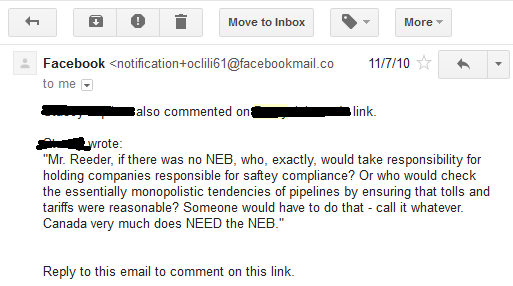
Now things start to get really exciting. A friend of the bureaucrat joins the discussion. She breathlessly demands how anyone could think the NEB should be abolished.
neb2

On the issue of safety, we must point out that everything could be done more safely than it is currently done. All safety decisions at the margin. The question is, who decides what is the “right” amount of safety?

There are only two options: the market can freely decide, or government can impose a safety standard. In the market, the price for “less safe” work will be bid up relative to “more safe” work. Hence the concept of “danger pay”. That’s why all Canadian lumberjacks have so much money. Tort law and contract law can deal with situations in which market chosen safety rules are violated.

Conversely, governments determine safety standards through political decision-making. They are imposed on firms with the power of guns and badges. Often, safety standards are determined by captured regulators. The largest, most powerful firms lobby for expensive safety standards that impair their smaller competitors. Furthermore, imposing standards reduces innovation, because resources will be shifted away from non-standard safety measures.

And who would check “essentially monopolistic” tendencies of pipelines? Who indeed? The market would normally do this. Monopolies only arise where competition is restricted by law. It is not a monopoly if I am the only guy with a pipeline in some area, so long as there is free entry to compete with my pipeline. But instead, the NEB exists to restrict competition, as one can see from its formation and continued operations. It doesn’t “check” the monopolies, but rather enforces them. The bureaucrat says so in his next comment. So it is foolish to say that without the agency which establishes the “essentially monopolistic” tendencies of the industry in question, no one would check these supposed tendencies.

We get to explore this further with the bureaucrat’s next comment:

neb3

First, I am always amused by how it is me, saying “let the market work,” who is arrogant. The bureaucrats who think they can manage something as complicated as energy markets are not arrogant at all. That’s rather modest. Because it can be done, as written in the regulatory economics textbook.

Who is to say what “duplication of facilities” is unnecessary? The bureaucrats? How do they know? They can’t know. But the market can determine whether a facility should be produced, because it involves people using their property and responding to prices. The bureaucrat’s attitude here smacks of simplistic Marxists who decry capitalism for giving us us too many brands of toilet paper and deodorant. Unnecessary production, they say. Because they know what is necessary? Right, and there is a herd of prancing unicorns that lives in my backyard.

One who grasps economic law comes to the realization that there is no “right” or “wrong” numbers of firms in a field of production. The market is constantly adjusting, and allocates resources accordingly when more competition is needed (rate of return is too high) and when there is less competition needed (rate of return is too low).

The reader should take special notice of how this bureaucrat — who assures us he is a champion of consumer interests — offers an argument that is ridiculously convenient for the monopolies and oligopolies themselves. “Yes, free competition is good, but not in this situation — i.e. the situation in which competition would threaten my own profits, which are determined on a cost-plus basis. It’s a natural monopoly, so competition just can’t be allowed!” Anyone intelligent can see what is going on here — unless they have a degree in Economics.

The bureaucrat needs to have it pointed out that there are no “natural monopolies”. There are only monopolies and monopolistic privileges created by restriction of competition. And this only arises through government interference. It is not a monopolistic advantage for one firm to be bigger than another. He cites TransCanada, which supposedly couldn’t benefit from its monopolistic privileges (provided by government) because it was regulated (by the government). What a mess. Without restrictions to competition, it would have literally been impossible for TransCanada to do what the NEB claims it prevented. The pipeline business overall would have been much stronger.

This follows the classic pattern of intervention. Government intervention introduces a problem (monopoly prices). People complain about it. The government does not eliminate its previous intervention, but instead responds with more intervention (regulation of prices) to “solve” the problem it created.

This is just like how we are supposed to believe governments and central banks do great jobs regulating their financial systems. Like the US government and the Fed must be real heroes, regulating the economy and looking out for the national interest rather than some other interest. Because that’s what it says in the Introductory Macroeconomics textbook.

And “cost of service”. Yuck. That’s just the best way to regulate, he says. Dear God. Are we going 150 years backwards in economic science here? To say that anything, anything at all, should be priced because of what it “costs” is to deny the subjective theory of value as applied to economic goods. Prices determine costs — not the other way around! We’ve known this since the 1870s. That’s what the Marginalist Revolution was. Yet bureaucrats prefer unscientific nonsense if it will justify their existence.
neb4

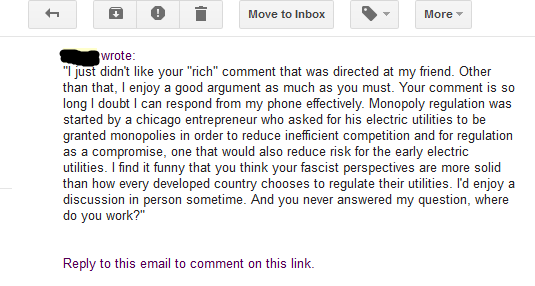
Oh no. He did not bring up Chicago. Yes, he did! Well this is the end for Mr Bureaucrat. He is absolutely clueless.

Before regulation replaced market competition in Chicago, there were FORTY-FIVE electric light companies. Gas prices had fallen 50 percent. The Chicago “entrepreneur” referred to by the NEB bureaucrat did not like all the competition. Instead of fighting it out in the marketplace, he lobbied local and state regulators to grant him monopoly privileges. Like our bureaucrat friend says, the Chicago utility owner wanted to reduce his risk. He wanted to protect his profits. He didn’t want competition raining on his parade. Great for him and his company. Great for bureaucrats with all their new regulatory jobs. Bad for everyone else!

Oh, but one might say: “If there is too much competition it will be impossible to get ‘fair’ return!” Apparently the bureaucrats and those benefiting from the monopoly know what a ‘fair’ return is, but a firm that wishes to risk its capital by competing in a “natural” monopoly doesn’t? Give me a break.

A quick tangent: The fascist reference is pretty hilarious. The guy who opposed to monopolies propped up by state regulators is the fascist. Not the bureaucrat who wants to run the economy his way. Not the firms who capture regulators to preserve their monopolistic advantages.

He finds it incredulous that I could regard the consensus about utility regulation to be totally wrong. All the countries do it like this, so they must be right, and I must be wrong! Again, there is no reason to think that just because it is currently done one way, that way must be good. Again, look at the world financial system. We are in the midst of a global economic catastrophe because that consensus is horribly, profoundly wrong. Mainstream economics, the very stuff the NEB bureaucrat is depending on, has totally failed us. Even Mervyn King said the financial system is a joke, regardless (or because of) of how closely it follows the textbook prescription.

If it’s true in the case of financial regulation, why not in the case of utility regulation? We can apply the same economic principles to public utilities as those we use to determine the financial system is bad, and we are inexorably bound to come to an anti-interventionist position on the issue. What is so inconceivable about thinking mainstream economics has monopoly theory completely screwed up, with its bogus, fantastic models of perfect competition held up as the standard to compare real economic activity?

I’m not sure why he cared about my job so much. Maybe because he was trying to network his way out of the soul-sucking bureaucracy, despite his claims of how awesome the NEB is. Or perhaps he wanted to put me in some category of people with allegedly less credibility than him, as if that were possible. My cat knows more about economics than this guy. If I remember correctly, I told him I worked at McDonalds and was an expert at making Big Mac Combos, so that it would be even more embarrassing for him to be out-matched on an economic debate.

There were a few other less substantive comments exchanged after this, but the damage had been done. The NEB bureaucrat deleted the page with this discussion and then drowned in an ocean of tears.

Foreign Aid and First Nations

As always, the ongoing controversy between First Nations and the Canadian government will produce no solutions, because no one seems to understand the problem.

Before we consider this matter, consider a basic principle. By their very nature, governments expropriate wealth from their subjects. Agents of the government allocate this wealth for all kinds of purposes that suits them or it. One of purposes available to wealthier governments is foreign aid.

Foreign aid has been called, “Stealing money from poor people in rich countries, and giving the money to rich people in poor countries.” Essentially, the aid is given to a corrupt foreign governments in backwards nations which are then expected to somehow help the common man in their countries. Usually the aid package involves the stipulation that the aid receiver must purchase stuff from the aid-giver.

The aid-receiver then uses this aid the same way it uses all its resources — reward political interests. This actually displaces real economic activity — i.e. activity that is determined by market participants and not politics. Naturally, the government and its friends benefit. The common man is worse off because their overlords have more wealth at the expense of others.

This also describes how First Nations Reserves work. These reserves are like third-world countries, with the role of crooked dictator and his cronies occupied by the chief, the band council, and their friends. The Indian Band is a legal entity under the Indian Act, and you could say it operates like a corporation that depends on government subsidies to exist. Hence, it is characterized by bad products and capital depreciation. Never forget this: the Indian Band receives its revenue via wealth expropriated from others. The “band” collectively receives aid from the government, but the aid must be administered by the reserve’s own governing body. These folks inevitably enrich themselves, and maybe leave a few crumbs for the decrepit Indians beneath them. The poverty on most Indian Reserves is truly horrifying, and completely expected given the system’s nature.

What of the common First Nations people who qualify as “Indians” under the Indian Act, who do not get to administer the loot? They suffer severe restrictions to their property rights, much more so than Canadians on the “outside”. For instance, they cannot use their land as security in a credit transaction. They cannot transfer their land to other members of the band without the Crown’s approval. They are gravely restricted in how they can appropriate the proceeds of selling or renting their property. This is like Communist Russia. It is incredibly more dysfunctional than the rest of Canada, which is already screwed up to a great degree.

What else do Indian Reserves have in common with Communist Russia? Extremely high rates of suicide, self-incapacitation, family breakups, promiscuity, “illegitimate” births, birth defects, sexually transmitted disease, abortion, alcoholism, and dull or brutish behavior. They have tragically low life-expectancies and their healthcare standards are far below the rest of Canada. See here and here.

People who understand how wealth is created must understand the Reserve system can never be fixed, because it is based not on private property, but on bureaucratic management and political decision-making. No one proposes doing anything about this. Furthermore, theory and experience tells us that people who understand that the groups who receive the most government “aid” are usually those who suffer the most. Therefore, it is critical to apply this to the First Nations issue as well. The more government “aid” received by Indians, the more this group must ultimately suffer.

US shows two negative indicators

Corporate insiders, apparently bullish no less than a month ago, have been selling nearly seven shares of their company’s stock for each share they are buying. When there is a major rally from summertime lows, you can typically observe the public starting to unload. But insiders seem better than average at buying their own stock on highs and lows. Recently, during the 2012 November lows, they were selling only three shares for every two shares they bought. During the summer lows, the ratio was 2:1.

This rate of selling is high above the long-term average, and close to relatively highs. This suggests that the market is coming up on a correction.

Meanwhile, another report brings grim tidings: The United States’ current account continues to shrink — imports are falling fast.

According to the data, imports are now down two months in a row having fallen 8.4% in the third quarter and 2% in the prior quarter.  This is a rare event and has definitely raises the recessionary “red flag,” according to Robert Brusca, chief economist at FAO Economics. When the economy weakens, imports weaken rather quickly, Brusca notes.

The last time imports declined for two quarters was in 2009, the end of a four-quarter slide in imports during the Great Recession.

Fewer imports is a sign that domestic demand is faltering. A recession is “a real risk,” Brusca said.

Note that the first indicator is probably aggravated due to the fiscal cliff, the second indicator is not.

When the US enters a recession and joins almost every other major economy, Canada will be quick to follow.

Don’t count on flood of cap-ex for 2013

There seems to exist a collective hope among financial professionals that there will be a flood of capital expenditures from cash-rich firms when (if?) the “fiscal cliff” is resolved in the US. Unfortunately, there is not always a positive market correlation with increased capital expenditure. Even if there were, Mr. Parker from Morgan Stanley suggests there is no reason to believe this is coming.

  1. Capital expenditures expected to decline in 2013, from near average levels in 2013. Therefore, upside not expected.
  2. Overall manufacturing utilization is still below long term average. Current trends indicate slowing utilization.
  3. Historical analysis suggests pent-up spending in some sectors, yet fundamental analysis suggests otherwise.
  4. Global inventory-to-sales has been flat for 10 years, there is no evidence suggesting a big capacity surge is forthcoming.

Rather than big cap-ex, 2013 will see mostly lay-offs.

— View the charts and read the analysis —

The myth of the “independent” central bank

The theater of Canadian politics never ends. Its inanity would be more embarrassing if every other country’s mainstream media were not basically just as bad.

The Canadian media was making a big deal yesterday about Bank of Canada GG Mark Carney hanging out with his friend, Liberal MP Scott Brison. OMG, was he going to join the liberal party? Was he arranging special favors?

Uh, maybe I’m missing something, but the whole thing just seems to be “business as usual”. High-level bureaucrats hang out with high-level legislators and high-level businessmen who are politically connected. They are often buddies. They hang out at dinner parties, or golf together. Their wives get together to gossip. Their kids go to the same private schools. Whatever. Seriously, follow any central banker around, and see who their friends are. It’s the same story for all of them.

Why does anyone care? Because it anything that threatens the myth that central banks are “independent” is a threat to the Establishment’s most important tool — the monopoly on money creation. So a story is created where there is none.

Well, much to the relief of mainstream economists, governments, and the sycophantic media everywhere, Carney has been cleared of any misconduct. He wasn’t seeking political office when he was staying at Brison’s summer home, smoking cigars, drinking scotch and discussing the best ways to exploit the rabble. So it’s cool. I guess.

But let’s be serious — does anyone who doesn’t have a PhD in economics and write economics textbooks really believe in the idea of “independent central banks”? I know a lot of people like to think the central bank only has the public interest at heart. They like to think none of the normal monopoly problems apply to central banks because central bankers are just so noble and wise. At least that is what the textbooks say, and the idea is key to the ultimate scam of monopolized money supplies.

So now the knaves who support central banking can say to anyone ignorant enough to listen: “Hey! Don’t worry! The central bank is totally independent! It’s looking out for us!”

Central banks are not independent, by any stretch of the imagination. Central banks exist to manipulate money supplies. If you think they do this for the “public interest,” you may also believe in things like Santa, decent highways in Saskyland, or the pantheon of Greek gods. To anyone who thinks “outside the box” in regards to this for two seconds, it becomes clear that the central bank benefits their scandalous stakeholders, like inefficient export industries, debt-laden governments, and inherently insolvent financial systems.

Talking about whether Carney and Brison hanging out together constitutes a conflict of interest is just so outside the realm of importance, there is no surprise that the national media focuses on this “scandal” — rather than the scandal of central banking as such. This is theater. It pretends to be newsworthy when it is truly pointless theatre for government and media to put the shucks on the Canadian rubes.

Recession will come to Canada in 2013.

Oh Carney. What a wacky guy. He seems convinced we will only enter a recession if the US falls off the fiscal cliff. Err, I’m sorry, not a “recession,” but a “near-recession.” Central bankers don’t like to use the word “recession” in their predictions, because that serves as a confession that they are not “managing” the economy effectively.

If the fiscal cliff is resolved, he says, Canada will surge with the resultant economic relief!

So… is it the case that Canada’s only economic threat is idiots in the US Congress? (That’s redundant — I should just say “US Congress.)

Sorry, Carney. That is nonsense.

What about recession in Europe? Asia? Not to mention the general problems of the US, out biggest trading partner.

First there is Europe. The European recession is spreading, evidenced by slowing price inflation and rising unemployment (at 12% for the Eurozone). This deeply aggravates the existing European crisis. Even Germany, the ‘good’ (cough cough) part of Europe, is grinding into economic slowdown. Its central bank predicts a pathetic 0.4% for next year. It could very easily be less. As long as everyone over there relies on Keynesianism to solve their problems, they will never escape the financial death spiral.

Japan is in a recession. Other Asian export markets are slowing down, because the weight of China’s economic distortions are turning into a brutal yoke and necessitating slowdown there.

And what of the US? The perception is that if “something” is done about the fiscal cliff, everything will be rosy. Shockingly, the US is still considered a safe haven. But foreigners are not scooping up US debt like they used to. China is reducing its exposure; Japan’s purchases are slowing. Bernanke’s surprise announcement to expand the Fed’s balance sheet by an additional $45 billion a month to buy US debt is a telltale sign that he understands the problem, at least to some extent. Yet I do not believe that Bernanke’s action will deflect the recessionary pressures coming from both sides.

Then there is Canada. Everyone here thinks we are special. “Well, if the world goes into recession, we will be okay — we’re CANADA!” they say. The myths spawned during the 2008 financial crisis have sunk deep into the nation’s collective unconscious. Canadians feel invincible. That is dangerous. So the debts continue to grow. Harper continues growing the government, thinking it’s perfectly acceptable to do so because Canada is not as bad as other countries (ignoring the fact that it is still bad).

I frequently speak with executives in the oil industry. There are big deals being made, plenty of excitement as usual. But I’ve noticed people seem strangely oblivious to even the prospect of slowdown in 2013. We are largely a resource based economy, so if the entire world is slowing down, they are not going to buy as much of our stuff. It’s a fairly easy prediction to make. Myanmar and Laos are not going to make up for lost demand from China. Canada’s slow growth will drop mid-to-late 2013 unless some new crisis speeds the world’s decline. Canadians should get ready for this. Hold cash. Get ready to use it when prices fall.

Carney is off to the Bank of England — Pray for England

Bank of Canada Governor and ex-Goldman bankster Mark Carney was selected to become the next Governor of the Bank of England. He will now be overseeing a central bank with nearly ten times the assets of the Bank of Canada. That is a big promotion in the world of central planners! Carney will now be able to create even larger disturbances in economic systems.

Truly, the worst rise to the top.

Good riddance, I say. Not that I expect him to be replaced with anyone much better. But there is always a chance.

I feel bad for England, though. They have no idea what they are getting themselves into (from Bloomberg):

Carney, who holds an economics degree from Harvard and a doctorate from Oxford University, swaps oversight of an economy which bounced back from the global recession without witnessing a single bank bailout for one which slipped back into recession in the second quarter and required multiple bank rescues.

Did you see what they did there?

Carney … swaps oversight of an economy which bounced back from the global recession without witnessing a single bank bailout for one which slipped back into recession in the second quarter and required multiple bank rescues.

Carney … swaps oversight of an economy which bounced back from the global recession without witnessing a single bank bailout … 

an economy which bounced back from the global recession without witnessing a single bank bailout …

without witnessing a single bank bailout

Excuse me? The banks that pushed for Carney to be their man in England have surely put the shucks on the rubes.

Of all the deleterious myths that persist about the Canadian financial system, none are more harmful or obnoxious than the bogus story that its banks never needed and/or never got a bailout.

Anyone who says this is simply lying or has no idea what they are talking about. Those are the only real possibilities. We have covered this at CMR previously, but let us quickly review.

The mainstream news doesn’t even try to deny it anymore. The Canadian banks got a bailout. Now they simply try to play down the significance of it. Even though it is was much bigger than anyone was led to believe.

So is this “no bailouts in Canada” proposition challenged by anyone in the UK? Carney is being sold on the pretense that there were no bailouts?   

(Side note: We could also mention that Canadian banks received assistance from emergency Federal Reserve lending facilities, which by itself is very interesting. We could also mention that rather material fact that Canadian banks are basically in a state of “perma-bailout” by virtue of the Canadian Deposit Insurance Corporation. The existence of the CDIC amplifies the level of risk banks are willing to engage in — it is classic “moral hazard.”)

So it would seem one is more likely to see bank bailouts with Carney, rather than less. That is precisely why the UK banking cartel wants Carney in this position.

Yet that is not the only reason citizens of the UK should worry.

Mark Carney is not only a believer in bailouts — he is a believer in Keynesianism and mercantilism. This means nothing more than this: he sees a connection between depreciating the currency and growing the economy. This he shares with nearly all central bankers (except, perhaps, those in Singapore): he regards a strong currency as harmful to “the nation”. Because when he talks about “the nation,” he is not talking about the consumers (i.e. everyone) who use their stronger currency to buy and invest in more goods. For men such as Carney, “the nation” instead refers to politically-connected export industries that are benefited by making it cheaper for foreigners to buy their stuff.

That being the case, Carney will tend to increase the money supply by adding assets to the central bank’s balance sheet whenever he thinks it’s a good idea. But this means prices must rise and debts will deepen. Britain already has big problems in these areas.

This should be the last thing someone in the UK should desire. The British pound has plummeted in value the last five years against stronger currencies like the yen. Here in Canada, it seems Carney’s manipulations have been obscured by strong demand for Canadian commodities, yet with the slowdown in Asia, Europe, and soon the US, I doubt this will persist. The Bank of Canada has been growing its balance sheet for nearly two years now, since offloading some of its emergency acquisitions during the financial crisis.

Also, it should be known that Carney likes to troll citizens whose currency he manages by blaming them for behavior that is strongly encouraged by his own central bank policies. What a jerk.

I am happy to see Carney go. While I am happy he no longer oversees the Canadian dollar, I am apprehensive about who his replacement will be. Most of all, I must also bemoan the lack of justice. Carney should be serving a prison sentence for counterfeiting, rather than getting $1 million a year to manipulate huge economies.