Geithner is an idiot, but he is right about at least ONE thing…

Geithner says:

“[S&P has] shown a stunning lack of knowledge about basic U.S. fiscal budget math.”

No kidding, Tim. If they really understood the US Treasury’s economics, they’d have downgraded it to junk in 2008. But I don’t think that’s what you mean…

Bernanke’s “stealth bailout” of RBC and other foreign banks.

To follow up on our earlier post about QE2 simply padding the excess reserves of precariously bankrupt financial institutions, I want to call attention to ZeroHedge’s excellent reporting about  QE2 amounting to nothing more than a foreign bank rescue operation.

ZeroHedge rightly identifies European banks on the NY Fed’s list of primary dealers as being main beneficiaries of QE2. Although it is interesting to draw attention to the lone Canadian bank, RBC, in this list, far more interesting are the implications of this “stealth bailout” (which provide ample support to my contention that there will definitely be QE3):

… here is Stone McCarthy’s explanation of what massive reserve sequestering by foreign banks means: “Foreign banks operating in the US often lend reserves to home offices or other banks operating outside the US. These loans do not change the volume of excess reserves in the system, but do support the funding of dollar denominated assets outside the US….Foreign banks operating in the US do not present a large source of C&I, Consumer, or Real Estate Loans. These banks represent about 16% of commercial bank assets, but only about 9% of bank credit. Thus, the concern that excess reserves will quickly fuel lending activities and money growth is probably diminished by the skewing of excess reserve balances towards foreign banks.

More points of interest:

Furthermore the data above proves beyond a reasonable doubt why there has been no excess lending by US banks to US borrowers: none of the cash ever even made it to US banks! This also resolves the mystery of the broken money multiplier and why the velocity of money has imploded.

Instead of repricing the EUR to a fair value, somewhere around parity with the USD, this stealthy fund flow from the US to Europe to the tune of $600 billion has likely resulted in an artificial boost in the european currency to the tune of 2000-3000 pips, keeping it far from its fair value of about 1.1 EURUSD.

But implication #4 is by far the most important. Recall that Bill Gross has long been asking where the cash to purchase bonds come the end of QE 2 would come from. Well, the punditry, in its parroting groupthink stupidity (validated by precisely zero actual research), immediately set forth the thesis that there is no problem: after all banks would simply reverse the process of reserve expansion and use the $750 billion in Cash that will be accumulated by the end of QE 2 on June 30 to purchase US Treasurys.

Wrong.

The above data destroys this thesis completely: since the bulk of the reserve induced bank cash has long since departed US shores and is now being used to ratably fill European bank balance sheet voids, and since US banks have benefited precisely not at all from any of the reserves generated by QE 2, there is exactly zero dry powder for the US Primary Dealers to purchase Treasurys starting July 1.

This observation may well be the missing link that justifies the Gross argument, as it puts to rest any speculation that there is any buyer remaining for Treasurys. Alas: the digital cash generated by the Fed’s computers has long since been spent… a few thousand miles east of the US.

Which leads us to implication #5. QE 3 is a certainty. The one thing people focus on during every episode of monetary easing is the change in Fed assets, which courtesy of LSAP means a jump in Treasurys, MBS, Agency paper, or (for the tin foil brigade) ES: the truth is all these are a distraction. The one thing people always forget is the change in Fed liabilities, all of them: currency in circulation, which has barely budged in the past 3 years, and far more importantly- excess reserves, which as this article demonstrates, is the electronic “cash” that goes to needy banks the world over in order to fund this need or that. In fact, it is the need to expand the Fed’s liabilities that is and has always been a driver of monetary stimulus, not the need to boost Fed assets. The latter is, counterintuitively, merely a mathematical aftereffect of matching an asset-for-liability expansion. This means that as banks are about to face yet another risk flaring episode in the next several months, the Fed will need to release another $500-$1000 billion in excess reserves. As to what asset will be used to match this balance sheet expansion, why take your picK; the Fed could buy MBS, Muni bonds, Treasurys, or go Japanese, and purchase ETFs, REITs, or just go ahead and outright buy up every underwater mortgage in the US. This side of the ledger is largely irrelevant, and will serve only two functions: to send the S&P surging, and to send the precious metal complex surging2 as it becomes clear that the dollar is now entirely worthless.

Ben Bernanke: 100% Wrong.

Bernanke made an appearance on “60 Minutes” the other night (Part 1, Part 2). This is a soft interview for Bernanke. There are no tough questions because the interviewer does not understand economic science or finance.

First, I would like to remark on what is apparently Bernanke’s profound nervousness — at least that is how I interpret his trembling voice and his quivering lips. I’ve seen a lot of Bernanke footage, albeit not often so close up on his bearded mug. He often sounds shaky, even back in 2006-2007 when his forecasts were all rosy, but not this shaky. This is not the look of a man who is 100% sure of his actions. But enough of my pop psychology, and on to a few matters of substance.

“This fear of inflation is overstated,” he says. Is it really? It looks like Bernanke did create lots of money, but has not yet translated into a rise in M1 — instead, it is stockpiled as excess reserves of commercial banks. The monetary base has been basically flat the last several months.

Yet, when the banks do start to lend and the magic of fractional reserve banking kicks in, prices will be bid up to epic proportions. Export economies such as Canada will in turn have to inflate so they can push up the US dollar and push down their own currencies. That is why QE2 is a big concern to many people. What Bernanke says in defense of QE2 is important:

“We are not printing money,”

This comment drew a few snickers from my peers, but I think this might be a rare case of Bernanke speaking the truth. The “QE2” announcement did not actually mention quantitative easing at all, it merely said the Fed would buy long-term Treasuries. Since then, it has increased its holdings of Treasuries but sold other assets. Net effect – no real change in the base. I suspect this will continue into the near future.

The purpose of the Fed is to protect the big banks. Bernanke can handle 10% unemployment so long as the big banks are happy. When the banks get in trouble, then he will be forced expand. I think this arises from his complete failure to understand the business cycle. His ideas about the Great Depression are not reassuring.

The mainstream likes to make Bernanke out to be a great sage on the subject of the Great Depression, and that is the case here. I guess the logic is something along the lines of: if Bernanke believes something about the Great Depression, it must be true. It’s Bernanke, he’s smart and he studied the Great Depression, how could he be wrong? (hmm…) Well, I have a big chip on my shoulder about this. This is one of the most baleful ideas in the realm of economic inquiry. Bernanke is totally wrong on this issue.

Bernanke’s thesis is that the Great Depression was caused by the Fed’s contraction of the money supply and the failure to inflate. The Fed did not reduce the monetary base after the crash. After a period of keeping it flat, they expanded the monetary base slightly in 1932 then dramatically from 1933 onward.

The money supply did collapse, but only because so many banks went bankrupt. This came to an end in 1934 when the FDIC was created. From here on the money supply rose. The Great Depression did not end until after World War II. Bernanke’s theory is not supported by evidence.
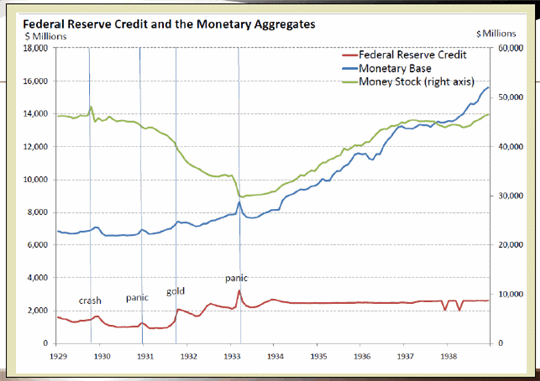
(This chart was taken from here.)

With Bernanke running things, we are probably doomed. I believe his policies will eventually cause mass inflation, and nations where the economy is structured towards servicing American consumption will be forced to inflate as well. Canada sells the Americans $350 billion dollars worth of goods each year. Mark Carney thinks a strong Canadian dollar is bad for Canada’s economy.

Canadian banks, bailed out by the Fed.

Documents released by the Federal Reserve show that Canadian banks used the Fed’s special loan programs to strengthen themselves when the economy started to go sour.

I find this very enlightening. First of all, there is stubborn myth that circulates our country, averring that Canadian institutions did not need a bailout. This is simply untrue. Canada’s bank bailout was a little more sophisticated, a little less blatant, than, say, the US bank bailouts, but it amounted to a bailout nonetheless. The Canadian government buffered its big financial institutions with a whopping $75 billion dollars used to buy bad assets.

Second, the Fed’s loan programs are bailouts too.

Canadian banks said the moves to seek loans from the Fed were dictated by strategy and not by necessity.

RBC accessed funding from the Fed “purely for business reasons – better pricing and collateral rules – and because they were the best deal for our shareholders at the time,” said Gillian McArdle, a bank spokesperson. “Our access to funding remained very strong through the entire crisis.”

This is an interesting thing to say. Let us think about this a bit.

Remember that the Federal Reserve has a monopoly on the creation of US dollars. It can buy any asset it wants with digital dollars created out of nothing. Other institutions cannot do anything like this.

If an institution like Royal Bank cannot raise capital on the market and turns to a central bank for help, this is a bailout. This allows it to strengthen its balance sheet in a way that would not be possible without the central bank’s intervention. Saying this does not amount to a bailout is incoherent.

Central banks exist to bail out big financial institutions and governments when markets go bad. In 2008, the Fed bought a trillion dollars or so in garbage assets that the market would not touch at face value. The Bank of Canada helped bailout banks too.

So in addition to getting bailed out by the the BoC and the Canadian government, Canadian banks were bailed out by the Federal Reserve as well!

Why is this important? In the business cycle, when the boom period reaches its apex and market forces begin initiating vengeful corrections, bad debts must be liquidated for the economy to become rebalanced. This is value of the recession — it restores soundness to the economic system by clearing out the malinvestments perpetuated by expansionary monetary policies that create the bubble. Of course, in 2008 governments and central bankers around the world stepped in to ensure that would not happen.

The fact that Canadian institutions availed themselves of the Fed’s interventionary loan programs (to say nothing of the $75 billion bailout from Canada) reveals that Canadian banks are not as strong as people claim. Like all commercial banks operating on fractional reserve banking systems, Canadian banks are inherently on the verge of bankruptcy at all times. Our system ought not be the envy of the world — instead, it is just another facet of the nightmarish system that Bank of England Governor Mervyn King candidly called “the worst banking system conceivable.”

Jim Rogers, Andrew Schiff, and some economic ignoramus named Doug Henwood talk about TBTF and taxes.

Listening to this Doug Henwood fellow on taxes is truly unbearable. Have fun.

This is an entertaining discussion but it is pretty boisterous and a lot of cogent points get lost. The group talks about the Too Big To Fail policy as “socialism for the rich,” which is a legitimate given the policy of bailing out big, insolvent financial institutions. There is no dispute with any of this.

Socialism for the rich should be rejected, but Schiff makes a valid point that, insofar as bailing out financial institutions was intended to keep credit flowing liberally to borrowers whose credit-worthiness was otherwise inadequate, the TBTF policy was “socialism for the poor” as well. American consumers are addicted to debt and low interest rates.

Rogers and Schiff are apparently opposed to socialism in principle, but Henwood is only against “socialism for the rich.” He likes other forms of economic interference, such as that which distorts interest rates, or that which taxes the rich.

Henwood thinks it is perfectly justified to say that higher taxes can possibly help economic growth. This is untrue, and the economic case against it is probably irrefutable. I will summarize:

If economic actors exchange property voluntarily, then it is implied that both actors are better off than they would be in absence of this trade. If both did not expect to benefit from the trade, they would not take part. The matter is quite different in the case of taxation. With taxation, the producer’s supply of goods is reduced against his will to a level below what it would be absent the taxation. In addition to this reduction of present goods, the supply of future goods is reduced as well. For taxation is not unsystematic and random, but systematic and expected to continue in one form or another. Therefore, it implies a reduced rate of return on investment and produces an added incentive to engage in fewer acts of production in the future than one otherwise would. Overall incentive to be a taxpayer decreases, and incentive to become a tax-consumer increases.

This is always true. But Mr. Henwood would disregard economic science and make his inferences based on a shallow analysis of empirical data. Of the US, he says the Clinton years saw a period of great economic growth, and tax rates were higher than they are now. So, he infers, higher tax rates contribute to economic growth.

This doesn’t make any sense. If Henwood were an economist, I would call him a crank. But he is not an economist, he is an English major. He does not have a background in economics, but he likes to write about it. There is no evidence that he is capable of applying formal theory to reality and interpreting it.

In addition to being completely fallacious, the above argument for higher taxes is only credible on the most superficial analysis. If Austrian business cycle theory is correct, then one could easily argue that the much-heralded ‘growth’ of the Clinton years was just phony wealth created by economic bubbles brought about by artificially low interest rates.

When Reagan was elected in 1980, short-term rates were 11.4 percent. When Bush I lost to Clinton in 1992, the rate was 3.4 percent. Rates moves upwards over the course of the Clinton years, and in 2000 the average Treasury bill rate was 5.8. The manipulation of interest rates created economic dislocations — the dot-com bubble, among other things — and the inevitable crash.

Doug Henwood doesn’t know what he is talking about.