Observations on the Royalty Review Panel Open House

In the following I will share the observations of a man who attended last night’s Royalty Review Panel Open House in Calgary, originally posted on Instaface or Facegram or whatever it’s called. This man is an entrepreneur in the Alberta oil industry, so it seems reasonable that he understands many of the underlying issues. His reporting rings true to me and it should deeply unsettle not just Albertans, but also the other Canadians who gobble up the transfer payments out of Alberta:

Well I went ahead and attended the Royalty Review Panel Open House in Calgary last evening to see what they had to say. They had lots of stand up displays with hundreds of factoids about supply, world prices, reserves and a whole bunch of other information most of us Albertans have known about for decades. Interestingly enough they had whiteboards for attendees to write comments, Trevor Marr took pictures and the attendees were hammering the government hard on the many points you’ve already posted, read, liked and shared on these pages.

I spoke and asked questions about the risk of engaging in a review at a time when prices are low and royalty revenues are already in full collapse. The Al Gore trained political hack, ATB CEO Dave Mowat did confirm that the government would be lucky to collect $3 Billion this year, down from $9 Billion last year. He couldn’t answer why if we were at $13 Billion prior to the last review and it contributed to a drop to $9B since and were now down at less than $3B, what good could possibly come from throwing two plus years of uncertainty into the mix now? He kept referring to how they were sure that they could OPTIMIZE the royalty rates. But no, the full report wouldn’t be shared with Albertans as a large portion of their process was so complicated it could only be done by 3 separate expert non public panels that they are hiring to work for a whole month. But the end result would be the best Royalty Rate system ever done and the OPTIMIZED recommendations would be provided to the NDP government by December 31st, 2015. He also said that since oil would be phased out over the next 20-30 years, it can no longer be viewed as a finite resource since we have more than will ever be able to be sold! He said the inability to get to markets wasn’t relevant to the rate structure! He also said if our oil wasn’t competitive in the world markets not having pipelines to those possible clients didn’t matter. He said it wasn’t their concern if other taxations such as corporate tax rate increases or carbon tax burdens were put on our oil and gas industry as they were only mandated to recommend a royalty rate structure that was based upon 4 core principles that could guide all the future rate reviews. He suggested that every two years or so they might want to adjust rates! He admitted that the $65 Billion in annual investment by the oil and gas industry was dependent upon both pricing and royalty competitiveness. He wouldn’t say how much lower the investment is this year nor how much investment might be withheld due to the not knowing what the rates are going to be. He couldn’t answer as to how long it might take the NDP government to implement their recommendations or even if they would.

I came away convinced that the whole process is a traveling Gong Show run by ideologues who are so enamored with their own intelligence that they actually believe that they can squeeze more revenue out of the resources that we own by performing a superb OPTIMIZATION of the rates. They have no concept of RISK. Dave Mowat declared that the USA is no longer a trusted customer, that they have become our biggest competitor and since they produce so much oil relative to our miniscule output, we cannot compete. I also spoke with Peter Tertzakian from the panel who accused the PC’s of not collecting enough over the past decades. He also had absolutely no concern that the revenues had fallen due to the low prices, he expressed a concern that Albertans weren’t getting enough revenue from the oil being sold with no concern that the O&G industry were operating at a loss as is!

In other words, much like Rachel’s NDP government, nobody on this Royalty Review Panel are prepared to Stand Up For Alberta! They do not understand risk management, product promotion, stability needs of large long term investment, spinoff benefits from capital investment, incentivization potential, access to tidewater ports and human cost impacts from reduced employment opportunities. We must redouble our efforts to wake them up. I got under their skin, Mowat tried to label me as smug but apologized when I called him out for attempting to assign a negative connotation on a brief facial expression I might have had while listening to another speaker grill him. Although someone in the back did holler that I should be the next Energy Minister. 🙂

Let me call attention to a few of the most startling comments here.

[Mowat] also said that since oil would be phased out over the next 20-30 years, it can no longer be viewed as a finite resource since we have more than will ever be able to be sold!

WHAT.

Dave Mowat declared that the USA is no longer a trusted customer, that they have become our biggest competitor and since they produce so much oil relative to our miniscule output, we cannot compete.

WHAT.

I also spoke with Peter Tertzakian from the panel who accused the PC’s of not collecting enough over the past decades. He also had absolutely no concern that the revenues had fallen due to the low prices, he expressed a concern that Albertans weren’t getting enough revenue from the oil being sold with no concern that the O&G industry were operating at a loss as is!

WHAT.

We shouldn’t be surprised by foolishness coming out of a Royalty Review Panel that is chaired by Al Gore fanboy Dave Mowat, but this is actually worse than I expected. If such considerations are guiding the panel’s recommendations, Alberta is in a lot of trouble.

The entire royalty review is based on asinine premises as demonstrated above along with the laughable pretense of caring what the public has to say.

Election 2015: How Bad Are The Liberals?

In this series CMR will examine the policy proposals set forth by the top three parties in Canada’s 2015 federal election.

PART I: The NDP
PART II: The Liberals (current article)
PART III: The Conservatives

Obviously these parties are all terrible. So the question is simply this: which party will beat you with the biggest stick?

We will refer to the helpful National Post article “Everything you need to know about the parties’ platforms, from taxes to terrorism to the environment.”

In Part I, we looked at the NDP. Their platform is awful, but in all fairness they had a couple of good policies related, including the repeal of Bill C-51 and ending the military campaign against ISIS. On economic issues, they were entirely dreadful other than their teeny tiny tax cut for small business. They earned a score of D-. Let’s see if the Liberals can fare better.

As Canada’s center-left party, one would expect them to be a little less stupid more moderate than the NDP, which is the party of the far left. Practically speaking, they might be closer to the Conservatives (center-right) when it comes to governance.

Economy

– Cut middle-class income-tax bracket to 20.5 per cent from current 22 per cent; create a new tax bracket of 33 per cent for annual incomes of more than $200,000.

Right on, tax cut! For some people, anyway. But it is an incredibly small tax cut. A lousy 1.5%? Come on, Canadians deserve better. Most people won’t even notice this. But they want to increase taxes on the ‘rich’ (though I hesitate to classify someone as rich for earning over $200K per year). This which is politically appealing but does absolutely nothing positive for the economy (it merely shifts money from productive people to the government).

This would probably increase taxation on net, therefore this policy is bad. They should drop the tax increase and keep the tax cut, then at least this policy would be stingy and lame but not bad.

If the Liberals said they were eliminating income tax on anyone in the middle class, then that would be something to get excited about, even if they were increasing taxes on the wealthier brackets. Better yet would be to cut everyone’s taxes.

Heck, even the NDP said they would keep the income tax rates the same! Well, they are probably lying but it’s funny that the NDP is arguably better than the Liberals on federal income taxes.

– Cancel income-splitting for families; party calls it “a $2-billion tax break to the top 15 per cent of Canadians.”

We can say the same thing we said about the NDP wanting to cancel income-splitting: “This would increase the tax burden on any family to which it applies, and is therefore bad. That it applies mostly to the “wealthiest” is true depending on how you define “wealthy,” but it also applies only to those who have someone with whom they can split their income. So it is rather selective and narrow in its tax relief. This is an interesting matter on its own, and of course tax relief for everyone would be better. But regardless of the fairness issue, added tax relief for some is better than added tax relief for none.”

– Introduce a new income-tested, tax-free monthly Canada Child Benefit that would boost payments to all families with children and annual income below $150,000.

As we said in our discussion of the NDP, the Child Tax Benefit is effectively a tax cut to net taxpayers with children, and welfare for net tax-consumers with children. Essentially, this Liberal policy says families with annual income >$150K should pay more. It’s not clear whether lower income folks would get more or less out of the deal versus the status quo.

Overall, this policy is essentially just dumb because it fiddles with something that shouldn’t exist. A better solution would be to just give families income tax cuts. Fiddling around with these tax credits is annoying and a roundabout way to give tax cuts to some and welfare to others. Meanwhile, net taxpayers with no children don’t get squat. The whole Child Benefit system is unfair and stupid.

– Cancel TFSA increase to $10,000, saying it helps well-off Canadians who need it the least.

As we said in our NDP platform review: “The TFSA is one of the only good things the Harper Conservatives have ever done. Reducing the contribution limits means more taxable income and therefore this is an evil NDP policy.” So we can say the same thing here: Evil Liberal policy. Don’t you love the government deciding who is needy and who is not? Plus, not that it should matter, but it’s questionable whether these claims about the TFSA mostly benefiting rich people are true in the first place. Evidence suggests that people at a broad range of income levels benefit from the TFSA.

– Retain tax breaks for small businesses but want to ensure this doesn’t primarily benefit the wealthy.

This doesn’t really mean anything. Small business gets “tax breaks” i.e. lower tax rates if business income is under a certain threshold. Most small business owners are not rich, and even if they were, so what? In small privately held businesses, income flows through to the owner, who gets taxed at his marginal rate. If he is rich, that tax rate is higher.

Side note: You learn a lot about people’s underlying philosophy when they say “less tax” is a “tax break.” In other words, anything less than having 100% of income taxed is a tax break. These disgusting people are basically saying all your income belongs to the state, and anything you are allowed to keep is a “tax break.” Yuck.

– Balance the budget in 2016.

I really hate when politicians say they are going to “balance the budget” and leave out the important part of HOW THEY ARE GOING TO DO THAT. Raising taxes, or cutting spending? Raising taxes is bad and cutting spending is good.

I would argue that if the government is not going to cut spending, running deficits is better than raising taxes, although both are bad. But there is a difference: you really don’t have a choice as to whether you pay taxes or not. You do have a choice about whether you lend the government money. Governments racking up debts is still bad, because it absorbs private capital and pumps it into wasteful government spending, but at least the taxpayer is less directly affected.

– Cancel Conservative plan to increase OAS eligibility age to 67.

Same thing we said about the NDP proposal applies here: “Evaluating this is a little more complicated than most proposals. On the one hand, OAS is welfare for old folks. This involves subsidizing old folks (who tend to have more accumulated wealth) by taxing younger people (who tend to have less accumulated wealth). Taking money from poorer people and giving it to wealthier people is a weird policy. On the other hand, old folks who are/were net taxpayers deserve to get all their money back, so the OAS could be considered on the same terms as taking a tax credit. Overall, the OAS is bad and should just be eliminated, and with that in mind increasing the age limit is probably better because the best result would be increasing the age limit to 1000 so no one could get it.”

– Increase Canada Pension Plan contributions and benefits for Canadians.

No. The CPP is a disgrace to humanity. If people want to put more money into the CPP, I guess that’s their choice, and they should be allowed to do that. In general, however, people should be allowed to opt out of the CPP and take responsibility for their own retirement. The younger generation will be lucky to get anything out of the CPP. Forcing people — at gunpoint, if necessary — to put money into the CPP is a moral and economic atrocity.

Security and Terrorism

 – End the bombing campaign in Iraq and Syria but keep military trainers in Iraq and boost humanitarian aid to help refugees; allow more refugees into the country from Iraq and Syria.

You see, the Liberals start here with something good and then dilute it with something bad. Ending the bombing campaign in Iraq and Syria is a good idea. Entangling ourselves in brutal foreign conflicts is senseless. But the Liberals want to keep military trainers in Iraq — in other words, they want to support one evil faction against another evil faction. The correct choice is actually to not choose an evil faction at all, and stay out.

There should be no humanitarian aid from Ottawa — Canadians should send their own humanitarian aid if they want, and the government should have nothing to do with it. Likewise, dealing with refugees should not be a government issue at all — if people and private organizations want to help refugees by giving them a place to stay and money and such, they should be allowed to do so.

– Make amendments to anti-terrorism Bill C-51 by: limiting the sharing of personal data to 17 government departments and agencies with national security responsibilities; eliminating CSIS’s new power to obtain court warrants to break the law in some cases to disrupt suspected terrorists; adding a three-year sunset provisions on some parts of the law and mandatory parliamentary reviews of the extraordinary security measures.

The Liberals supported C-51, and these amendments are simply a joke. Oh, so personal data will be shared with only 17 departments and agencies with national security responsibilities. (How do we have that many bureaucracies with national security responsibilities? How do we have that many government agencies at all?)

How nice to eliminate CSIS’s power to break the law — after you gave it to them. Give me a break. They routinely break the law anyway so nothing will change without defunding CSIS and prosecuting lawbreakers.

Sunset provisions at least create the possibility that a bad law will go away, so that’s not a terrible idea because laws are virtually never repealed. But notice how politicians only propose sunset provisions on bad laws. Wouldn’t it just be better to not pass the law, and if it’s already passed, just repeal and try again? Don’t say, “Hey, this law is bad but we will keep it for a few years and then decide whether we still want it, By the way, we probably will.”

The NDP, which says they would repeal C-51, has the Liberals and Conservatives beat when it comes to this awful law.

– Create an all-party national security oversight committee to oversee the 17 government departments and agencies with national security responsibilities.

Committees. The solution is always committees. News flash: Committees are dumb and if you think we need more committees you are quite likely also dumb. They are routinely stacked with members favorable to whoever is setting up the committees in the first place, and inevitably create giant reports no one reads then everything just continues as it was, if not worse.

Government oversight doesn’t fix anything. It just changes the way the government wastes money. Furthermore, it usually doesn’t work as intended, because rather than restricting government activity, it tends to add legitimacy to functions that are bad in the first place. It does this by creating the illusion of “checks and balances” while it white washes bad things.

The only way to reign in abusive government agencies is to cut their budgets or get rid of them.

And again: how do we have 17 government departments and agencies with national security responsibilities? That is way too many. The bureaucratic nightmare in dealing with “national security” must be suffocating.

If the Liberals weren’t clueless and/or dishonest, they would be getting rid of agencies rather than setting up committees.

Environment

– Continue to oppose proposed Northern Gateway pipeline; support Energy East and Keystone XL pipelines.

Frankly, the federal government should have no influence whatsoever in the Northern Gateway pipeline, which is an Alberta/BC issue.

It’s nice that they support Energy East and Keystone XL, in the sense that “supporting” means “not opposing.” The government shouldn’t be advocating for special industry projects one way or another. They should let these issues resolve themselves among legitimate stakeholders.

– Put a price on carbon pollution that allows provinces to design their own carbon pricing policies.

This seems contradictory. If you put a price on carbon pollution, you preclude the provinces from deciding how carbon pollution should be priced — or whether it should be priced at all.

Carbon pricing creates a weird managed market that benefits the most richest, most powerful carbon pollution generators and financial institutions while hurting everyone else. This policy is terrible.

– Partner with provinces and territories to establish national emissions-reduction targets.

Sorry, no. There should be no national emissions-reduction targets.

– Invest millions in clean technologies and enhance tax measures to create more green jobs.

No. We should not have the government pouring taxpayer money into politically connected businesses, destroying jobs in some sectors and to subsidize wasteful jobs in other sectors. However, we should not be opposed to cutting taxes, even if only for certain sectors of the economy. Although a tax cut for all industries is better, selective tax cuts are relative improvements. If they want to have “green” companies pay less tax, sure, I can get on board.

– Introduce an environmental review process with more “teeth.”

Virtually all the worst pollution takes place on government land. The problem isn’t an environmental review process that lacks enough “teeth,” but instead the fact that the government allows pollution on its land at all. Government land should be desocialized and laws of tort and trespass should be enforced. Adding more teeth just means a few more boxes need to be checked before the government will let someone dump toxic waste in publicly owned rivers. Ultimately, they are still letting someone pollute.

– Hold First Ministers’ meeting with premiers within 90 days of the Paris UN climate change conference this December to establish a framework for reducing Canada’s carbon footprint.

Canada doesn’t need to reduce its carbon footprint. Like, at all. So establishing a framework for doing so is dumb.

This proposal is completely moronic. Who cares what the climate change conference in Paris says? It is a conference of goons and fools. Reducing our carbon footprint hurts us and helps countries like India and China. We should be trying to increase our carbon footprint, so that we are wealthier and healthier.

– Increase the amount of Canada’s protected marine and coastal areas to five per cent by 2017 and 10 per cent by 2020.

No. All the marine and coastal areas should be desocialized. The end.

– Phase out subsidies for the fossil fuel industry.

Well, yes, absolutely! Now this probably wouldn’t result in any less spending overall, because the subsidies cut from A would just go to B, but in and of itself this is a good policy. The government should not subsidize any industries.

– Along with the U.S. and Mexico, develop a North American clean energy and environmental agreement.

ABSOLUTELY NOT! These kinds of agreement, whether they are ‘free trade’ agreements or ‘environmental’ agreements, result in harmful political integration and a surrender of sovereignty. We have less than 10% the population of the rest of North America. Canada would be surrendering power to other countries that don’t share our values. The agreement would harmonize regulations and benefit the most powerful and politically connected special interests.

Infrastructure and Transport

– Boost infrastructure funding through “alternative sources of capital” such as having large pension funds invest in major infrastructure projects in urban and rural communities.

The details are very fuzzy on what the Liberals intend for this. They have not given any concrete plan. They say they want to entice investment from private pension funds to invest in Canadian infrastructure projects. That could mean all sorts of things. In all fairness, we cannot judge this policy (but it will probably be bad).

– Provide infrastructure funding for affordable housing, public transit, transportation, climate change and “smart cities.”

NO!!! I mean, this is just dreadful. The federal government should not fund any of these things. The fact it extracts money from the provinces, takes a huge cut for itself, and then parcels out the rest based on political influence makes things worse. It would be far better to just cut that part of Ottawa’s budget and leave all infrastructure decisions in the hands of the provinces.

And don’t you shudder to think what happens when the government starts dishing out cash for “smart cities”? Smart to whom? Ottawa? All the stupidest possible public infrastructure fantasies will have their crazy advocates fighting over the federal money that’s up for grabs. Someone please save us.

– Hold a big city mayors’ meeting in Ottawa annually to discuss pressing infrastructure issues facing cities.

This is completely useless. A bunch of big city tax-devouring beggars rack up a big bill on a fancy trip to Ottawa so they can hang around with Justin Trudeau and talk about how much federal money they need, without which their cities will be lousy. Waste of time and money, and surely leading to nothing positive in the future.

Foreign Affairs and Defense

– Make Canada a “world leader” at multinational institutions.

National Post could have left it out of the article. This doesn’t mean anything. I am sure Justin Trudeau would like to give lots of speeches at the United Nations or something, but that doesn’t help anybody.

Realistically speaking, Canada probably shouldn’t even be in most of these “multinational institutions.” They do not represent Canada’s interests and tend to be counterproductive regarding the goals of prosperity and justice throughout the world.

Canada can be a “world leader” by advocating for peace and free markets, and be demonstrating those values to the world with its own domestic policies. This is not what the Liberals are offering.

– Reopen nine Veterans Affairs regional offices closed by the Conservative government.

I understand why this riles people up. The government treats veterans very poorly. But these are fake cuts. Veteran Affairs spends more money in total each year, so even if some regional offices close and a bunch of bureaucrats get fired in one place, the money is being spent elsewhere in Veteran Affairs. Are the veterans better or worse off than before? It’s impossible to say for sure. That is the problem with government spending.

You’d be better off just getting eliminating all tax on military families and getting rid of Veteran Affairs Canada. Any money that Ottawa would otherwise tax and spend would just stay in the provinces and their health care systems could deal with sick and injured people.

– Create a cabinet committee to oversee and manage Canada’s relationship with the United States.

One of the worst ideas I have ever heard.

– Host a new trilateral summit with the United States and Mexico.

No.

Social Issues

– Strengthen the federal government’s role in safeguarding the national health-care system; meet with the premiers on how to improve the system in areas such as wait times, affordability of prescription drugs, and availability of homecare.

What is it with the Liberals and having all these meetings and committees?

Anyway, we really need to rethink our heath care system. We should leave the money in the provinces and let them figure it out. When something is as important as health care, you want your influence to be closer to home. Therefore, the Liberal desire to strengthen Ottawa’s role in “safeguarding” the health care system is the exact opposite direction we should go.

– Restore door-to-door home mail delivery by Canada Post.

Whatever. This basically just subsidizes Amazon. Mail delivery should be entirely privatized.

– Reinstate the long-form census and make Statistics Canada independent.

The long-form census is ridiculous and it’s insane that some think the government should threaten people with imprisonment if they don’t want to fill it out. What is wrong with people?

Democratic Reform and Governance

– Introduce changes to strengthen the Access to Information system and ensure this applies to the Prime Minister’s Office and ministers’ offices.

Supposedly they want to make all government data open by default otherwise the government must provide written response in 30 days blah blah blah. I think the people should have access to all the government’s data without restriction, but I don’t necessarily think the Liberals would help with this. The changes to the Access to Information Act, written by government lawyers, would probably just add more ways to avoid producing information.

Government agencies have secrets because they exist. You wouldn’t care about the Access to Information Act if the government didn’t have so much power.

– Create a quarterly, more detailed parliamentary expense report, and open up the secretive House of Commons Board of Internal Economy.

Theoretically we could get some entertainment and scandals out of this. Ultimately it wouldn’t matter much. So Ottawa would hire a few more bureaucrats to provide more detailed accounting of how parliament wastes money. Big deal. Why don’t we just… cut their budgets? Members of Parliament shouldn’t even get a salary.

– Create a non-partisan, independent process for advising the prime minister on Senate appointments.

Lame. No one cares. No one likes the Senate.

– Allow more time for questions and answers during question period, and introduce a prime minister’s question period.

Might occasionally be good for theatre, but otherwise has no meaningful impact on anything. The money will still be spent. At best it might slow things down — fewer laws, fewer ways to hurt Canadians. That would be good.

– Ban partisan government ads and appoint an Advertising Commissioner to help the Auditor General provide oversight on government advertising.

Lame. Why can’t we just ban all government advertising?

– Revamp the electoral process by eliminating the first-past-the-post voting system; will study measures such as ranked ballots, proportional representation, mandatory voting, and online voting.

All of the different electoral approaches to democratic majoritarianism are varieties of bad, and I’m not sure how they would rank. But one thing is for sure — mandatory voting is evil. Threatening people with fines and violence if they don’t pick one gangs of jerks or another is just cruel. The Liberals are evil just for considering mandatory voting. If anything, the ability to vote needs to be restricted. Anyone who works for the government or gets the majority of their income from the government should be prohibited from voting.

Justice

– Legalize pot and allow it to be sold – and taxed – in approved outlets. Liberal Leader Justin Trudeau says he expects people would not be allowed to buy the drug until they turn 18 or 19, depending on the province in which they live.

This is an improvement over the status quo. Putting sin taxes on it and allowing only “approved outlets” are bad ideas but this would lead to fewer injustices related to the drug war. The drug war is a complete failure. Surely the money would be spent elsewhere, maybe just allocating more resources to other parts of the drug war. Nonetheless, this would probably result in less state aggression against people overall.

  – Consider reviewing mandatory minimum sentences.

Depends on the crime, I guess.

– Require judicial nominees to the Supreme Court of Canada to speak both official languages.

Yawn. No one cares.

Aboriginal Issues

– Rebuild the relationship between aboriginal and non-aboriginal Canadians.

This doesn’t tell us anything. There is only one right way to do this: abolish the Department of Aboriginal Affairs and Northern Development, and desocialize all First Nations, Inuit, and Metis land.

– Call a national inquiry into murdered and missing aboriginal women.

Inquiries, committees, meetings…

– Implement all 94 recommendations from Truth and Reconciliation Commission.

Has anyone read all of these? Mostly they just feed into the problem — demanding meaningless gestures, money, and more interference from the Canadian state, which has done such damage to the indigenous Canadians. They should be demanding freedom. They should be trying to get the federal government out of their lives completely.

– Create more transparency and accountability with First Nations; pass legislation in consultation with First Nations people on implementing the reforms.

– Provide stable, predictable funding for First Nations education to close the “unacceptable gap” in learning outcomes for First Nations students.

With funding comes control. More federal control over First Nations. This is more the same. First Nations need sovereignty and property rights, not more ‘help’ from Ottawa.

Conclusion

That was quite the slog. After all that, there can be no doubt the Liberal Party’s platform is genuinely wretched — a tissue of economic stupidity and amazingly pointless proposals. Their tax cuts are pathetic. You wouldn’t even notice. They definitely want to increase taxes and the burden of government in various ways. The aboriginal policies were a joke. Overall the Liberals only had a few things that were actually good, particularly their scaling down of the drug war and not bombing countries that haven’t attacked us.

Compared to the NDP, the Liberals had more completely pointless proposals and they seem to like committees a lot more. Both are dedicated to economically disastrous climate change issues and neither will do anything to make Canada better overall. The NDP was definitely better on C-51, but worse on the drug war.

Overall score:

D-

Next time: We look at the platform of the ruling party — the Conservatives! You know it will be awful, but can they score higher than the NDP or Liberals? 
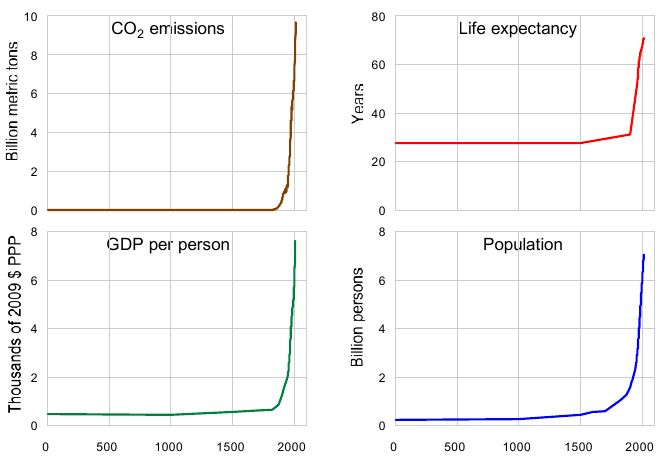
Anyone Who Hates Fossil Fuels Is Anti-Human

aaa1Sources: Boden, Marland, Andres (2010); Bolt and van Zanden (2013); World Bank, World Development Indicators (WDI) Online Data, April 2014

Election 2015: How Bad Is the NDP?

In this series CMR will examine the policy proposals set forth by the top three parties in Canada’s 2015 federal election.

PART I: The NDP (current article)
PART II: The Liberals
PART III: The Conservatives

Obviously these parties are all terrible. So the question is simply this: which party will beat you with the biggest stick?

We will refer to the helpful National Post article “Everything you need to know about the parties’ platforms, from taxes to terrorism to the environment.”

In Part I, we will look at the NDP.

We know all the platforms are going to be bad, but intuitively any free market supporter will expect this one to be the worst. We shall see.

Economy

– Balance the budget in 2016.

This is meaningless unless we know how they will balance the budget. Cut spending? This would be good, but unlikely. Raise revenue by increasing taxation, fees, and other forms of plunder? This would be bad. Since it’s the NDP, we can safely assume the latter is more likely.

– Not raise personal income-tax rates.

Well that’s ‘nice’, but a personal income tax cut be better. Still, it’s a pleasant surprise that they don’t want to hike taxes on “the rich.”

– Cancel government’s income-splitting policy for families; says it helps only wealthiest 15 per cent.

This would increase the tax burden on any family to which it applies, and is therefore bad. That it applies mostly to the “wealthiest” is true depending on how you define “wealthy,” but it also applies only to those who have someone with whom they can split their income. So it is rather selective and narrow in its tax relief. This is an interesting matter on its own, and of course tax relief for everyone would be better. But regardless of the fairness issue, added tax relief for some is better than added tax relief for none.

– Reverse changes to TFSA contribution limits; says higher amount helps the wealthy and does little for middle-class Canadians.

The TFSA is one of the only good things the Harper Conservatives have ever done. Reducing the contribution limits means more taxable income and therefore this is an evil NDP policy.

– Increase income-tax rates on Canada’s largest corporations to about the levels that existed before the Conservatives took office.

After the income tax, the corporate tax is probably the dumbest tax possible. It should be eliminated, not raised. Shareholders own corporations. Shareholders are paying the tax. The NDP wants to increase taxes on shareholders of Canada’s largest corporations. Due to the way many people and pension plans invest, this applies to a huge portion of Canadians.

– Cut small-business tax rate to nine per cent from current 11 per cent.

Tax cuts are good. But let’s be serious here: going from 11 to 9 percent is extremely ungenerous. Why don’t they just say “no more corporate income tax on small businesses”? That would significantly change economic behavior and the economy would get a large boost of productivity and job growth.

This NDP proposal reveals a certain cluelessness about how the business world works, which is unsurprising when it comes to the NDP. Most small businesses (less than $500,000 income) having earnings less than $100,000 per year. Most have less than $100,000 in revenues each year. This tax cut amounts to peanuts for a lot of businesses and will rarely make or break hiring decisions.

Furthermore, accountants prepare tax returns with the objective of minimizing the tax of the corporation. Most small businesses companies are “flow-through entities”, meaning it is well understood by tax professionals and the tax collectors that the corporation will minimize its tax, and earnings will “flow through” to the private owner, who is taxed for personal income. So the businesses targeted by this tax cut don’t pay much tax anyway and it really wouldn’t make a whole lot of difference.

But a tax cut is a tax cut, so this is actually good.

– Honour the expanded Universal Child Care Benefit.

This benefit is a mixed bag. For families that are net taxpayers, it amounts to a reduction of tax burden and is therefore good. For families that are net taxconsumers, it amounts to a form of welfare where people with no children are forced to subsidize people with children. This is unfair.

– Create $15-a-day national child care program, and create or maintain one million affordable child care spaces across Canada.

This is really bad. This is a huge tax on people with no children and a huge subsidy to people with children. That is unfair. It is also a huge boon to the the crony capitalists of the child care industry.

A better way to deal with the high prices of child care services would be to remove all associated regulations, licensing, and taxation. Quality and supply of child care would soar.

And what exactly should this national child care program consist of? Because it’s a government program, this will be decided by those with the most political influence — and that will never be the average parent.

– Cancel Conservative decision to increase OAS eligibility age to 67.

Evaluating this is a little more complicated than most proposals. On the one hand, OAS is welfare for old folks. This involves subsidizing old folks (who tend to have more accumulated wealth) by taxing younger people (who tend to have less accumulated wealth). Taking money from poorer people and giving it to wealthier people is a weird policy. On the other hand, old folks who are/were net taxpayers deserve to get all their money back, so the OAS could be considered on the same terms as taking a tax credit. Overall, the OAS is bad and should just be eliminated, and with that in mind increasing the age limit is probably better because the best result would be increasing the age limit to 1000 so no one could get it.

– Increase Canada Pension Plan contributions and benefits for Canadians.

The NDP makes these increased contributions sound compulsory, so that is bad. People should be able to opt out of CPP if they want.

Terrorism, War, and National Security

– End the bombing campaign and pull out all military personnel from Iraq and Syria; boost humanitarian aid to help refugees affected by ISIL as well as investigate and prosecute war crimes.

This is mostly good, as Canada’s role in the war against the Islamic State / ISIL / ISIS should end at immediately. No bombs, no troops, no military support for other countries participating in the conflict. It is a regional conflict between bitter enemies and all outside intervention is merely aggrandizing the situation. ISIS is no threat to our national security. It is certainly no “existential threat” as Harper says, and it is just delusional paranoia to think otherwise. ISIS is a small ragtag army with a few hardcore jihadi veterans and the rest is a bunch of losers. They have no navy, no air force, and they probably can’t even fix their sweet new Toyotas if they break down. This isn’t Nazi Germany or Soviet Russia, people.

However, the federal government should not provide humanitarian aid or help refugees or prosecute war crimes in other countries. It should not prevent Canadians from aiding in any way they see fit, whether that means letting refugees into their homes, sending aid overseas, or traveling to conflict zones to help directly. The government has no business bringing foreigners into the country and giving them welfare.

– Repeal Bill C-51, the anti-terrorism act.

This is a good policy. Bill C-51 is a dangerous law representing an aggressive attack on free speech, habeas corpus, privacy, and other features of the rule of law and civil liberties. All in the name of “security”, of course. It is premised on the bogus “War on Terror” so that automatically makes it awful. Realistically, the government doesn’t need more laws to catch bad guys, and C-51 just removes restrictions that make it harder for the government to punish innocent people.

– Provide more independent review of Canada’s national security agencies.

Independent review is meaningless, because anything in which the government is involved is political. The only way to limit the power of national security agencies is to cut their budgets or simply eliminate them. These proposals about having “better oversight” are useless.

– Support a counter-radicalization program.

I have been unable to find any clarity about that this means, but it is probably something stupid. Does it mean the government interfering with certain religious institutions, or institutions with unsavory political views, or crazy websites?

Actually, it probably involves more welfare to certain people, because there is a silly leftist-liberal notion that if you give people enough money and help from the government they won’t want to become terrorists.

Despite lack of details, it seems impossible that this policy wouldn’t be dumb,

The Environment

– Continue opposing the Northern Gateway pipeline; it initially supported concept of west-east pipeline, but says Energy East can’t be approved without more stringent environmental review process; opposes Keystone XL pipeline.

Why does the NDP have to be so full of jerks? The Northern Gateway pipeline issue can be settled entirely between BC and Alberta — you know, the provinces actually touched by the pipeline route. There is no reason for Ottawa to have a say in the process at all.

Likewise for Energy East. The route touches six provinces and it can be sorted out between those provinces. There is no justification for Ottawa to impose more stringent environmental regulations when the provinces affected can handle that themselves.

One might contend that the Keystone XL pipeline is different because it goes to another country, but international borders are economically arbitrary and there is no justification for Ottawa to interfere here either. The Keystone XL pipeline really has nothing to do with Ottawa at all. It’s Alberta’s oil and the route only touches Alberta and a handful of American states. It should be an issue settled between Albertan and American property owners and the pipeline company.

Ottawa has no business either supporting or opposing any of these pipeline projects. The right choice is simply to decentralize the whole issue. The NDP is terrible on this issue.

– Create a cap-and-trade system with a market price on carbon emissions; revenue from cap-and-trade would be invested in a greener energy sector in regions where dollars are generated.

Horrible. Tax industries the NDP doesn’t like and subsidize politically-connected cronies in industries that the NDP does like. It would encourage people to shift resources out of productive sectors that are being taxed into nonproductive sectors that are being subsidized. This is one of the NDP’s worst policies so far.

– Work with provinces to create a new fund to help Canadians retrofit their homes and offices to save energy and money.

This is a subsidy to people who own homes and office buildings, which tend to be wealthier people. This would be paid for by people who don’t own homes or office buildings. This is a pathetic transfer of wealth from poorer people to wealthier people. Stupid and evil.

– Redirect $1 billion a year from fossil fuel subsidies to investment in the clean energy sector.

The government should not subsidize fossil fuels and it should not subsidize the clean energy sector. The government should simply eliminate the subsidies and let different forms of energy production be determined on their own merits.

– Invest in Sustainable Development Technology Canada – including wind, hydro, solar and geothermal technologies – to create thousands of new jobs for Canadians.

This is truly awful. What does “invest in Sustainable Development Technology Canada” mean? It means subsidizing what the government considers be worthy, so crony capitalism.

And here is a critical point: this doesn’t create jobs! The government has no resources of its own. To spend money to generate jobs in one sector, the government must take money from another sector, thus destroying jobs. This policy would actually leave the country poorer, giving us fewer real productive jobs, and more unproductive jobs. Again, this would encourage people to shift resources out of productive sectors that are being taxed into nonproductive sectors that are being subsidized. Just awful.

Infrastructure and Transport

– Dedicate an additional one cent of the existing 10-cents-per-litre federal gas tax to roads, bridges and other core infrastructure, reaching an additional $1.5-billion annually by the end of an NDP government’s first mandate, on top of almost $2.2 billion in existing annual gas tax transfers to municipalities.

This is a slight improvement all in all. It is better for the province to keep a bit of the money rather than having it all go to Ottawa. If the NDP were serious about their desire to help communities fix their infrastructure, they would just eliminate the federal gas tax completely and have that money stay in those communities. There is no reason why drivers in Nova Scotia should subsidize bridges in British Columbia or vice versa.

– Develop a better transit plan with the provinces and territories and invest $1.3 billion annually over next 20 years for predictable and stable public transit funding for municipalities.

A subsidy to public transit, which only benefits places with public transit. Why should people in rural Saskatchewan subsidize Toronto’s subway system, with Ottawa taking a big cut? Only a real jerk would support this.

Foreign Affairs and Defense

– Increase Canada’s foreign aid to 0.7 per cent of gross national income, or GNI (Canada currently spends 0.24 per cent of GNI on foreign aid).

Foreign aid? FOREIGN AID!? This tends to be the most unpopular form of government spending across the political spectrum, and the NDP wants to increase it? Nay, nearly triple it! Let’s not forget that foreign aid takes money from people in this country, and gives it to corrupt foreign governments that use the money to enrich themselves and their friends. Maybe the lowly people who need help will get a few pennies on the dollar, if they’re lucky. Also, foreign aid frequently comes with the stipulation it be spent on Canadian products, which amounts to a roundabout subsidy to certain politically favored big business.

This proposal is unbelievably stupid. The NDP should be embarrassed over how stupid this policy is.

– Reopen the nine Veterans Affairs regional offices closed by the Conservative government.

The Cons merely shifted resources around. It’s six of one thing or half a dozen of another. This is a non-issue. Veteran Affairs Canada should just be closed down completely, and veterans should automatically be exempt from all forms of taxation.

Social Issues

– Restore the six-per-cent annual increase to health-care transfers to the provinces.

The health care budget should be reduced every year, so this is a step in the wrong direction.

– Restore door-to-door home mail delivery by Canada Post for households that lost it under Conservative government.

This is a social issue? But no, the government should not decide how mail should be delivered. Canada Post should be privatized, all legal restrictions for private mail carriers should be eliminated, and the market should decide how mail will be delivered.

– Reinstate the mandatory long-form census, which the government replaced with the voluntary National Household Survey.

In other words, the government should force people to waste their time providing information that helps the government control their lives better — at gunpoint, if necessary. The long-form census is a disgrace to humanity and should never be reinstated. The short-form census should be completely voluntary.

Democratic Reform and Governance

– Replace the current first-past-the-post electoral system with a mixed member proportional system, which combines proportional representation of parties in House of Commons with direct election of MP in each riding.

Pointless fiddling with the broken system called democracy, and arguably this makes things worse by rewarding more populous provinces with more political influences.

– Abolish the Senate (which requires constitutional talks with the provinces).

Sure, everyone wants to abolish the Senate (except the senators). I don’t think this is a serious proposal, however.

– Strengthen the mandate and independence of the Parliamentary Budget Officer and make the position an Officer of Parliament.

This is pointless and no one cares.

Justice

– Immediately decriminalize marijuana, where users aren’t criminally prosecuted so nobody goes to jail for smoking a joint; party is open to considering legalization, but is calling for a commission to consult Canadians and instruct Parliament on how to carefully regulate non-medical use.

Decriminalizing drug use is an improvement, but it preserves the black market and seemingly all laws about selling drugs. The war on drugs is a stupid failure and there is no reason to continue it.

Setting up a commission is a waste of time that will produce a giant report that no one will ever read. Marijuana should just be legalized without a fuss, along with every other drug, and no regulation or taxation at all.

– Introduce legislation demanding Supreme Court of Canada justices be bilingual.

Bilingualism is a bad government policy and this is a dumb proposal. Basically they are saying all the Supreme Court of Canada justices should be from Eastern Canada.

– Strengthen laws to keep drunk drivers off of streets.

They actually don’t need to strengthen any laws or create any new laws for this. They just need to enforce laws about injuring people or killing people or destroying property. As any drunk driving lawyer will tell you, the current system entails a perverse situation where the best way to kill someone and get a light punishment is to get drunk and hit them with your car.  Therefore, this is a bad proposal.

Aboriginal Issues

– Call a national inquiry into murdered and missing aboriginal women, and act on other recommendations from the Truth and Reconciliation Commission.

The high rate of homicide against Aboriginal women is awful (4.5x higher than other Canadian women), but a national inquiry doesn’t help the situation at all. It’s just a big waste of time and money.

Crimes should be investigated and evildoers should be prosecuted and punished. That’s it. The problem is that the RCMP apparently does a lousy job investigating crimes. What else is new? A national inquiry into the “social context”of murdered Aboriginal women doesn’t help that situation at all, because the RCMP is inherently inefficient.

If you really want “social context” regarding Aboriginal women and homicide, consider this: the government has done incredible damage to the indigenous people of Canada with its bureaucratic, Soviet-style rulership of this political sub-class. Aboriginals are subject to the most socialistic treatment of any Canadians, and unsurprisingly the consequences have been social dysfunction. We actually saw the same pattern in Soviet Russia. When you deny people their most basic, fundamental rights to property and make the state in charge of taking care of them, the result tends to be greater levels of dysfunction such as alcoholism and drug abuse, vagrancy, idleness, illegitimacy, promiscuity, criminal behavior, suicide, and wife-murdering or girlfriend-murdering. Maybe if the government gave some respect to aboriginal property rights their situation would start to turn around. Instead, it is content to maintain the status quo where the Crown owns all native land, and it is administered through a huge, inept bureaucracy and Soviet-like band councils.

– Reduce poverty, improve educational outcomes and increase opportunities for First Nations, Inuit and Métis communities across Canada.

If the NDP really wanted to do this they would abolish the Department of Aboriginal Affairs and Northern Development. We know they aren’t going to do that. Instead, this implies spending more money on a failed system and hurting First Nations, Inuit, and Métis even more. Hasn’t the government done enough to these people? Why does the NDP hate them so much?

– Create a cabinet committee, chaired by the prime minister, to ensure federal government decisions respect treaty rights and Canada’s international obligations.

No. Just… no. Abolish Aboriginal Affairs and Northern Development.  Let aboriginals actually own their land and homestead land currently owned by the Canadian state. Recognize the property rights of aboriginals. Anything else is a waste of time.

One can only infer that the NDP hates the aboriginal people of Canada.

Conclusion

The NDP platform is mostly full of dreadful policies that will make Canada worse. However, to their credit, they have a few policies that are relatively good.

Overal score:

D-

Next time: CMR will look at the Liberal Party’s platform. 

Which Science Can We Trust?

Since the science of global warming is a sham, it makes you wonder what other scientific shams are out there making our lives worse.

For 50 years, we’ve been told that fats are bad and you will get fat if you eat fat and you will die.

Well, maybe that’s not actually true.

The saturated fats found in meat and dairy produce are not as bad for health as previously believed, a study has found. However, the scientists who conducted the research have warned against reaching for the butter dish.

A major study into the health implications of dietary fats has failed to find a link between food containing saturated fats, such as eggs, chocolate and cream, and an increased risk of dying from heart disease, stroke or type-2 diabetes.

The study nevertheless did find that industrially-produced “trans-fats” made from hydrogenated oils, and once used in margarine, snack foods and packaged baked foods such as some cakes and crisps, are linked with a greater risk of death from coronary heart disease.

The latest findings, published in the British Medical Journal, appear to confirm the growing realisation that the prevailing health advice for the past half century to cut down on foods that are rich in saturated fats such as butter and cheese may have been misguided.

Oops. Yet another example of arrogant scientists being so sure they were right, then it turns out they were wrong.

Scary NDP Climate Change Survey Reveals Their Desired Policies

Members of Notley’s NDP government are global warming radicals. Remember that the global warming movement is not actually about science and global warming, which is why global warming fanatics disregard the mountain of evidence that refutes them. Global warming activists slavishly cling to junk science because they yearn for power where lawmakers, bureaucrats, and crony capitalists who favor socialism can gain control over the economy.

With that in mind, the government has released a fake survey regarding Alberta’s policies on climate change. It is fake because they really don’t care what anyone thinks. It’s like “you can choose any color you like as long as it’s red.”

(By the way, you don’t need to be an Albertan to take the survey.)

Basically, it is a rather unfair survey. It doesn’t really give you the option to reject all the proposals. Sure, it asks you whether you support more “government action” on climate change, but after that you only get loaded questions and the option to rank various dumb policies from most awesome to least awesome. So obviously the plan is to disregard any opinion where the respondent says they want no further government action on climate change, and just tally up results the rest of the survey and say “Such and such are the policies Albertans support the most!”

First it asks you whether you are worried about climate change. Well, despite all the chatter about it, no one really seems to be all that concerned about climate change to be honest. They care about it less and less with each year, and it’s at the bottom of their list when it comes to environmental issues.

global warming gallup poll

worriedagreatdeal

From there, each section starts with a preamble of deceptive, shallow propaganda. A large section of deception precedes the bulk of the survey:

The world’s climate has changed at an unprecedented rate since the 1950s. Increasing concentration of greenhouse gases have warmed the atmosphere, diminishing snow and ice, warming oceans, raising sea levels, and causing more extreme weather, such as floods and droughts. We can also see its effects locally through impacts such as the spread of the mountain pine beetle.

Scientific evidence tells us that – without significant action on a global scale – the consequences of climate change will be severe.

Even if all of this were true (it isn’t; global warming exists only in the minds of charlatans and cranks), it doesn’t follow that we can or should use the government to do anything about it. So the survey basically starts off with a big non sequitur and by lying to the respondent .

Then comes the craziness:

In advance of the conference, the Government of Canada has proposed a commitment to reduce greenhouse gas emissions to 30 per cent below 2005 levels by 2030. While Alberta’s energy-based economy helps fuel economic growth across Canada, we also account for approximately 37 per cent of Canada’s total emissions. The reputational impact of Canada’s action on climate change is likely to fall heavily on our province, which has already drawn domestic and international criticism.

This is really awful. The NDP is telling us that we should ravage the economy for the sake of our reputation among contemptuous and ignorant people — within and without Canada — who might not like us because we burn a lot of fossil fuels while we recover even more fossil fuels, supporting humanity with cheap energy which makes the modern world’s economy possible at all. At the same time, some people seeking power in the next federal election want to prevent Alberta from mining tar sands and burning fossil fuels in the process.

Slight detour: Regardless of any commitment Ottawa makes, there is no real constitutional authority for the federal government to interfere with a province’s resource development. The 1982 Amendments to the Constitution Act explicitly state the that the provinces have exclusive jurisdiction over their non-renewable natural resources. Of course, as always with these matters, there are some loopholes. The federal government has jurisdiction over  “local Works and Undertakings declared by the Parliament of Canada to be for the Advantage of two or more of the Provinces.” That’s a problem. Plus, we had the National Energy Program regardless of any constitutional division of powers. So the Constitution Act doesn’t seem to be worth a damn. On the other hand, provincial governments have the constitutional right to do anything they want regarding the resources in their territories.

But anyway…

Then the propaganda tries to make us care about another climate change conference and fairy tale treaties:

In December 2015, the United Nations is hosting the Conference of Parties in Paris. The desired outcome is to create a binding treaty that will commit all nations to significantly reduce their greenhouse gas emissions.

This is completely Irrelevant. These treaties never go anywhere. No one cares about them. There are no sanctions. The governments of the world never bothered to implement the Kyoto treaty of 1992 or its update in 1997. It lapsed on with the end of 2012. Game over. No one cares.

Then comes this nonsense:

Alberta’s energy economy depends on its ability to reach – and sell – our resources in markets throughout North America and around the world. These markets are increasingly demanding cleaner forms of energy. If we don’t take action on climate change locally, Alberta will find itself increasingly isolated and shut out of markets.

This is just wrong and sneakily misleading. When it comes to the environmental issue, opposition to the pipeline infrastructure stems from people, rightly or wrongly, being afraid of toxic substances flowing through the country in pipelines with the potential to leak out or spill and poison everything around them and kill everybody. It has nothing to do with climate change! Alberta can implement all the climate change policies it wants, but people will still have rational and irrational concerns about pipelines. Alberta’s efforts to access new markets for its products will not at all be helped by its abusive government’s bigger, badder climate change policies.

From there, the various agree/disagree questions reveal all the dream policies of the NDP. Question #14 is where it becomes obvious that they don’t care about your opinion. These are the things the NDP wants and it’s going to do them.

Now, thinking about the options discussed above, please rank them by priority with the highest being the action you would most like to see taken. Drag the choices into your preferred order, or use the arrow buttons to move the options up or down.

choices

So it asks you to rank a bunch of terrible policies that all belong in the “evil and uneconomical” category: an exploitative interprovincial cap n’ trade system, increasing taxes on industrial companies that burn fossil fuels, increasing subsidies to companies with political connections, increasing taxes on everyone, and subsidizing middle and upper class people who own buildings and houses.

You’ll notice it fails to include the option of “no further government intervention, thanks.”

Then in goes on to ask whether you support more horrible policies, including:

  • Redistributing money to favored municipalities and spending more money on government institutions for “retrofits”
  • Subsidizing homeowners (which tend to be middle or upper class people) with ‘incentives’ and grants (theoretically, incentives could include reducing taxes and regulations on more energy efficient technology — but who are we kidding? This is the NDP).
  • Subsidizing and protecting politically favored renewable energy producers.
  • Literally killing (or “phasing out,” as the NDP likes to say) an industry that some people don’t like. Don’t you love when the government decides who will be in business and who won’t be?

This is all quite terrifying. This tells us what the NDP wants. They just want to beat us over the head with fake survey results in a pathetic attempt to justify their destructive policies.

If you want bureaucratic control over the economy, inefficiency, unemployment, and impoverishment, you should support the NDP’s climate change policy.

If you want to subsidize India and China, where they don’t care about the bureaucratic rules and regulatory systems in Alberta, then you should support the NDP’s climate change policies.

If you want to get less energy and pay more for everything, then support the NDP’s climate policies.

If you are a good person, you should oppose them.

Mises on Social Justice Warriors

Ludwig von Mises had the social justice warriors nailed 50+ years before they became a thing.

This search for a scapegoat is an attitude of people living under the social order which treats everybody according to his contribution to the well-being of his fellow men and where thus everybody is the founder of his own fortune. In such a society each member whose ambitions have not been fully satisfied resents the fortune of all those who succeeded better. The fool releases these feelings in slander and defamation. The more sophisticated do not indulge in personal calumny. They sublimate their hatred into a philosophy, the philosophy of anti-capitalism, in order to render inaudible the inner voice that tells them that their failure is entirely their own fault. Their fanaticism in defending their critique of capitalism is precisely due to the fact that they are fighting their own awareness of its falsity.

“The suffering from frustrated ambition is peculiar to people living in a society of equality under the law. It is not caused by equality under the law, but by the fact that in a society of equality under the law the inequality of men with regard to intellectual abilities, will power and application becomes visible. The gulf between what a man is and achieves and what he thinks of his own abilities and achievements is pitilessly revealed. Daydreams of a ‘fair’ world which would treat him according to his “real worth” are the refuge of all those plagued by a lack of self-knowledge.

The Anti-Capitalist Mentality, pp.14-15

NDP’s Royalty Review Czar Dave Mowat Is a Climate Change Propagandist Trained by Al Gore

I knew I smelled a rat when Notley’s NDP chose ATB President and CEO Dave Mowat to head the royalty review board.

In a process that will surely revolve around “fairness” and other uneconomic nonsense, why would the NDP pick a banker of all things to head the review?

Well, now we know.

mowatandgore

algorelies

http://www.canada.com/edmontonjournal/story.html?id=5371ac3d-3b2d-4825-a158-45fd0c3978bb&k=18066

Hmm, do you think his thinking might be a bit clouded by Algore’s lies?

Al Gore’s documentary is one of the most deceitful pieces of trash ever created. Rather than provide a thorough critique, it is sufficient to show this:

al_gore_graph

The x-axis there is supposed to be time. How does the data go backwards in time? That doesn’t make any sense!

I know Algore created the internet with his bare hands and all that, but did he invent a way to break the laws of space-time too? This is total nonsense — climate change propaganda at its worst.

Can Dave Mowat explain this magical graph? Was that part of his propaganda training with Algore?

Heck, the famous Algore graph shows CO2 increases preceding the temperature rise. You fail automatically at science if you observe that A precedes B and therefore conclude that B causes A.

Algore is a shameless liar and anyone trained to spread his lies should not be running a royalty review for Alberta’s oil industry.

It’s seems fair enough to say that Dave Mowat is biased. So he is the perfect guy to push the NDP’s agenda.

Market Lemmings Case Study: Tourmaline Oil Corp.

The fall in oil prices is starting to expose some of the waste in the energy sector, but this central bank fueled bubble is still rife with clusters of error.

The ‘boom’ phase of the business cycle — more accurately described as the malinvestment phase — is where a lot of things just stop making sense. People will shovel money into wasteful investments based on distorted credit conditions and hyped up expectations.

Today our case study is Tourmaline Oil Corp., a favorite in the independent energy growth company category. With a 52-week high of $58.73, the consensus analyst rating is “buy” while presently trading around $39 at 18x earnings. It recently issued $168 million in new shares (at $39.50/share).

CMR analyst Daniel Plainview shows why Tourmaline is an economic black hole relying on the “greater fool.” Regardless of whatever distortions manifest in the stock market, Tourmaline is its present form is a zombie company — not an investment, but just one of many ways to gamble in the stock market casino.

A Question for Tourmaline Oil Corp.: How Do You Make Money?

By Daniel Plainview

When trying to determine the proper price of a stock the conventional rule of thumb is to predict the amount of money that stock is going to make each year over the long term, and then discount those earnings to the present at an appropriate rate for the risk you are taking.

The inverse of this, but it is in essence the exact same methodology, is to use a Price to Earnings ratio to evaluate a stock. The higher the ratio, the more expensive the stock; the lower the ratio, the more likely you are getting a good deal, so long as the future earnings hold up.

But what if the stock you are looking at is in an industry that typically doesn’t make any money?  I’m referring to industries where the company earnings are often affected, to a large degree, by depletion expenses.

Depletion is a non-cash charge and it can ensure that a company generates plenty of cash flow but renders the conventional Price to Earnings analysis moot. Industries with high DD&A (Depletion, Depreciation & Amortization) are generally involved in resource extraction.

Because earnings are essentially meaningless for a lot of resource companies (not to mention the other accounting tricks that can affect earnings) it’s always a good idea to look at a company’s cash flows.  There are three types of cash flows:

  1. Cash flows from operations
  2. Cash flows from investing
  3. Cash flow from financing

While in any given period the cash flows in any of these buckets can be either positive or negative, over the medium to longer term (2+ years) one invariably wants to see that cash flow from operations is positive, cash flows from investing is slightly negative, and cash flows from financing is also negative; with the change in cash position from period to period being immaterial.

What a positive/negative/negative cash flow segmentation is indicative of is 1) the company is making money, 2) that it is reinvesting in the business to grow the business, and 3) it is able to return capital to the shareholder, or at least doesn’t steadily require new financing to fund its investments.

It is with this in mind that we now consider the Canadian oil and gas industry.

Recently the commodity prices that drive the cash flow from operations that Exploration and Production (E&P) companies generate took a tumble.  Both oil and gas prices fell by ~50% from their levels in the first half of 2014.

By itself a single year of lousy prices shouldn’t erode as much value in the markets as what occurred, but what changed is the market is now more pessimistic about prices for all future periods too.

Companies have responded by scaling back their investing, and cutting capital expenditures for the drilling of new wells and building of new facilities.

Generally speaking, oil and gas companies always have to be spending some money on new production in order to maintain overall production levels.  Well performance declines over time, and by how much depends a lot on the geology of the particular “play”.

A really good well might only decline at ~20% per year, but it still declines.  Newer unconventional extraction methods (drilling horizontal multi-stage frac wells into shales) can come down a lot faster: ~50% per year.

So ultimately the goal of any oil and gas company, in any environment, is to have enough cash flow from operations that it can pay for all the cash flow from investing (capital expenditures needed to keep production up), and still have enough left over to pay the shareholder.

Enter Tourmaline Oil: the oil company that has 85% of their production coming from natural gas.  Etymology aside, there are more serious issues with this company’s business model.

In their last earnings announcement in March, they happily proclaimed their 76% growth in cash flow. Sounds good… but wait! There is a footnote: “Cash flow is defined as cash provided by operations before changes in non-cash operating working capital.” So what about capital expenditures?

Here is a chart of Tourmaline’s cash flows, going back to 2009:

tourmaline

The cash flow from operations is in green, and the company’s capital expenditures (only a sub-set of cash flow from investing) are in red.  The black line represents the cumulative amount of cash flow from operations minus capital expenditures (or Free Cash Flow) up to each period.

What this shows is that Tourmaline has spent almost $4.7 billion more on drilling holes in the ground, than it has made from the hydrocarbons those holes have produced, since 2009.  Furthermore, over 25 quarters of results, they have never made more money than they spent: Free Cash Flow has never been positive.

In the company’s defense, they have grown production at an industry-leading rate.  But it really looks like they’re spending a dollar to make fifty cents, and making up for it on volume.

It has gotten to the point where if the company stopped spending money, but continued to earn cash flow from operations (and let us assume the same prices and only a 20% production annual decline), they could not make that money back.  In actuality Tourmaline’s wells probably decline a lot harder than 20%, but the story is bad enough as it is.

These harsh realities force us to ask the question: where did the company get $4.7 billion?  The answer is that they got it from new investors who bought shares in secondary offerings, and some money from raising debt.  It looks as though this external funding process will have to continue ad infinitum; another secondary offering being announced just recently for $168 million.

And investors should keep this in mind: the only reason Tourmaline is able to grow production on a per share basis is because the shares have a decent valuation, but the only reason the shares manage to eke out a decent valuation is because they are able to grow production on a per share basis.  If the shares were to fall enough in price, the amount of dilution created by external financing would make it impossible for the company to grow.

And the last point to make about the company: the management team in prior iterations at Berkeley and at Duvernay were able to successfully build up and then sell the company to a bigger fish.  Duvernay in particular made a lot of people a lot of money as it was sold at the height of the commodity boom in 2008 and Shell paid an unmatched valuation in the transaction (~27x EBITDA).

In fact, the only way Tourmaline’s business model makes any sense is with an M&A exit strategy: ramp up production at any price, and find a sucker to buy it just before the house of cards collapses.

But if investors are assuming Tourmaline will be similarly sold I would only point out that Tourmaline is now worth about $9.2 billion and is the 8th largest E&P company by market capitalization in Canada.  It’s getting to be too big for others to swallow, and suckers like Shell might be hard to find this time around.

Then again, they did just find another 4.25 million suckers…

(Click here for supporting calculations.)

Alberta’s NDP, Unions, and the Minimum Wage

When analyzing public policy, one must typically ignore stated goals and understand the economic incentives that make groups favor certain forms of economic intervention.

Unions, as a group, tend to favor market restrictions that prop up their higher wage rates.

Alberta’s NDP, led by Rachel Notley, favors unions.

evilnotley

This an important factor in the NDP arguing for a 50% increase to Alberta’s minimum wage, despite protests from the business community and anyone with an understanding of basic economic law. NDP goal to hike minimum wage has nothing to do with helping less productive workers make more income, regardless of what their stated objectives are.

Minimum wage laws are a classic form of monopolistic grants of privilege that benefit some groups at the expense of others. Despite the proclaimed objective of minimum wage laws, which is to increase incomes of the most marginal workers, the actual effect is the exact opposite — it makes them unemployable because they are not sufficiently productive to be employed at the legal wage rates. This means that minimum wages will always cause more unemployment than otherwise — any economist who denies this is either a liar or a fool who doesn’t even understand the basic principles of price controls.

Who benefits from such laws? Certainly not the marginal workers, for it becomes illegal to hire them at the wage justified by their productivity. On the other hand, anyone employed above the minimum wage benefits because their competition is reduced. In particular, unions benefit from minimum wage laws. Unions despise cheaper labor competition. Minimum wage laws remove competition of less productive workers by forcing them to be unemployed.

And there is another reason why unions love minimum wage hikes — it is a devious way to increase their own wages. This can work in many ways depending on the labor agreement. Some agreements trigger mandatory wage hikes when statutory minimum wages increase (because wages are based on a percentage above minimum wage). Others have provisions to open wage negotiations if minimum wages go up.

I am not making this up. Economic theory informs us that we should expect nothing less. But consider also a 2004 study in the Journal of Human Resources by economists William Wascher, Mark Schweitzer and David Neumark. They clearly showed that lower-wage union workers usually see a boost in employment and earned income following a mandated wage hike. And those non-union wage workers who are now unemployed or unemployable? Who cares! The union members already have higher wages and protected jobs. So what if this cruel policy leaves in its wake desperate workers who can no longer legally work?

As for the NDP, there should be no doubt that Premier Rachel Notley is a union hack. Most of her career has been in the service of unions. Consider a few facts from her personal history:

She is married to Lou Arab, a communications and public relations staffer for the Canadian Union of Public Employees[2] and a campaign strategist for the party. She lives with him and their two children in the historic district of Old Strathcona located in south-central Edmonton.[17]

After law school, Notley articled for Edmonton labour lawyer Bob Blakely, and went on to work for the Alberta Union of Provincial Employees representing members with Workers’ Compensation cases.

She worked for a short time for the National Union of Public and General Employees (NUPGE),[20] worked at Athabasca University,[21] acted as volunteer co-ordinator for the Friends of Medicare “Romanow Now” campaign, and finally as a labour relations officer for the United Nurses of Alberta.[1]

Can there be any doubt that Notley will seek to benefit her union friends at the expense of other groups in society? Of course not.

Rachel Notley and the NDP are looking to empower unions. They don’t care if they hurt society’s least productive workers, like teenagers, people with disabilities, workers with language barriers, anyone without much experience for any reason, and ethnic or racial groups that may face discrimination.

Some will argue that forcing minimum wages higher makes employers invest in more equipment and develop new technology and this will increase productivity of labor. Therefore, this improves the economy. But this is a silly argument. Capitalists are always seeking ways to increase productivity, so to think they are just sitting around waiting for the government to force price floors on labor to do so is a joke.

But even assuming the employer doesn’t just reduce his quantity of labor demanded, his investment in new capital is limited by savings in the economy. Increasing minimum wage does not increase the total supply of capital available. If anything, capital will merely be shifted from some industries to others in an attempt to offset an artificially higher cost. Capital is not being reallocated because of a market requirement, and so this is not an economic improvement.

Don’t be fooled by anyone who says they want to increase the minimum wage to help the poorest workers. The main concern motivating the NDP to increase the minimum wage is helping unions.

Anyone advocating a higher minimum wage should be ridiculed and shamed out of public office on account of sheer ignorance.