Alberta Floods 2013: RCMP Invades High River Homes, Seizes Guns

The RCMP is acting like an occupying army in High River.

RCMP officers working in High River, Alta., on June 25, wear protective masks to prevent toxic dust from entering their lungs. The RCMP took some guns from homes they searched that they said were not stored safely and the Prime Minister's Office issued a statement Friday saying it wants them returned.

Governments invariably use emergencies to extend their powers and subject the citizenry to greater abuse. Natural disasters are no exception.

High River was devastated by the flood. The entire town was evacuated.

It has been eight days since residents were forced from their home. As the waters recede, people want to return home and see the status of their property.

“No way,” says the RCMP.

High River is effectively under a state of martial law so intense the citizens cannot even enter the town at all. The RCMP set up a roadblock with 30 officers to prevent residents from entering. Dozens of police cars with flashing lights lined the streets menacingly. A spike strip was deployed to cripple the vehicle of any outlaw who dared to enter the town.

But it is not enough for the RCMP to use threats of violence to keep out residents. Some High River residents have firearms in their home, you see. So those homes had to be invaded, and the firearms had to be confiscated.

“People have a significant amount of money invested in firearms … so we put them in a place that we control and that they’re safe,” said one RCMP sergeant.

Oh. They are taking guns to do those owners a favor. See? No problem.

“It’s like Nazi Germany,” says a resident. Yes, it is sort of like that. It’s also sort of like New Orleans and Hurricane Katrina. FEMA confiscated civilian firearms during that disaster in the name of “safety.” That’s the real template for what’s going on here.

This kind of behavior by the RCMP was entirely predictable because of the lessons of Katrina. Memories of the scandals surrounding FEMA’s gross incompetence during Hurricane Katrina’s aftermath informed us how big, bureaucratic government agencies with police powers behave during emergencies. The RCMP is not particularly less malevolent just because they have funny uniforms.

Based on their actions, every level of government involved in the Alberta floods seems desperate to be as incompetent and harmful as FEMA.

The RCMP says they will return the guns to owners “after residents are allowed back in town and they provide proof of ownership.” Something tells me the occupying forces will make it difficult for the gun owners to provide such proof. “Oh, your proof of ownership was destroyed in the flood? That’s a real shame. No gun for you.”

Lorraine Hjalte / Postmedia News

Premier Redford defended the actions of the RCMP. “I really hope that we can focus on more important matters at hand, like getting 12,000 people back into High River than continue to circulate this story,” she said. She seems to overlook that the government has utterly failed in High River. The more they focus on getting High River residents back to their homes, the longer it is likely to take.

When will residents be able to return home? The RCMP tells us: “People much higher up are going to make those decisions.” That sounds efficient. The mayor of High River says no one can return home until Home Hardware and Shoppers Drug Mart are  open. 

In a rare moment of sanity, the Prime Minister’s Office said the RCMP should return the guns. By this I think they mean, “Make it possible in theory for the owners to get the guns back.” Since the Minister of Public Safety is in charge of the RCMP, the Prime Minister can essentially just order the RCMP to return the guns immediately. Yet this has not been done.

But the RCMP never claimed it would keep the guns forever. They’ve maintained the pretense that the guns will be returned. But it’s unlikely that process will be easy.

Will every owner get their guns back?

These are the guys the RCMP is so afraid of?

— Read more at the Calgary Herald, the Globe and Mail, and CBC — 

Alberta Flood 2013: Redford Promises “Whatever It Takes.” Uh Oh.

Premier Redford will help Alberta “no matter the cost.” How generous. But the Alberta government has no money. It’s all spent.

So what her promises really mean is the people who have already suffered enough from flooding will suffer further when Redford taxes them more and grows a bigger debt to dump on them. She would never in a million years cut any spending to free up cash because of unforeseen circumstances.

She will probably use this opportunity to push her darling PST for which she desperately yearns. Of course, it will be promoted as merely a “temporary measure,” but nothing is more permanent than a temporary tax.

Government policy is going to turn this “state of emergency” into a permanently worse Alberta.

Alberta Floods 2013: Calgary Flood Fascism

A crisis always brings out the best in people.

And it always brings out the worst in government.

20130624-155226.jpg

Alberta Floods 2013: Zero Connection to “Climate Change”

(Updated! See below)

Various manipulators with socialistic agendas have emerged in the aftermath of the epic Alberta floods to make unscientific declarations about how these floods were caused by “climate change.”

What kind of climate change? Probably global warming, but they don’t actually say so. Global warming ended about 17 years ago.

Global warming propaganda suffered a devastating blow in November 2009 when hackers released emails from the UK’s Climate Research Unit. These emails revealed the depths of deception on the global warming issue. These emails turned the subsequent  Copenhagen meeting on global warming into a big joke and the movement has never recovered. Now propagandists rely on the phrase “climate change” to try and deflect attention from the fact that there is basically no evidence for global warming.

Back in 1975, scientists blamed heavy rain and flooding on global cooling. So who knows?

In any case, it is unlikely that the epic Alberta floods have any connection whatsoever to “climate change”. Downtown Calgary is built right between two rivers — we’re lucky this kind of thing doesn’t happen more often.

Evidence suggests that it used to happen more often. Here are some historical cases of extreme Calgary flooding:

CALGARY (June 1897) Bow River rises about five metres turning downtown into a lake, washing out bridges, short-circuiting electricity and cutting Canadian Pacific’s line to Vancouver.

CALGARY (June 1915) The Bow washes away Centre Street Bridge, nearly drowning two city officials. Sheep Creek floods Okotoks and cuts gas mains, leaving Calgarians without cooking fuel.

CALGARY (June 1923) The Elbow River breaks the 1915 record by 20 centimetres when it rises to 2.9 metres. The Bow River, though it rises 1.5 metres above normal, is still about .6 metres under the 1915 record height.

CALGARY (June 1929) Bow, Elbow and Highwood rivers overflow to submerge High River as well as southwest and northwest city districts under a metre of muddy water. It takes a heavy toll on zoo animals.

CALGARY (June 1932) On June 1, 1932, Calgary receives 79.2 mm over a 24-hour period, just .6 mm less than the average rainfall for the whole month. The empty reservoir of the recently completed Glenmore Dam prevents major damage.

It might seem obvious, but High River’s name didn’t come from nowhere:

HIGH RIVER (May 1942) The town lies under two metres of water after rains swell the Highwood River, forcing evacuation of homes.

And here is a picture of the 1932 Calgary flood. Looks a bit familiar, doesn’t it (note the water level relative to the Centre Street bridge)?

flood

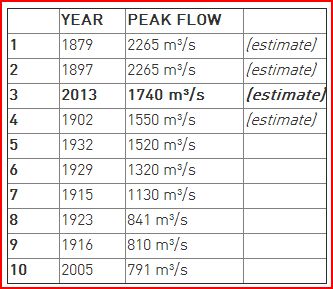
UPDATE: A crushing blow to the climate change propagandists: We are informed by the Weather Network that before the 2013 flood, the eight worst recorded floods in Alberta history occurred before 1933. In 1879 and 1897, the floods were about 35% worse.

floods 

Read more at the Calgary Herald

Alberta Floods 2013: Putting Fresh Perspective on Foreign Aid

The Premier Redford and Prime Minister Harper have pledged “full support” to victims of the devastating Alberta floods.

What they do not mention is that both Alberta and Ottawa are broke. There is no special fund for disaster relief. They can only provide help by taking more of other people’s money — either through taxation or borrowing. They will probably borrow money from countries like China.

At a time like this, giving money to corrupt foreign governments seems even worse than it does normally.

Last year, Canada gave almost $6 billion away in foreign aid (MS Excel). That might seem small, but it is a very significant amount of money for Canada’s small population. That money would definitely be useful to help Canadians during times of disaster.

The biggest recipient of our foreign aid was Ethiopia —  an American puppet state that takes money from the West to fight brutal wars against the Somalis. Another big recipient of Canadian aid is Afghanistan — where we help NATO inflict man-made disasters with missiles, then we pay up to rebuild what we destroyed.

Southern Alberta is underwater, thousands are homeless, and our governments have no money. But aren’t you glad the Canadian governments gives millions to evil regimes in Jordan, Burma, and North Korea?

Alberta Floods 2013: Government’s Absurd Water Usage Restrictions

Don’t wash wash your cars… unless you go to a commercial car wash.

• Limit toilet flushing.
• Limit showers to five minutes or less and keep baths shallow.
• Hold off on doing laundry.
• Only use your dishwasher if absolutely necessary and you have a full load.
• Turn off taps when brushing teeth or shaving.
Don’t wash your vehicle.

Effective immediately and until further notice, the use of tap water outdoors is suspended….

There are exceptions to the Water Utility Bylaw. They include:
• Washing outdoor surfaces for health and safety reasons for childcare facilities, food and beverage establishments and kennel and animal care facilities.
• Washing of vehicles to follow health and safety regulations.
• Watering of plants, shrubs and trees offered for sale.
Businesses that have a license to operate exterior window washing services and car washes.

— Read more at Calgary City News Blog

European Union Wants to Tax Heavy Crude from Oil Sands

The European Union is falling apart. It is desperate for money. The bureaucrats in Brussels will tax anything they can.

Now the EU wants to modify its fuel quality directives, so that refiners who use oil that is “too dirty” (according to bureaucrats) must pay a tax.

Joe Oliver, the Natural Resource Minister of Canada, thinks this amounts to specifically targeted tax on Canadian oil-sands product. He says Canada will sue the EU at the World Trade Organization if they implement the changes, because the oil-sands crude isn’t any “dirtier” than many other crude imports which are not subject to the tax.

Firstly, let me note the hypocrisy when an official from Harper’s government whines about tariffs, while Harper’s government loves tariffs. “Oh yeah, taxing our stuff is bad; taxing your stuff is okay.” Typical government knavery.

On a more general level, yes the EU fuel quality directives and its associated penalties are bad for the economy. They are bad for Europe and bad for Canada. They reduce production of the taxed good and divert resources to government approved fuels. The government is in principle incapable of knowing to what extent a given quality of oil should be used.

Oil sands production is “dirty”, sure. The industry has a lot of flaws. Really, the CO2 emissions aren’t even a big deal, although that’s what everyone focuses on. But the environmental situation is still very screwed up, because Alberta is essentially a mini-petro-state. Property rights and laws of tort can rarely protect the environment because virtually all the pollution takes place on government land.

Even so, that is true of most oil. There is very little “clean” oil where you just turn on the tap and get light, sweet, succulent crude with minimal impact on the earth. Most of it is heavy and sour and difficult to get. Due to inept government regulation and interference with property rights, its production is environmentally problematic. So the European tax seems to be not just destructive, but arbitrary.

If the WTO agrees with Canada that the fuel directives constitutes an unjustified tax, they can’t force them to change it. It just means the Canadian government can put their own tariffs up to retaliate. That is bad for everyone. It would be better to just accept one dumb tax over which one has no controlnthan implement another dumb tax to go along with it. If the Canadian oil producer finds it harder to sell its oil, that’s already bad enough. Why should the Canadian consumer also be punished? It makes no sense, and only a politician or a shyster would advocate this.

Read more at Market Wire

LOL Justin Trudeau

Ok, so it is very possible that Justin Trudeau is an annoying, spoiled brat who hungers for power. Let us be charitable and see if we can find anything good about Justin Trudeau.

Now the leader of the Liberal Party, Trudeau spent his first day in the House of Commons attacking Harper over proposed tax hikes on imported goods, including iPods. That’s good! Of course, the NDP was also attacking Harper over these tariffs. Obviously the opposition is purely political. After all, just a few years ago the NDP was in favor of iPod taxes (and the Conservatives were opposed — politics makes me sick).

If Trudeau devoted himself to arguing against raising taxes, that would seriously be great. I would probably become a fan. Unfortunately, that will never happen. Trudeau actually loves taxation in general, because it is that on which the Canadian system of West-to-East transfer-payments depends. He must realize that the tariffs he is arguing against will in no small part pay for stuff in Quebec.

Speaking of which, people seem unclear of where he stands on the separatism issue. The Tory attack ad makes him seem to favor Quebec separation, but Trudeau had said he would only favor Quebec independence if “Harper succeeds in imposing his values on Canada,” or something.

I find that interesting. Firstly, since Trudeau blames Canada’s problems on Alberta, I am sure he would love to punish Alberta if he had an opportunity to impose his values on Canada. Would he then favor Alberta separatism if Albertans objected to his values? Of course not. Secondly, if Harper’s values are so bad for Canada (and they are), wouldn’t that justify Alberta independence as well? Again, Trudeau would say no — because even with Harper in charge, he would not want to jeopardize the essential status quo of the Canadian power structure, which depends on the extraction of wealth from any “have” provinces like Alberta (but they won’t be for long, because its government is quickly grinding them to ruin).

Basically, Justin Trudeau is a hypocrite and a jerk. I suspect he would happily argue in favor of tariffs doing so would benefit him politically. I also suspect he would never seriously support Quebec’s secession if the issue came up in real life.

Everyone should support free trade. It’s not even a question. But everyone should also support the freedom to choose separatism, because it is the ultimate check on centralized power.

Yet power-hungry politicians always want more territory under their dominion, not less. Trudeau really doesn’t support separatism at all. He wants a united Canada so that Ottawa can continue subsidizing the politically connected elite. He would never really support the independence of Quebec beyond a few oracular assertions, because then Quebec would actually have to cut its spending.

Ron Paul in Calgary

Last Friday, I attended the Ron Paul speech at the “Making Alberta Safe for Capitalism” summit.  This was at the Westin Ballroom in downtown Calgary. I was among approximately 300 attendees, which included financial professionals, publishers, IT nerds, engineers, students, neocons, and more.

I would like to note how this attracted virtually NO media attention. I do not think there is any “conspiracy” here — rather, it is simply due to Ralph Klein’s memorial service being held at the same time. We all know how the media loves to fill its time with the glorification dead politicians whenever the opportunity presents itself. This week, they’ve got Thatcher.

Besides, Ron Paul’s ideas make Canadians uncomfortable. Most people don’t want to talk about such things.

Ron Paul’s speech was basically what you would expect if you’ve been following him for the last few years. I’ve been watching Ron Paul’s political career since 1998, so I was very familiar with all the themes: personal responsibility, free markets, small government, anti-war, and anti-central banking. Still, it was great to pay respects to someone who is more than just an honorable statesman (a contradiction in terms when applied to anyone else), but a man whose efforts have done more for the liberty movement than anyone else in the modern era.

Having retired from politics, this was Ron Paul without any filter that might have previously been imposed by the realities of being in political office. Yet since his message has always been fundamentally radical, there was no difference with post-politics Ron Paul. The message is just as unfavorable to economic, social, and imperial intervention as ever.

At various points throughout the speech, I would look around to gauge the response to certain statements. How delightful to see various attending neocons squirm uneasily when Paul declared there should be no income tax. Some folks scowled at the suggestion to replace government welfare entirely with private charity. Otherwise, the ideas of less spending, less tax, less regulation, and more civil liberties were received favorably. Paul age and manner makes is a kind, wise grandfatherly figure — part of his great success is due to his ability to convey radical arguments in favor of liberty while making them seem completely non-controversial.

The biggest opportunity that was missed in Dr Paul’s speech was HEALTHCARE. If there is a sacred cow in Canadian politics, it’s definitely government healthcare. Without a doubt, government healthcare is a disaster, and Canadians need to learn why it will always be awful regardless of the huge piles of money thrown at it. Unfortunately, healthcare was not covered at all in Dr Paul’s remarks. Too bad. Huge missed opportunity, I think.

He is a medical doctor and an economist who can speak with authority on the failings of public healthcare. He is also old enough to speak about American healthcare system before the government became heavily involved. Before Medicaid, Medicare, the HMO Act of ’73, and so on, there was relatively little government intervention with the provision of healthcare. Basic medical services were cheap and plentiful, and a greater portion of the population had health insurance compared with now. The audience would have greatly benefited from hearing his insights on this subject. He has effectively explained the necessity of free markets in medical care — it is a message Canadians desperately need to hear from somewhere. Virtually no one will touch the issue of public healthcare in this country. We will all be worse off as long as this condition persists.

I would have also liked to hear more war-related remarks. Essentially, anything that applies to the US wasting lives and money on Afghanistan applies to Canada as well. Paul spoke about Iraq more than Afghanistan — which is fine in and of itself, but Canada was not seriously involved in Iraq. Our participation in Afghanistan is another story. Sadly, Afghanistan is an issue that people barely seem to care much about. If they do, it’s because they are dumb enough to think we have Canadian forces there “fighting for our freedom.” Yuck. The lack of interest is even more critical now, because Obama has declared he is “bringing the troops home” in 2014. This is typical government strategy: declare “victory!” and suddenly no one cares anymore. Just like Iraq, where there was never any “victory”, and as I write this the country continues tearing itself apart.

Ron Paul’s speech included a few “fanservice” parts for the Calgarian audience:

He said, “Ralph Klein sounds like a guy I might have liked.” Fair enough, given the memorial was that day, and Klein actually did cut spending at one point.  So that’s cool, whether or not Klein was a principled friend of liberty.

He also gave his support to the Keystone XL — with the important qualification that one can get the permission of property owners, the government should not stand in the way of pipeline construction. This is an rather critical proviso, because in reality pipeline construction does involve government takings/expropriations. Remember: in Canada, the Crown owns all the land as a matter of law.

Anyone who attended this event specifically for Ron Paul could be described as “cutting-edge.” Canadians are not generally ready for the radical Paulian message. For many Americans, there is the emotional connection to ideas of independence, revolution and decentralization, even these are not embraced in practice. The Paulian message can get its hooks in that. For Canadians, the state is endlessly glorified in subtle and not-so-subtle ways. There is no element within our culture that reinforces skepticism about state power. The closest thing to this is Albertans’ memories of the NEP, but that is a regional sentiment and it is being gradually overwhelmed with the pleas for more government.

I hope that the mere fact that Ron Paul has visited Canada to give pro-capitalism speeches indicates that there is a growing audience for the message of liberty in this country. Just as the 20th century demonstrated communism was a lie, the 21st century will show us that democracy is a lie. Democracy’s death throes will be earth-shattering. Liberty’s natural elite must spread and shine the light through dark times, so that a better age may yet emerge.