The Bank of Canada’s Balance Sheet: Bigger than During the Financial Crisis

During the 2008 financial crisis, the Bank of Canada intervened with an unprecedented 50% expansion of its balance sheet to a total of nearly $80 billion. This was done by creating money and purchasing assets from the big banks in order to add liquidity to the market.

By mid-2010, they had unloaded these emergency acquisitions and their balance sheet returned to pre-crisis levels.

But now, after years of growth, the Bank of Canada’s balance sheet is bigger than ever. The BoC holds nearly $90 billion in assets.

boc july 2013

But the crisis is over, isn’t it? The Bank of Canada is trying to keep the Canadian dollar down and interest rates low. They are acting like the crisis is not over, or like another crisis is waiting to emerge.

Marc Faber: Central Bank Intervention “Will Be Very Painful”

Continuing the theme from our last post, Marc Faber — publisher of The Gloom Boom and Doom Report — argues how central bank policy distorts asset prices. The unwavering commitment to monetary expansion will reach its conclusion when inflation explodes or the system becomes so unwieldy it just collapses.

He takes this analysis a step further, to the social implications of central bank intervention. He says monetary intervention ultimately foments social unrest and must culminate in disaster, be it financial meltdown or war.


Why the Fed Will Not “Taper”

Is the Fed going to “taper”? In other words, will it slow the rate of monetary expansion? When will the Fed do this?

That’s what everyone wants to know. As the central bank for the world’s biggest consumer, the Fed is especially important. Their actions have a major effect on the actions of other central banks. The Bank of Canada’s policy is in many ways a function of the Fed’s.

Canada’s head central banker Poloz will not rock the boat. He fears price deflation. The central bankers in Europe and Britain are explicitly committed to inflation. More and more central banks are joining to cause of money printing, like Japan and Australia, yet the Fed seems to be a bit of a wild card.

That’s because because of Bernanke’s remarks on June 19, where he appeared to raise the Fed’s unemployment target from 6.5% to 7%. He suggested the Fed might slow its bond purchases sooner than previously indicated.

Bernanke went out on a limb and changed the target numbers for unemployment in his speech from what was written in the FOMC report.

St. Louis Fed President James Bullard was critical of Bernanke’s comments, in a wishy-washy bureaucratic sort of way. He tried to tell us that Bernanke didn’t really mean what he said. Bernanke even later came out and confirmed his position is the same as it’s always been: “When the economy gets better, we’ll stop. Someday. Maybe.”

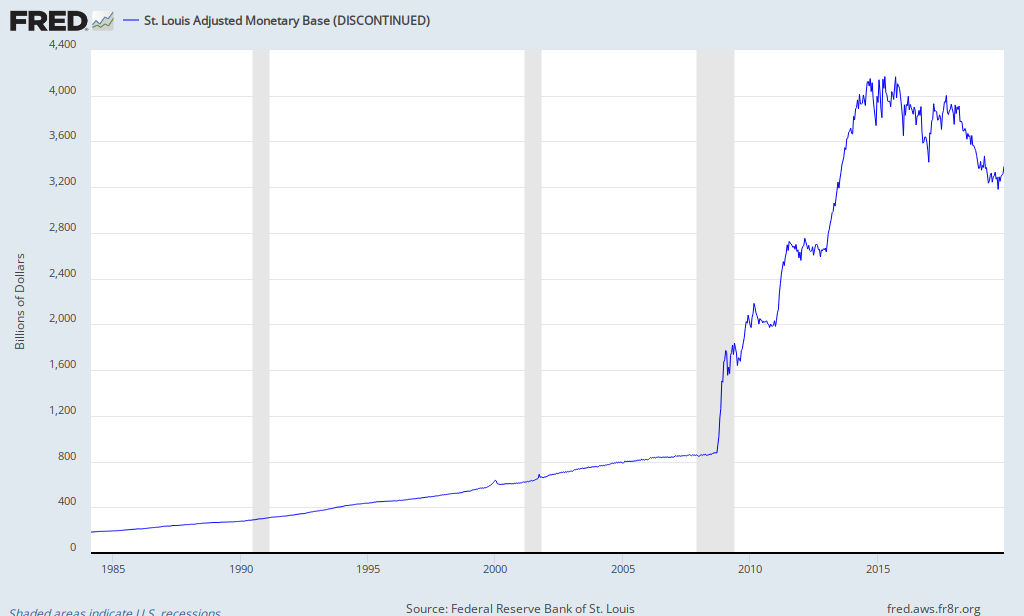
Which sort of goes without saying. Of course the Fed plans to execute its promised “exit plan” when the economy gets better. That’s the whole idea behind extraordinary measures like quadrupling its monetary base since the 2008 crisis with QE 1-3. So what’s the big deal?

Other than Bernanke’s 7% comment, the FOMC has been very clear about what it plans to do. The position in the June 19 press release was unchanged from their March press release. The March release was the same as the January release. Literally the sameword for word.

In these press releases, the FOMC has been explicit. The Federal Reserve will maintain its current policy of QE if the US unemployment rate remains above 6.5% and price inflation remains below 2.5%.

All this debate over whether the Fed will “taper,” and all because no one seems to read what the FOMC says.

A few FOMC members said maybe they should taper later this year. But unemployment is not falling fast enough. Price inflation is not rising fast enough. The Fed’s policy is unlikely to change.

Even if it does change, and they slow the rate of monetary expansion, they will be forced to intervene again. No one mentions that there was tapering after the previous QE’s. Heck, they didn’t just taper in 2012: they actually deflated slightly.

But these little taper episodes don’t last. They simply led to further expansion later. So why not a little bit of tapering after QE3? But that will eventually necessitate QE4. When central banks begin slowing their monetary expansion, the correction will manifest and they will intervene again in desperation.

Despite this reality, economists, investors, and financial reporters are obsessed with rumors and hypotheticals because they do not understand central bank policy.

The spastic reaction of investors was very interesting. Markets fell. Yields shot up quickly as a massive $80 billion was pulled from bond funds in June. Gold briefly fell below $1200. Clearly this illustrates that this economic error cycle is perpetuated entirely by faith in central bank bureaucrats to keep the money pumping. Which is, by the way, exactly what the Austrian business cycle tells us.

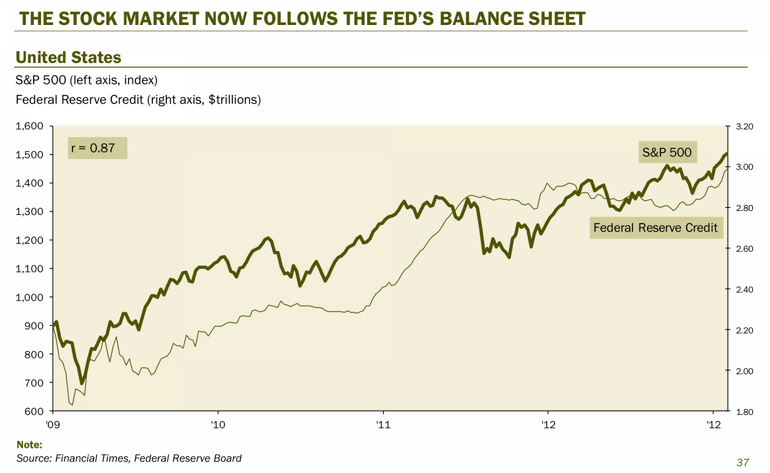
You can quite clearly see how the Fed’s expansion is correlated with stock market performance in the last few years. Any time the markets have been worried, the Bernanke Fed has stepped up to deliver QE.

s&p and fed

I don’t think the Fed is communicating any kind of serious change in policy. And regardless of what they say, they are completely trapped by their own policy.
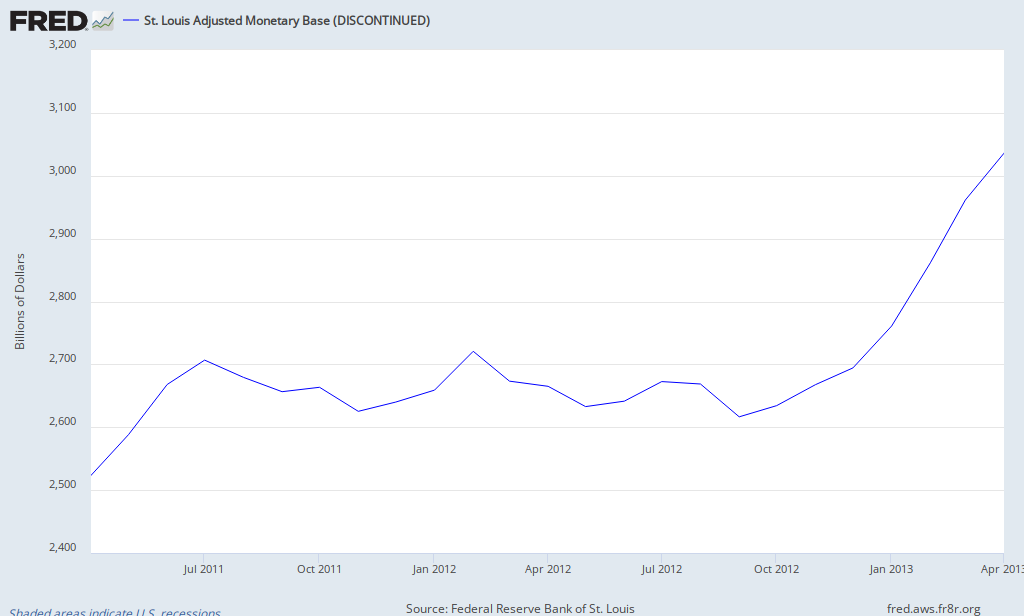
FRED Graph

The Fed cannot pull off a smooth “Exit Plan” with that monster they call a balance sheet without causing a crash far more vicious than 2008.

Is there any way the Federal Reserve could avoid this?

Actually, yes. Their asset sales would have to be offset by the releasing of commercial banks’ excess reserves into the economy. Currently these reserves are massive, corresponding to the Fed’s expansion.

Graph of Excess Reserves of Depository Institutions (DISCONTINUED SERIES)

If the Fed stopped QE entirely and started selling assets, but the banks lent out their excess reserves, you wouldn’t even notice the Fed’s exit. In fact, there would be price inflation. That’s because the fractional reserve process could generate nearly $10 trillion in new money out of those excess reserves.

But this will never happen. This becomes obvious as soon as you ask: “Why would the big banks want to release their excess reserves?”

They are not lending now, so why would they want to lend it when the Fed is selling assets and therefore bringing about a recession? The banks are hoarding their excess reserves now due to extreme uncertainty and impaired balance sheets. They are less likely to lend those funds if the Fed tapers.

But what if the Fed tapers and stops paying interest on excess reserves? Yes, the could do this if they wanted. This is a relatively new policy implemented in 2008. But halting this would have little effect.

The banks earn almost nothing on their deposits at the Fed: close to zero percent. Going from almost-zero to zero will be insufficient motivation to lend, especially when the economy is expected to slowdown. Better to make zero return than risk losing 5% or 10% or more when the economy goes bad.

But what if Bernanke went further? He could charge the banks fees and penalties for having too high a level of reserves. I do not believe he will do this because the banks would not like it. Due to counter-party risk and the danger of short-term creditors doing a bank run on a major institution, it’s least risky for the banks to hold their reserves at the Fed.

Another reason why he and other central banks will not force their big banks to lend: they fear massive inflation would result, and no one wants to deal with that. Bringing it under control would bring about a crippling depression.

An interesting possibility that should be considered is the Fed reducing the rate of QE3 just before Bernanke departs in Feb 2014. They could then safely blame him for any negative effects which follow. If the Fed announces a reduction in QE in September, that would fit with this scenario. However, I do not believe they will do this. Bernanke wants to ride off into the sunset without any additional controversy. He is not even speaking at the Jackson Hole meeting this summer, due to “personal reasons.” He wants to get out his position stealthily rather than in a flurry of disputation. He doesn’t want to push a tapering policy that will reflect badly on him as he leaves his position.

And what’s true of Bernanke is true of all the central bankers — none of them want to look bad in front of their friends. So they will continue to inflate.

CONCLUSION

After the NASDAQ bubble exploded and the US went into recession, Alan Greenspan pumped money into the economy to generate a new boom cycle. Over that time, the economy responded to the resulting misshapen financial markets with the formation of a housing bubble. Greenspan departed and Bernanke began to raise rates. The result was the 2008 crash, during which Bernanke & Friends carried out an unprecedented expansion of the monetary base. Another boom period was generated. The US stock market is again making all-time highs, optimism is much more widespread, and all forecasts and experts seem to agree that the recovery is robust and genuine. This means we are in the economic danger zone.

The Fed’s 100-year pattern of propagating booms and busts will continue either until they crash the economy by selling assets, or a monetary crisis arises that they cannot control.

The Fed may tinker with its money supply here and there, but we are a long way from any “exit plan.” Until then, don’t count on any real tapering for any significant amount of time.

David Rosenberg on Canada vs. the US

Debate rages on about how sustainable or even real the economic recovery is in the US.

David Rosenberg, former chief economist at Merrill Lynch, showed a presentation at one of John Mauldin’s recent conferences. It is entitled: “The Fed Is Trying Like Crazy, But Nothing It Does Can Save The Economy.”

The presentation consists of 60 slides that collectively devastate the case for expecting serious economic recovery in the US. The charts are extremely convincing. The argument he builds with his evidence seems irrefutable.

You can see the entire presentation here. It is worth your time.

While Rosenberg is very bearish on the US, he seems optimistic about Canada. He thinks the “short Canada” trade is a huge mistake.

He draws his conclusion about Canada mostly by looking at 2013 Q1 data, but overall he underestimates Canada’s problems. Canada’s housing sector is more distorted by intervention than he realizes, and our employment data is terrible.

He also downplays the interventions of the Bank of Canada. He says Canada has performed better than the US “without nearly as much … expansion of the central bank balance sheet.”

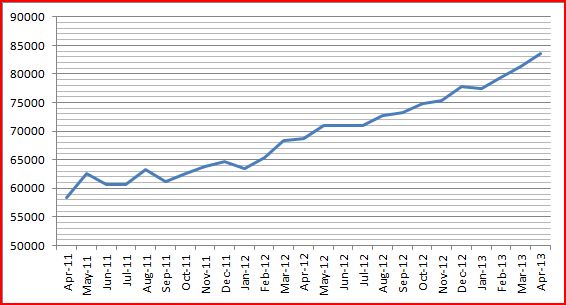
Is this actually true? The BoC deflated in the immediate aftermath of the financial crisis, but it has been busy making acquisitions in the last couple years. In two years, the BoC has expanded its balance sheet by about 30%, whereas the Fed has expanded by about 20% in the same time.

The Fed:

FRED Graph

Here is the BoC monetary base (this chart uses data from here):

boc chart

I think Rosenberg is right on the US and a bit off-base for Canada.

What Three Billionaires Are Doing with Their Money

It is interesting to contrast what the “irrationally exuberant” average investor has been doing vs. the recent activity of a few high-profile billionaires.

Richard Russell, editor of Dow Theory Letters, says that if we judge them by their recent activity, Warren Buffett, John  Paulson, and George Soros are pessimistic about American consumers. They are selling consumer-oriented stocks. This is interesting particularly from Buffett, who has been a “cheerleader for US stocks” all along.

In the last quarter, Buffett sold off a large share of consumer stocks. Berkshire’s overall stake in such investments as dropped by 21%, including significant sales of Kraft and Proctor & Gamble. He dumped his entire position of Intel. He also sold 10,000 shares of GM and 597,000 shares of IBM.

John Paulson liquidated 14 million shares of JP Morgan, and sold off his full stake of consumer-oriented Family Dollar and Sara Lee.

George Soros also unloaded JP Morgan shares, and almost all his other bank stocks as well, including Citigroup and Goldman Sachs.

These billionaires — right or wrong — are shifting to greater cash holdings and away from American consumers. In America, consumption is 70% of the economy. The billionaires seem to anticipate a hit to consumption as the economic strain on American consumers grows.

The US is Canada’s biggest trading partner. It is the world’s largest consumer. Most of the world is structured around selling stuff to Americans. If the US consumer’s situation is worsening, it creates challenges for the Canadian economy.

A nearly universal bullish sentiment is driving average investors into the American stock market. This could certainly drive the American stock market higher for some time yet. Eventually, however, the offers will start coming in with no bids, and the system will violently recoil.

Read more at King World News Blog

Yield on Canadian Government Bonds Rising

About three weeks ago, I speculated that the bottom on interest rates had come and gone, and interest rates were rising.

This now seems more and more certain. Because of Abenomics, yields on Japanese government bonds have shot up and set off an ugly chain reaction. Bond prices are falling and yields are rising. Rather quickly, I might add.

Take a look at these charts of yields for selected Canadian government bonds. Pay extra attention to the longer-term bonds.

First, marketable bonds. The average yield on 1-3 year bonds:

Government of Canada marketable bonds - average yield - 1 to 3 year

Now 3-to-5 year bonds:

Government of Canada marketable bonds - average yield - 3 to 5 year

5-10 year:

Government of Canada marketable bonds - average yield - 5 to 10 year

Here’s the average for 10+ year bonds:

Government of Canada marketable bonds - average yield - over 10 years

Now the benchmark bonds.

First, the 2-year:

Government of Canada benchmark bond yields - 2 year

The 3-year:

Government of Canada benchmark bond yields - 3 year

The 5-year:

Government of Canada benchmark bond yields - 5 year

The 7-year:

Government of Canada benchmark bond yields - 7 year

The 10-year:

Government of Canada benchmark bond yields - 10 year

Long-term benchmark bonds:

Government of Canada benchmark bond yields - long-term

Here’s the long-term real return bond yield:

Real return bond - long term

You can draw your own conclusions from this data, I’m sure.

The European Central Bank Is Deflating

A lot of people talk on and on about how all the central banks are printing money.

But, to the dismay of radical Keynesians, central banks are not always printing money all the time.

The ECB has spent the last several months deflating.

ecb assets

This will put pressure on Europe. It will be interesting to see how long this lasts, given how bad things seem to be over there.

Bank of Canada Should Raise Rates to Pop Bubbles, Says Former Carney Advisor

Paul Masson, former advisor to Mark Carney, says the Bank of Canada should raise interest rates and pop the housing and debt bubbles.

He says years of low interest rates have distorted the economy and driven people to take higher risks. The accumulation of debt has left Canadians and their institutions stretched thin, ill-prepared to withstand the impact of another financial crisis.

Mr Passon correctly describes our situation.

The Bank of Canada could raise rates very quickly by selling assets. It will definitely not do this, because it would cause a depression. All talk about “maybe” raising rates “in the future” is just that: talk.

Should the BoC raise rates? Well, the Bank of Canada should be closed down, so really all of its assets should be sold. Central banks exist to empower governments and the elite at the expense of everyone else.

But in the context of having the BoC and Canadian dollars, I am sympathetic to the argument that the BoC shouldn’t really do anything. It would be reasonable to leave the money supply as it is and let the market determine interest rates from there. The BoC shouldn’t be jacking the rates around, whether to raise them or lower them. Let the market set interest rates free of further invention. This would give us a bit more time to prepare for the crash, versus an active contraction of the BoC’s balance sheet. “Laissez-faire.”

— Read more at The Financial Post

We Are Close to the Top of the Market

Here is The Economist‘s May 11 cover.

Uh oh.

Bank Assets As a Percentage of GDP

And you thought the American banks were too big to fail!