Politicians are “Obsessive Megalomaniacal Do-gooders”

The following interview with Hans-Hermann Hoppe first appeared in the German weekly Junge Freiheit on November 2, 2012, and was conducted by Moritz Schwarz. It has been translated here into English by Robert Groezinger.

—————–

Are taxes nothing but protection money? The state a kind of mafia? Democracy a fraud? Philosopher Hans-Hermann Hoppe is not only considered one of the most prominent pioneering intellectuals of the libertarian movement, but also perhaps the sharpest critic of the Western political system.

Professor Hoppe, in your essay collection “Der Wettbewerb der Gauner” (“The Competition of Crooks“) you write that “99 percent of citizens, asked if the state was necessary, would answer yes.” Me too! Why am I wrong?

Hoppe : All of us, from childhood, have been moulded by state or state-licensed institutions—preschools, schools, universities. So the result you quoted is not surprising. However, if I asked you whether you said yes to an institution having the last word in each conflict, even in those it is itself involved in, you would certainly say no—unless you hoped to be in charge of this institution yourself.

Er … correct .

Hoppe : Of course, because you know that such an institution cannot only mediate in conflicts but also cause them, you can recognize that it can then resolve them to its own advantage. In the face of this I, for one, would live in fear of my life and property. However, it is precisely this, the ultimate power of judicial decision-making, that is the specific characteristic of the institution known as the state.

Correct, but on the other hand the state is based on a social contract, which provides the individual with protection and space for personal fulfilment, which without the state he would not have—in a struggle of all against all.

Hoppe : No, the state is anything but the result of a contract! No one with even just an ounce of common sense would agree to such a contract. I have a lot of contracts in my files, but nowhere is there one like this. The state is the result of aggressive force and subjugation. It has evolved without contractual foundation, just like a gang of protection racketeers. And concerning the struggle of all against all: that is a myth. Of course the racketeer protects his victims on “his” territory from other racketeers, but only so he can conduct his own racket more successfully. Moreover, it is states that are responsible for the deaths of hundreds of millions of people and immeasurable destruction in the 20th century alone. Compared to that, the victims of private crimes are almost negligible. And do you seriously believe that conflicts between the inhabitants of the tri-border region [of France, Germany and Switzerland] near Basle, who are living together in a condition of anarchy, are more numerous than conflicts between the inhabitants of Dortmund and Düsseldorf, who are citizens of one and the same state [Germany]? Not that I know of.

Why in your view is democracy just a “competition of crooks”?

Hoppe : All highly-developed forms of religion forbid the coveting of someone else’s property. This prohibition is the foundation of peaceful cooperation. In a democracy, on the other hand, anyone can covet anybody else’s property and act according to his desire—the only precondition being that he can gain access to the corridors of power. Thus, under democratic conditions, everybody becomes a potential threat. And during mass elections what tends to happen is that the members of society who attempt to access the corridors of power and rise to the highest positions are those who have no moral inhibitions about misappropriating other people’s property: habitual amoralists who are particularly talented in forging majorities out of a multitude of unbridled and mutually exclusive demands.

“Politicians: lazy and spongers!” Aren’t you afraid you might be reproached for complaining on the level of the “Bild” tabloid newspaper?

Hoppe: So what? Up until the 20th century there was hardly an important political thinker who didn’t speak disparagingly about democracy. The key word was: “mob rule.” The populist criticism of democracy, as can be found in Bild or at the water cooler, is all very well. But it is not fundamental enough, nor does it go far enough—to date Bild hasn’t asked me for an interview either. Of course politicians are spongers; they live off money extorted from other people with the threat of violence—which is called “taxation.” But unfortunately, politicians are not lazy. It would be nice if all they did was squander their booty. Instead they are obsessive megalomaniacal do-gooders, who in addition make life difficult for their victims with thousands of laws and regulations.

Democracy is only one possible variety of statehood. Would a different form of state be more acceptable to you?

Hoppe: In a monarchist state everyone knows who the ruler is and who the ruled are, and accordingly there is resistance against any attempt to increase state power. In a democratic state this distinction becomes blurred, and it becomes all the easier to expand state power.

Just a moment: that’s what courts, laws and the constitution are for, to limit and control the state—government as well as parliament.

Hoppe : The mafia also has “executive”, “legislative” and “judicial” branches. Just go and watch the movie “The Godfather” again!

Another objection: What about the new internet-based detractors of the state, such as “Occupy” or the “Pirates,” who demand transparency and participation, without immediately condemning the state and democracy in their entirety?

Hoppe : The “Occupy” movement consists of economic ignoramuses who fail to understand that the banks’ dirty tricks, which they rightly deplore, are possible only because there is a state-licensed central bank that acts as a “lender of last resort,” and that the current financial crisis therefore is not a crisis of capitalism but a crisis of statism. The “Pirates,” with their demand for an unconditional basic income, are well on the way to becoming another “free beer for all” party. They have a single issue: criticism of “intellectual property rights” (IP rights), which could make them very popular—and earn them the enmity in particular of the music, film and pharmaceutical industries. But even there they are clueless wimps. They just need to google Stephan Kinsella. Then they’d see that IP has nothing to do with property, but rather with state privileges. IP allows the inventor (I) or ‘first maker’ of a product—a text, picture, song or whatever—to forbid all other people to replicate this product, or to charge them license fees, even if the replicator (R) thereby uses his own property only (and does not take away any of I’s property). This way, I is elevated to the status of co-owner of R’s property. This shows: IP rights are not property but, on the contrary, are an attack on property and therefore completely illegitimate.

In “The Competition of Crooks” you outline as an alternative the model of a “private law society.” How does it work?

Hoppe: The basic concept is simple. The idea of a monopolistic property protector and law keeper is self-contradictory. This monopolist, whether king or president, will always be an expropriating property protector and a law-breaking law keeper—who will characterize his actions as being in “the public interest.” In order to guarantee the protection of property and safeguard the law there has to be free competition in the area of law as well. Other institutions apart from the state must be allowed to provide property and law protection services. The state then becomes a normal subject of private law, on an equal footing with all other people. It can’t raise taxes any more or unilaterally enact laws. Its employees will have to finance themselves just the same as everybody else does: by producing and offering something that freely engaging customers consider value for money.

Wouldn’t that quickly lead to a war between these “providers?”

Hoppe: War and aggression are costly. States go to war because they can, via taxes, pass on the cost to third parties who are not directly involved. By contrast, for voluntarily-financed companies, war is economic suicide. As a private law subject the state too will, like all other security providers, have to offer its customers contracts that can only be changed by mutual agreement, and which in particular regulate what is to be done in the case of a conflict between itself and its customers, or between itself and the customers of other, competing security providers. And for that there is only one solution acceptable to everyone: that in these sorts of conflicts not the state, but an independent third party decides—arbitrators and judges who in turn compete with each other, whose most important asset is their reputation as keepers of the law, and whose actions and judgments can be challenged and, if need be, revised, just as anyone else’s can be.

Who should be such a “third party?” And with what instruments of power should it assert the interests of an individual citizen against his contractual partner—the private state, which of course is much more powerful?

Hoppe: In local conflicts, in a village or a small town, these will very often be universally respected “natural aristocrats.” Or else, arbitrating organisations and courts of appeal, which insurers and insured have contractually agreed on from the start. Whoever then does not abide by the judgments will not only be defaulting, he will become a pariah in the world of business. Nobody will want to have anything to do with him, and he will immediately lose all his customers. This is no utopian idea. This is already the usual practice in international—anarchical—business transactions today. And another question for you: How should the individual citizen assert his interests in the face of a monopolistic tax-state? It is much more powerful—and always has the last word!

Do you understand the continuing scepticism with regard to your proposition?

Hoppe : Of course, as most people have never heard of this idea, let alone thought about it seriously. I am only unsympathetic towards those who yell out at the top of their voices when they hear this idea and demand the condemnation of its representatives, without having the least knowledge of economics and political philosophy.

It is hardly likely that a majority of citizens will ever support such an unfamiliar model. But what parts of it at least could be adopted, in order to achieve at least partial improvements of our current system, without a complete abandonment of state and democracy?

Hoppe : There is an interim solution. It’s called secession and political decentralization. Small states must be libertarian, otherwise the productive people will desert them. Desirable therefore is a world made up of thousands of Liechtensteins, Singapores and Hong Kongs. In contrast, a European central government—and even more so a world government—with a “harmonized” tax and regulation policy, is the gravest threat to freedom.

For that too you will probably not find a majority. Therefore how will state and democracy develop in future? Where will we finally end up?

Hoppe : The Western “welfare state model,” “socialism light,” will collapse just like “classical” socialism—of course, I can’t say whether in five, ten or 15 years. The key words are: state bankruptcy, hyperinflation, currency reform and violent distribution battles. Then it will either come to a call for a “strong man” or—hopefully—a massive secession movement.

— From Mises.org

Canadian Healthcare: As Little Care As Possible

Few people realize what is implied with public healthcare. Government services are funded through taxation. They receive money irrespective of their service to the customer. This is why the public sector is so frequently characterized by incompetence, waste, carelessness, laziness, mistreatment, and delusion (“we serve the public good”).

Unlike a normal business, which is rewarded based on how much its output satisfies the consumer, the government services regard the consumer as a burden that consumes resources that it has already taken. Why should it be encouraged to provide good service? Hence, the tendency will always be for public services to maximize the cost, and minimize the actual service provided.

Some recent stories out of B.C. provide classic illustrations. Delta Hospital recently sent home a blind 90-year-old lady home by herself in the middle of the night with a bleeding arm and wrapped in a bed sheet.

In another case, a 76-year-old lady was at Mount St. Joseph for two weeks with pneumonia and anemia. She was sent home, when her condition was obviously still delicate. At home she kept drifting in and out of consciousness, so her son returned her to the hospital, where she collapsed on arrival.

After six hours, the hospital declared she should stay overnight. The son went home to gather some things for his mother. When he returned less than three hours later, he was informed his mother had been sent home.

2012 hospital discharge complaint

Seniors are treated especially poorly by public hospitals

She was sent home in a taxi, alone and afraid, with no ID, no money, no keys to her home, and hospital staff had dressed her in someone else’s clothes.

For government services, the consumer is a burden that needs to be sent home as soon as possible, with or without proper care having been administered. This is especially reprehensible in the healthcare system, where our seniors are systematically mistreated by contemptuous staff.

— Read more at CBC.ca —

Former NATO Commander Argues against Syria Strike

To the embarrassment of sane Canadians everywhere, Canada’s Prime Minister Harper is one of a tiny minority of world leaders foolish enough to clamor for military intervention in Syria.

Douglas Macgregor, retired U.S. Army Colonel and director of NATO joint operations for the Kosovo air campaign, argues about why such intervention will probably make no positive impact and more likely make matters worse.

———————————————————–

I gather you think it is not a good idea for any kind of a strike in Syria, so let’s begin there: why is that?

We have no compelling strategic interest that justifies the use of force inside Syria.

There are two wars going on right now in the region. One is the civil war in Syria, and that’s between the Sunni Islamists on one side, aligned with Al-Qaeda, the Muslim Brotherhood, funded by Saudi Arabia, the Emirates, and Turkey — and on the other side, a secular dictator whose protecting the various minority groups inside the country — Christians, Alawites, Shia — who most certainly will be annihilated if the Sunni Islamists expel him from office. We have no interest in, frankly speaking, any side being the victor, but we have spent the last 12 years killing the same people Mr Assad is currently fighting.

And then on a regional level, you have the larger war with Iran on one side, Saudi Arabia and Turkey on the other — the Sunni-Shia War.

What about responsibility to act though? We heard from the White House spokesperson earlier that the world has to act because, as he says, we know the administration in Syria has used chemical weapons more than one time. Is it not a case of having to go in a prevent further chemical attacks?

Well first of all, I don’t think you can, and in fact if you remove Mr Assad and his opponents win (who will benefit from any attacks that we launch) they will certainly gain control of the chemical weapon stocks and turn them against their enemies, which include Israel. So I don’t see how our intervention is somehow morally justified. These people could have just been slaughtered by machine guns and artillery fire. Indeed thousands and thousands of civilians, men, women and children, have died in this civil war since the beginning, so I find this an exercise in hypocrisy frankly.

It certainly sounds as if the US administration is at the ready for some kind of military intervention, so let’s talk about a “what if” scenario then. How would the US work with its allies in the region in that case?

First of all I don’t think we’ll have to work much with our so-called “allies” in the region. We will inform them of our intentions if we decide to launch these strikes, but most of these strikes will be launched from offshore, by naval platforms, various kinds of ships, and various aircraft that can launch cruise missiles without any violation of Syria’s airspace.

The Turks are no doubt very anxious to see the Sunni Islamists win in Syria, and also anxious to see them win in Egypt, will no doubt allow us to fly strikes from Turkish soil if we choose to do so. But these are very limited strikes, strikes designed to attack targets that we think are remote from civilian centers.

So how would they go about targeting? Especially if the goal is to prevent any further use of chemical weapons? That obviously comes with some huge challenges itself.

You’re not going to stop the use of chemical weapons in the future through strikes of the type that we are likely to launch. You would have to use frankly an enormous amoutn of explosive, ultimately even a low-yield nuclear warhead, in order to guarantee the destruction of chemical stocks, because you want to effectively burn them up and make them unusable in the future. We can’t really do that with the numbers of cruise missiles that we might launch. In fact if you are not careful you can make matters worse by causing chemicals to explode and be used accidentally. I think what we’ll do is focus on what we think are Mr Assad’s command and control nodes, his forces — things that we think we can identify with reasonable certainty  are not near civilian centers. We obviously do not want to cause the death of civilians.

As we know more than 100,000 people have lost their lives in this conflict. How tough would it be to avoid civilian casualties?

Well I think it would be very tough, and your point is well taken. We’re trying to tiptoe if you will through a minefield. And again, I don’t see any evidence that strikes will change the facts on the ground. Will they help the Sunni Islamists, allied with Al-Qaeda, the Muslim Brotherhood, backed by Turkey and Saudi Arabia? Probably. But will it be enough to bring down Mr Assad? That seems doubtful.

The larger problem is how does the rest of the world react? You mention people in London, Washington, and Paris who are a minority of people who think they should act as imperial policeman, essentially behaving as a large nanny-state in the world arena. Inside the United States there is virtually no support among the American people for this, and we don’t quite know how the Russians will react, or Iran. But we know one thing: If we launch these strikes, Mr Assad has no absolutely incentive to exercise any restraint. In fact the opposite is the case, we are likely to see much worse in the future.

So are you saying that you think the best option for President Barack Obama right now is no option at all? That the world has to sit back and potentially see more images such as those we’ve seen coming out of Syria in the last week — hundreds of people, children, women, killed by chemical attacks?

London, Paris, and Washington are not the world , let’s get that straight. They don’t speak for the world — they speak for themselves. This is a small minority of people who think they are morally superior to everyone else. There is nothing nice about civil wars. The civil war in the United States was far worse than anything you’ve seen in Syria. Civil wars are “no quarter given” conflicts. There are no good guys in the civil war. There is a winner and a loser. If you don’t like what you’re seeing, you probably shouldn’t watch. But as far as our intervention is concerned, the only thing we can do is make matters worse and then ultimately look ridiculous at the other end of the strikes, when things get worse and we end up changing nothing.

You talk about the limited of capacity of airstrikes to have any effect on the chemical weapons. I wonder if the US does see a scenario where there is intervention, if there was boots on the ground — and the White House says “that’s not our plan” — but in your opinion would that be a better way to go to try and get at those chemical weapons and make sure they don’t get in the hands of anyone?

If you intervened in Syria, you’d have to use a lot of armor — tanks and armored fighting vehicles — to get into the country and execute the kind of mission you’re outlining. If you use boots on the ground, that is men with rifles, you’ll simply get large numbers of people killed and you won’t accomplish very much.

The real question is why would we do that to begin with? Where is the strategic interest on the part of the United States to do that? I don’t think there is one. The country in the region with an interest in what you’re describing is Israel, and the Israelis have been very prudent so far. They see no reason to intervene in this conflict for the reasons we’ve already covered. They understand if they embroil themselves in this they’ll be shot at from every side by everyone, as we would be. So I don’t see any good options and I think that’s why the president has said there will be no ground forces.

You touch on the effect on the region if there are strikes, and President Assad in Syria has warned that the entire Middle East would be affected. What kind of scenario would we be looking at then on the neighboring countries in the region?

We have to be careful of the hyperbole. Russia has said this would be a military catastrophe. No, I don’t think that’s accurate. Quite frankly the people who are most interested are those in the immediate vicinity: the Turks, Lebanon, Iraq. Their interests vary tremendously. They’re the ones with the greatest interests, they’re the ones dealing with refugees, Jordan as well. Israel has an interest. But beyond those countries, no one really cares what happens in Syria to be perfectly blunt. It just doesn’t affect the rest of the world. So I discount the regional war scenario. I think this is hyperbole designed to persuade everyone to stay away. I happen to agree that we should all stay away from it. But having said that, I don’t see a major regional war erupting as a result of all this.

 — Watch the interview at CBC — 

The Bank of Canada’s Balance Sheet: Bigger than During the Financial Crisis

During the 2008 financial crisis, the Bank of Canada intervened with an unprecedented 50% expansion of its balance sheet to a total of nearly $80 billion. This was done by creating money and purchasing assets from the big banks in order to add liquidity to the market.

By mid-2010, they had unloaded these emergency acquisitions and their balance sheet returned to pre-crisis levels.

But now, after years of growth, the Bank of Canada’s balance sheet is bigger than ever. The BoC holds nearly $90 billion in assets.

boc july 2013

But the crisis is over, isn’t it? The Bank of Canada is trying to keep the Canadian dollar down and interest rates low. They are acting like the crisis is not over, or like another crisis is waiting to emerge.

These Charts Give a Clue About Where the Gold Price is Headed

The price of gold has been going through an anxious bottoming period and now seems resolutely back above $1300. But what’s next?

Look at the following chart:

Basically, this chart shows the difference between commercial long and short positions. The green dots are positioned at intermediate low-points in the price of gold, which are also points where commercial net longs are at relative highs. This is no coincidence. The commercials are major players in the market. They hedge against price fluctuations rather than speculate. They reduce their short positions near significant price bottoms. If you could go back in time, the green dots would be your buy signals. This chart shows commercial short positions at the lowest point in a very long time — more than ten years. Where do you think the newest green dot will appear?

Now look at this chart, which is a little different.

This also illustrates how the falling price and increase in commercial long positions generally foreshadows a meaningful rally for gold. If I were to judge from this chart, I’d say we should expect a significant expansion of commercial longs. The price of gold should correspondingly rise. Here, the red dots are the buy signals. Where do you think the newest red dot would go?

As a conservative estimate, if we saw a rally comparable 2005 and 2008’s moves, the next phase of the gold bull market would approach $2000/oz.

This process is likely to unfold as the current business cycle matures, over the next one or two years  Then when another panic hits, gold will sell-off until central banks accelerate their monetary interventions. They will do this to fight the onset of a crushing economic depression.

— Read more at King World News

Why the Fed Will Not “Taper”

Is the Fed going to “taper”? In other words, will it slow the rate of monetary expansion? When will the Fed do this?

That’s what everyone wants to know. As the central bank for the world’s biggest consumer, the Fed is especially important. Their actions have a major effect on the actions of other central banks. The Bank of Canada’s policy is in many ways a function of the Fed’s.

Canada’s head central banker Poloz will not rock the boat. He fears price deflation. The central bankers in Europe and Britain are explicitly committed to inflation. More and more central banks are joining to cause of money printing, like Japan and Australia, yet the Fed seems to be a bit of a wild card.

That’s because because of Bernanke’s remarks on June 19, where he appeared to raise the Fed’s unemployment target from 6.5% to 7%. He suggested the Fed might slow its bond purchases sooner than previously indicated.

Bernanke went out on a limb and changed the target numbers for unemployment in his speech from what was written in the FOMC report.

St. Louis Fed President James Bullard was critical of Bernanke’s comments, in a wishy-washy bureaucratic sort of way. He tried to tell us that Bernanke didn’t really mean what he said. Bernanke even later came out and confirmed his position is the same as it’s always been: “When the economy gets better, we’ll stop. Someday. Maybe.”

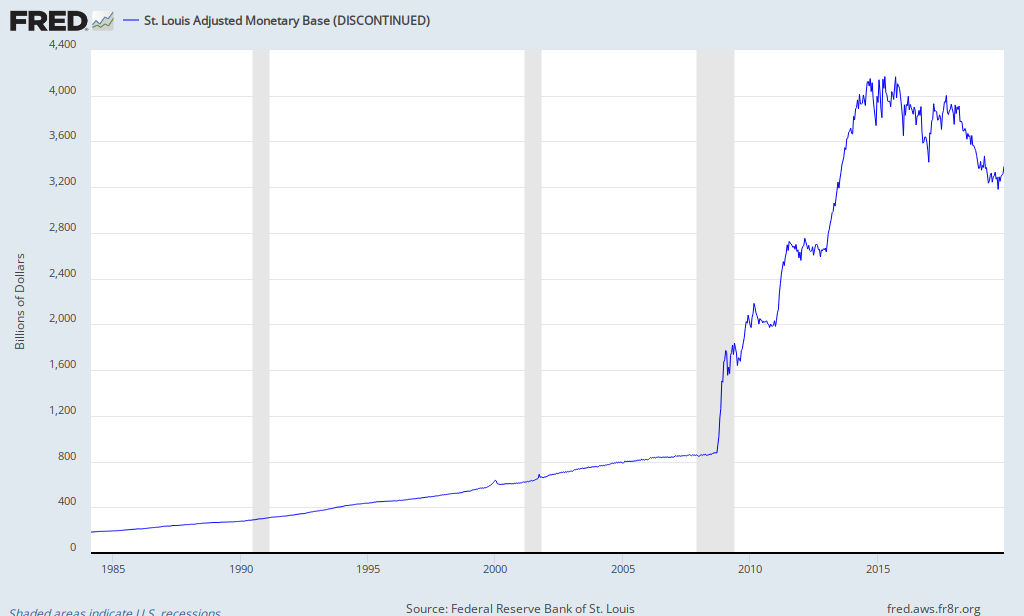
Which sort of goes without saying. Of course the Fed plans to execute its promised “exit plan” when the economy gets better. That’s the whole idea behind extraordinary measures like quadrupling its monetary base since the 2008 crisis with QE 1-3. So what’s the big deal?

Other than Bernanke’s 7% comment, the FOMC has been very clear about what it plans to do. The position in the June 19 press release was unchanged from their March press release. The March release was the same as the January release. Literally the sameword for word.

In these press releases, the FOMC has been explicit. The Federal Reserve will maintain its current policy of QE if the US unemployment rate remains above 6.5% and price inflation remains below 2.5%.

All this debate over whether the Fed will “taper,” and all because no one seems to read what the FOMC says.

A few FOMC members said maybe they should taper later this year. But unemployment is not falling fast enough. Price inflation is not rising fast enough. The Fed’s policy is unlikely to change.

Even if it does change, and they slow the rate of monetary expansion, they will be forced to intervene again. No one mentions that there was tapering after the previous QE’s. Heck, they didn’t just taper in 2012: they actually deflated slightly.

But these little taper episodes don’t last. They simply led to further expansion later. So why not a little bit of tapering after QE3? But that will eventually necessitate QE4. When central banks begin slowing their monetary expansion, the correction will manifest and they will intervene again in desperation.

Despite this reality, economists, investors, and financial reporters are obsessed with rumors and hypotheticals because they do not understand central bank policy.

The spastic reaction of investors was very interesting. Markets fell. Yields shot up quickly as a massive $80 billion was pulled from bond funds in June. Gold briefly fell below $1200. Clearly this illustrates that this economic error cycle is perpetuated entirely by faith in central bank bureaucrats to keep the money pumping. Which is, by the way, exactly what the Austrian business cycle tells us.

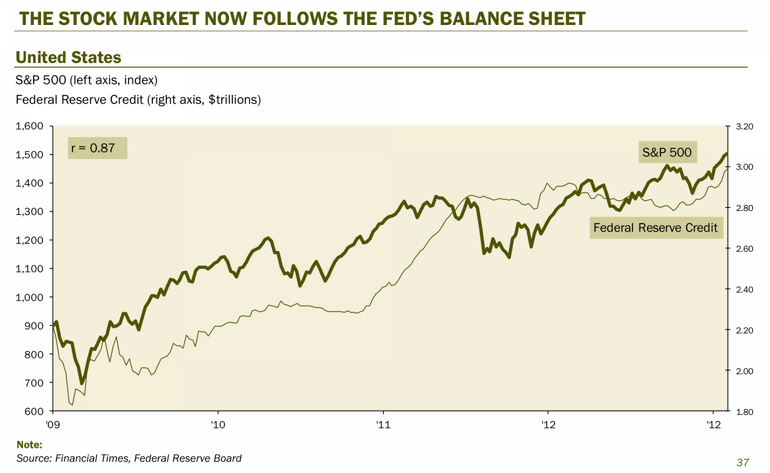
You can quite clearly see how the Fed’s expansion is correlated with stock market performance in the last few years. Any time the markets have been worried, the Bernanke Fed has stepped up to deliver QE.

s&p and fed

I don’t think the Fed is communicating any kind of serious change in policy. And regardless of what they say, they are completely trapped by their own policy.

FRED Graph

The Fed cannot pull off a smooth “Exit Plan” with that monster they call a balance sheet without causing a crash far more vicious than 2008.

Is there any way the Federal Reserve could avoid this?

Actually, yes. Their asset sales would have to be offset by the releasing of commercial banks’ excess reserves into the economy. Currently these reserves are massive, corresponding to the Fed’s expansion.

Graph of Excess Reserves of Depository Institutions (DISCONTINUED SERIES)

If the Fed stopped QE entirely and started selling assets, but the banks lent out their excess reserves, you wouldn’t even notice the Fed’s exit. In fact, there would be price inflation. That’s because the fractional reserve process could generate nearly $10 trillion in new money out of those excess reserves.

But this will never happen. This becomes obvious as soon as you ask: “Why would the big banks want to release their excess reserves?”

They are not lending now, so why would they want to lend it when the Fed is selling assets and therefore bringing about a recession? The banks are hoarding their excess reserves now due to extreme uncertainty and impaired balance sheets. They are less likely to lend those funds if the Fed tapers.

But what if the Fed tapers and stops paying interest on excess reserves? Yes, the could do this if they wanted. This is a relatively new policy implemented in 2008. But halting this would have little effect.

The banks earn almost nothing on their deposits at the Fed: close to zero percent. Going from almost-zero to zero will be insufficient motivation to lend, especially when the economy is expected to slowdown. Better to make zero return than risk losing 5% or 10% or more when the economy goes bad.

But what if Bernanke went further? He could charge the banks fees and penalties for having too high a level of reserves. I do not believe he will do this because the banks would not like it. Due to counter-party risk and the danger of short-term creditors doing a bank run on a major institution, it’s least risky for the banks to hold their reserves at the Fed.

Another reason why he and other central banks will not force their big banks to lend: they fear massive inflation would result, and no one wants to deal with that. Bringing it under control would bring about a crippling depression.

An interesting possibility that should be considered is the Fed reducing the rate of QE3 just before Bernanke departs in Feb 2014. They could then safely blame him for any negative effects which follow. If the Fed announces a reduction in QE in September, that would fit with this scenario. However, I do not believe they will do this. Bernanke wants to ride off into the sunset without any additional controversy. He is not even speaking at the Jackson Hole meeting this summer, due to “personal reasons.” He wants to get out his position stealthily rather than in a flurry of disputation. He doesn’t want to push a tapering policy that will reflect badly on him as he leaves his position.

And what’s true of Bernanke is true of all the central bankers — none of them want to look bad in front of their friends. So they will continue to inflate.

CONCLUSION

After the NASDAQ bubble exploded and the US went into recession, Alan Greenspan pumped money into the economy to generate a new boom cycle. Over that time, the economy responded to the resulting misshapen financial markets with the formation of a housing bubble. Greenspan departed and Bernanke began to raise rates. The result was the 2008 crash, during which Bernanke & Friends carried out an unprecedented expansion of the monetary base. Another boom period was generated. The US stock market is again making all-time highs, optimism is much more widespread, and all forecasts and experts seem to agree that the recovery is robust and genuine. This means we are in the economic danger zone.

The Fed’s 100-year pattern of propagating booms and busts will continue either until they crash the economy by selling assets, or a monetary crisis arises that they cannot control.

The Fed may tinker with its money supply here and there, but we are a long way from any “exit plan.” Until then, don’t count on any real tapering for any significant amount of time.

Disney’s 1943 Anti-Nazi Propaganda Cartoon: Public Education in a Nutshell

During World War II, there were a lot of cute propaganda cartoons made for kids.

Here is one from Disney about public education in Nazi Germany. What applies to public education under the National Socialists applies in principle to public education everywhere.

Public education is one of the most dangerous of all government programs.

Alberta Floods 2013: RCMP Invades High River Homes, Seizes Guns

The RCMP is acting like an occupying army in High River.

RCMP officers working in High River, Alta., on June 25, wear protective masks to prevent toxic dust from entering their lungs. The RCMP took some guns from homes they searched that they said were not stored safely and the Prime Minister's Office issued a statement Friday saying it wants them returned.

Governments invariably use emergencies to extend their powers and subject the citizenry to greater abuse. Natural disasters are no exception.

High River was devastated by the flood. The entire town was evacuated.

It has been eight days since residents were forced from their home. As the waters recede, people want to return home and see the status of their property.

“No way,” says the RCMP.

High River is effectively under a state of martial law so intense the citizens cannot even enter the town at all. The RCMP set up a roadblock with 30 officers to prevent residents from entering. Dozens of police cars with flashing lights lined the streets menacingly. A spike strip was deployed to cripple the vehicle of any outlaw who dared to enter the town.

But it is not enough for the RCMP to use threats of violence to keep out residents. Some High River residents have firearms in their home, you see. So those homes had to be invaded, and the firearms had to be confiscated.

“People have a significant amount of money invested in firearms … so we put them in a place that we control and that they’re safe,” said one RCMP sergeant.

Oh. They are taking guns to do those owners a favor. See? No problem.

“It’s like Nazi Germany,” says a resident. Yes, it is sort of like that. It’s also sort of like New Orleans and Hurricane Katrina. FEMA confiscated civilian firearms during that disaster in the name of “safety.” That’s the real template for what’s going on here.

This kind of behavior by the RCMP was entirely predictable because of the lessons of Katrina. Memories of the scandals surrounding FEMA’s gross incompetence during Hurricane Katrina’s aftermath informed us how big, bureaucratic government agencies with police powers behave during emergencies. The RCMP is not particularly less malevolent just because they have funny uniforms.

Based on their actions, every level of government involved in the Alberta floods seems desperate to be as incompetent and harmful as FEMA.

The RCMP says they will return the guns to owners “after residents are allowed back in town and they provide proof of ownership.” Something tells me the occupying forces will make it difficult for the gun owners to provide such proof. “Oh, your proof of ownership was destroyed in the flood? That’s a real shame. No gun for you.”

Lorraine Hjalte / Postmedia News

Premier Redford defended the actions of the RCMP. “I really hope that we can focus on more important matters at hand, like getting 12,000 people back into High River than continue to circulate this story,” she said. She seems to overlook that the government has utterly failed in High River. The more they focus on getting High River residents back to their homes, the longer it is likely to take.

When will residents be able to return home? The RCMP tells us: “People much higher up are going to make those decisions.” That sounds efficient. The mayor of High River says no one can return home until Home Hardware and Shoppers Drug Mart are  open. 

In a rare moment of sanity, the Prime Minister’s Office said the RCMP should return the guns. By this I think they mean, “Make it possible in theory for the owners to get the guns back.” Since the Minister of Public Safety is in charge of the RCMP, the Prime Minister can essentially just order the RCMP to return the guns immediately. Yet this has not been done.

But the RCMP never claimed it would keep the guns forever. They’ve maintained the pretense that the guns will be returned. But it’s unlikely that process will be easy.

Will every owner get their guns back?

These are the guys the RCMP is so afraid of?

— Read more at the Calgary Herald, the Globe and Mail, and CBC — 

Carney vs. the British Pound

UK citizens are running out of time before Mark Carney takes over their central bank.

Carney got the Bank of England job because he was a friend of bank bailouts and has shown no reluctance when it comes to printing money.

Mike Amey, head of sterling bonds at PIMCO, believe that’s what Carney plans to do when he takes over the BoE. He predicts Carney will devalue the pound by as much as 15%. That’s because Britain is desperate, and central bankers don’t really have any solutions other than “MOAR PRINTING.”

I’m so glad Carney’s going to be gone, not that I expect Stephen Poloz to be any better. But we should feel bad for the citizens of the UK. The pound has already lost significant value in recent years.

— Read more at The Telegraph —


Mark Carney - HERE I COME BRITAIN YOU SHOULD SELL YOUR POUNDS BEFORE I GET THERE