Mini-Review: CBC Documentary “The Secret World of Gold”

On April 18, CBC aired a documentary called “The Secret World of Gold.” Though flawed, the program was interesting and covered many issues.

Here are some things talked about in the documentary:

  • The Bank of Canada has sold almost all our country’s gold over the last 30 years.
  • Underwater treasure hunts for gold.
  • Secret government deals to control gold.
  • Futures market manipulation (this was by far the weakest part of the show — the futures market is not explained and the case made for manipulation is very thin).
  • Buildings with gold windows.
  • Wars for gold.
  • How Chavez got all Venezuela’s gold back from the US and Europe
  • Gold shifting to the East from the West
  • Death gold from Nazi extermination camps (some of which was used to fill Hitler’s teeth — WTF).
  • Allocation of central bank gold holdings — who owns the gold? Is the gold even there?

Think about taking 45 minutes out of your weekend to check it out. You can watch it here for free, the only drawback is there are a few dumb CBC ads.

UPDATE: You no longer need to watch it at CBC. The copyright police got to “The Secret World of Gold” on YouTube, so it looks like you have to watch on CBC…

LOL Justin Trudeau

Ok, so it is very possible that Justin Trudeau is an annoying, spoiled brat who hungers for power. Let us be charitable and see if we can find anything good about Justin Trudeau.

Now the leader of the Liberal Party, Trudeau spent his first day in the House of Commons attacking Harper over proposed tax hikes on imported goods, including iPods. That’s good! Of course, the NDP was also attacking Harper over these tariffs. Obviously the opposition is purely political. After all, just a few years ago the NDP was in favor of iPod taxes (and the Conservatives were opposed — politics makes me sick).

If Trudeau devoted himself to arguing against raising taxes, that would seriously be great. I would probably become a fan. Unfortunately, that will never happen. Trudeau actually loves taxation in general, because it is that on which the Canadian system of West-to-East transfer-payments depends. He must realize that the tariffs he is arguing against will in no small part pay for stuff in Quebec.

Speaking of which, people seem unclear of where he stands on the separatism issue. The Tory attack ad makes him seem to favor Quebec separation, but Trudeau had said he would only favor Quebec independence if “Harper succeeds in imposing his values on Canada,” or something.

I find that interesting. Firstly, since Trudeau blames Canada’s problems on Alberta, I am sure he would love to punish Alberta if he had an opportunity to impose his values on Canada. Would he then favor Alberta separatism if Albertans objected to his values? Of course not. Secondly, if Harper’s values are so bad for Canada (and they are), wouldn’t that justify Alberta independence as well? Again, Trudeau would say no — because even with Harper in charge, he would not want to jeopardize the essential status quo of the Canadian power structure, which depends on the extraction of wealth from any “have” provinces like Alberta (but they won’t be for long, because its government is quickly grinding them to ruin).

Basically, Justin Trudeau is a hypocrite and a jerk. I suspect he would happily argue in favor of tariffs doing so would benefit him politically. I also suspect he would never seriously support Quebec’s secession if the issue came up in real life.

Everyone should support free trade. It’s not even a question. But everyone should also support the freedom to choose separatism, because it is the ultimate check on centralized power.

Yet power-hungry politicians always want more territory under their dominion, not less. Trudeau really doesn’t support separatism at all. He wants a united Canada so that Ottawa can continue subsidizing the politically connected elite. He would never really support the independence of Quebec beyond a few oracular assertions, because then Quebec would actually have to cut its spending.

Sun News Network Pleads for Government Intervention

As an example of how government regulation distorts markets and encourages waste, it is interesting to consider to Sun News Network, aka CNN (Canadian Neocon Network) or “Fox News North.”

This network is supposedly more populist and conservative-leaning than, say, CBC or CTV news networks. One would hope that a “conservatives-leaning” network would be more friendly to letting the market determine its own outcomes.

Yet Sun News Network is petitioning the CRTC to declare it a “must-carry” channel, so that all basic digital television packages must have it by default. This would add approximately 7 million Canadian digital TV subscribers who would receive the channel, and about seven total people who would become new viewers. Yet all the providers would have to allocate a portion of their subscription revenues to Sun News Network if they are forced to carry the channel. It is essentially a tax — forcing people to pay for a service they do not want.

It would be perfectly fine to negotiate with the television service providers directly. But note that the mandatory carriage channels are compulsory regulatory requirements. If I am Bell, Shaw, Rogers or whoever, I cannot offer television service without including the must-carry channels in the basic package. As a subscriber, one must get the basic package in its entirety before one can select other services to add.

Let’s put aside that it’s things like “must-carry” channels and other CRTC regulations that are causing people to drop their cable subscriptions en masse, although that is interesting. Instead, let’s focus on how to become a mandatory carriage channel, you have to jump through the CRTC’s CanCon hoops. That means having lots of Canadian content that no one watches.

So, Sun News Network invests large amounts of resources in producing Canadian content to become must-carry, which would automatically give them a huge boost in revenue. Since no one cares about Canadian content for the most part (particularly that of the neocon variety), this causes Sun News Network to lose a lot of money ($18.5 million last year). Losses are the result of consumers telling a firm that it is using resources inefficiently. Here we see that Sun News Network executives are throwing resources at uninteresting Canadian content that no one cares about, to satisfy government regulations. All so that they might win on the gamble that the CRTC can be convinced to coerce everyone else into subscribing to Sun News Network.

It is also interesting how Sun News defends its efforts by saying CBC and CTV’s news networks are must-carry, and they are profitable. A true market-friendly argument would instead contend that must-carry regulations should end entirely, not be expanded further. Service providers, responding to consumers, should decide what channels are offered — not a government regulator.

Read the original story at The Globe and Mail.

Cyprus: could something like that happen in Canada?

Marc Faber contends that at some point, everywhere will become like Cyprus.

It will happen everywhere in the world. In Western democracies, you have more people that vote for a living than work for a living. I think you have to be prepared to lose 20 to 30 percent. I think you’re lucky if you don’t lose your life … If you look at what happened in Cyprus, basically people with money will lose part of their wealth, either through expropriation or higher taxation.”

But in Canada? No way!

Well… maybe. Check out page 144 of the 2013 “Economic Action Plan” (I hate that term):

The Government proposes to implement a “bail-in” regime for systemically important banks. This regime will be designed to ensure that, in the unlikely event that a systemically important bank depletes its capital, the bank can be recapitalized and returned to viability through the very rapid conversion of certain bank liabilities into regulatory capital. This will reduce risks for taxpayers. The Government will consult stakeholders on how best to implement a bail-in regime in Canada. Implementation timelines will allow for a smooth transition for affected institutions, investors and other market participants.

The details are not made explicit in the budget document. But remember, your deposit is the bank’s liability. When the budget talks about “certain liabilities” being converted into “regulatory capital,” it kinda sounds like Canadian government might be willing to enact a Cyprus-esque solution to a banking crisis.

Apparently, this is not what they mean. Instead, Ottawa wants banks to issue “contingent capital bonds,” something Carney has advocated. These bonds would provide an above-average return. The catch is that if the bank gets into trouble, the bond is converted into shares. The bank would then have emergency capital without a taxpayer-funded bailout.

I think this is a stupid idea. Sure, I suppose banks should be able to issue whatever kind of bonds they want. However, Ottawa claims it wants to “limit the unfair advantage that could be gained by Canada’s systemically important banks through the mistaken belief by investors and other market participants that these institutions are “too big to fail.” The contingent capital bond doesn’t really do anything about that. The moral hazard still is there, because there remains an implicit assumption — which seems to permeate all Western nations at this time — that if anything bad happens to a bank that made bad investments, the entire world will explode. So the government or the central bank will have no choice but to intervene to “save the world (banks)”! We don’t even know that the government itself would not buy these bonds. Or, in a serious crisis, why they couldn’t just buy preferred bank stocks, like a Paulson plan style of bailout/bail-in.

If the implicit guarantee is still there (and why would it not be? Canada’s banks were bailed out in the financial crisis), then contingent capital bonds don’t address the moral hazard issue. Instead, they just let the moral hazard continue with a wink and a nudge, while someone gets a higher yield bond out of the deal. Meanwhile, the explicit generators of moral hazard, like the BoC, CDIC, and the CMHC, continue to exist without change.

Canada’s Big Five banks hold nearly $3 trillion in assets. Their capitalization is about 8%.  So their leverage is so great that they would not withstand even a moderate crisis on a “bail-in” of converted contingent capital bonds. A 20-30% hit on assets would crush them. The idea is a joke.

Yet, the Canadian government, for all its ineptitude, must reasonably fear that a critical Canadian bank failure is a plausible situation. Whatever their “bail-in” plan entails, you must remember that CDIC insurance covers only $100,000 of your chequing and savings deposits, and short-term GICs. It doesn’t cover your stock account or your RRSP accounts. Don’t count on the ‘geniuses’ in Ottawa to regulate the economy so effectively that all your money will be safe.

— Read more at CBC —

Is the gold price being manipulated?

When oil prices rise, many economically illiterate people will say something like this:

“Speculators and oil companies are manipulating the market to drive up the price of oil.”

When there is a price change that people don’t like, it’s often blamed on “manipulation.” Did the price of gas rise in the summer? It’s those monopolistic oil companies.

Of course, no one ever blames the manipulators when the price of oil falls.

When it comes to gold and silver, people behave in a similar way. The difference is that people decry the “manipulators” and “conspiracies” when the price goes down.

I read Ed’s Gold and Silver Daily in the morning because I like the charts. I find it hard to read his commentary, because he is always blaming “da boys” for any price decline. Price declines which, he claims, are “impossible” in the free market. (For example, it’s claimed to be utterly incomprehensible that gold would fall in the post-Cyprus crisis, unless the cause of the decline is manipulation.)

Yet you will never hear Ed, or anyone like him, use manipulation to account for a price increase.

Gold and oil often move together. If gold is down, see if oil is down as well. If you think manipulators are driving down oil prices, then at least you are being consistent if you claim manipulators are driving down gold also. Yet no one ever blames manipulators for driving down oil prices.

In my opinion, people should not worry themselves over gold manipulation. So short-term futures traders might cause the market to move around a bit. But every short has a long. Futures traders do not want to manipulate the price downward if prices “should” be going up with massive shorts, because if so the market will rape them when price rises. Secondly, the banks that are supposedly manipulating gold prices lend huge amounts of money to gold producers. None of the board members of mining companies that I know believe there is manipulation.

And really: if the price of gold is being manipulated to a lower-than-otherwise level, why not just buy more? If someone drives the price of a commodity below what its market price “should be”, it would be… below the price at which it should be. Good deal. If some idiot like Gordon Brown (who sold half of Britain’s gold at hilariously low prices) wants to drive the price down, good luck. They obviously can’t keep it the price down forever.

Forget the manipulators. Here is why I think the gold price is falling: the economy is slowing down. Europe, Japan, and China are in recession. I believe North America is fighting hard to avoid one, but by the end of the year there will be nowhere left to run.

A panic will cause central bankers to inflate even more, and gold will move up in response to new monetary expansion. Otherwise, slowing economies are rough on investments. People want to avoid losses and gather cash, so they sell stuff like gold and stocks. When  demand deteriorates, prices drop. This is totally normal and not at all related to “manipulation.”

Inside the Mind of a Bureaucrat from the National Energy Board

The search function in email these days is pretty good. Most of one’s slack in email organization can be carried by the search tool.

Sometimes your email searches can pull up really OLD stuff along with whatever you were trying to find. Like an interesting exchange with a bureaucrat from the National Energy Board. Fun!

The exchange occurred on Facebook in 2010. It began when I said something to the effect of, “Bureaucrats are bad forecasters; almost no one cares about their predictions; and the NEB should be abolished.” That might have been considered rude, because I said it to a NEB bureaucrat with whom I went to high school! We exchanged a few arguments, and the bureaucrat was clearly outmatched, seeing his economic ignorance exposed at every turn. He ragequit the debate, then deleted the corresponding page to preserve whatever remained of his crumbling credibility.

Because the page was deleted, I cannot get Facebook screenshots or links. I can, however, take screenshots of email notifications I received from Facebook on the subject. These notifications contain the NEB bureaucrat’s replies in full. Unfortunately, this means we cannot produce my replies, which were pretty good from what I can remember. We can infer some details about my replies from the bureaucrat’s own comments.

So what I will proceed to do is use some of the bureaucrat’s quotes to reveal why his creed is comprised of pure economic ignorance. In doing so, I am sure I will rely on the same arguments I used before, but I am mainly going to provide commentary rather than systematic arguments. Most of what the bureaucrat says is so absurd it refutes itself. We will see how bureaucrats must rationalize their pernicious role in the economy. We will also be frightened by the reality that faulty economics guides government regulation. I will be courteous and take steps to conceal the bureaucrat’s identity.
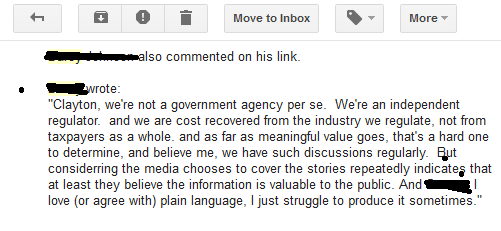
neb1

Oh wow. First of all, it is a joke to say that the NEB is an “independent regulator”. Although it is not admittedly clear what that even means. The NEB was created by the government of Canada to function as a cartelization device. There isn’t even a question.

Once upon a time, Western Canada’s independent oil producers wanted to build a pipeline to the East. Big international oil producers, who had far more political clout, preferred an arrangement whereby the east imported oil to be refined in Montreal, and Alberta oil would be exported to the US. How could this ever be settled?

The government did the only thing that could be done — it set up a commission, which later went on to create the NEB.

The conclusion regarding the pipeline was determined in advance. Therefore, the Royal Commission on Energy was stacked with people favorable to those who wanted to create political advantages for some of their friends — including the chief of the commission, Henry Borden. He was head of a utility company who had agreeably helped the government run various different wartime central planning boards during WW2. Other members of the commission were knaves such as George Edwin Britnell, another central planner who’d honed his price setting abilities at the Wartime Prices and Trade Board, and Robert D Howland, a longtime bureaucrat who was fundamentally dedicated to government intervention. The most influential witness heard by the Commission wasn’t even a Canadian guy. It was Walter J Levey, a consultant from Wall Street who represented international oil businesses. This guy too loved central planning. He was head of the petroleum division of the Marshall Plan!

The NEB was never “independent”. It’s been purely political from Day 1. Central planning has always been its purpose. Any “independence” is a fantasy.

The NEB extracts “fees” from the industry it regulates. If these are involuntary, they are taxes. If they are voluntary, that too is worrisome because it conflicts with the idea of an impartial regulator. Not only that, but the agency doesn’t take enough from the energy industry to cover all its costs anyway, so yes, the taxpayer at large is fundamentally on the hook for this “independent” agency.

Note how the comment reveals how the bureaucrat is unsure of the value of the NEB’s market forecasts. He assumes it must be useful and important because the local Calgary news reported about it. Local Calgary news does not report — it parrots government pabulum and offers wildly inaccurate weather predictions. They are desperate for stories, and will therefore cover meaningless reports issued by government agencies that no one cares about. And believe me, the viewers don’t care — if they are the type of people who get their energy market predictions from the local news, then they don’t really care about energy market predictions. “Hi, futures broker? Please sell the March oil contract at market — because of what I saw on Calgary local news!” Nothing like that has never happened in the history of human existence.

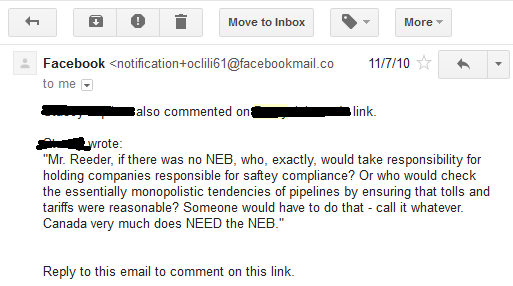
Now things start to get really exciting. A friend of the bureaucrat joins the discussion. She breathlessly demands how anyone could think the NEB should be abolished.
neb2

On the issue of safety, we must point out that everything could be done more safely than it is currently done. All safety decisions at the margin. The question is, who decides what is the “right” amount of safety?

There are only two options: the market can freely decide, or government can impose a safety standard. In the market, the price for “less safe” work will be bid up relative to “more safe” work. Hence the concept of “danger pay”. That’s why all Canadian lumberjacks have so much money. Tort law and contract law can deal with situations in which market chosen safety rules are violated.

Conversely, governments determine safety standards through political decision-making. They are imposed on firms with the power of guns and badges. Often, safety standards are determined by captured regulators. The largest, most powerful firms lobby for expensive safety standards that impair their smaller competitors. Furthermore, imposing standards reduces innovation, because resources will be shifted away from non-standard safety measures.

And who would check “essentially monopolistic” tendencies of pipelines? Who indeed? The market would normally do this. Monopolies only arise where competition is restricted by law. It is not a monopoly if I am the only guy with a pipeline in some area, so long as there is free entry to compete with my pipeline. But instead, the NEB exists to restrict competition, as one can see from its formation and continued operations. It doesn’t “check” the monopolies, but rather enforces them. The bureaucrat says so in his next comment. So it is foolish to say that without the agency which establishes the “essentially monopolistic” tendencies of the industry in question, no one would check these supposed tendencies.

We get to explore this further with the bureaucrat’s next comment:

neb3

First, I am always amused by how it is me, saying “let the market work,” who is arrogant. The bureaucrats who think they can manage something as complicated as energy markets are not arrogant at all. That’s rather modest. Because it can be done, as written in the regulatory economics textbook.

Who is to say what “duplication of facilities” is unnecessary? The bureaucrats? How do they know? They can’t know. But the market can determine whether a facility should be produced, because it involves people using their property and responding to prices. The bureaucrat’s attitude here smacks of simplistic Marxists who decry capitalism for giving us us too many brands of toilet paper and deodorant. Unnecessary production, they say. Because they know what is necessary? Right, and there is a herd of prancing unicorns that lives in my backyard.

One who grasps economic law comes to the realization that there is no “right” or “wrong” numbers of firms in a field of production. The market is constantly adjusting, and allocates resources accordingly when more competition is needed (rate of return is too high) and when there is less competition needed (rate of return is too low).

The reader should take special notice of how this bureaucrat — who assures us he is a champion of consumer interests — offers an argument that is ridiculously convenient for the monopolies and oligopolies themselves. “Yes, free competition is good, but not in this situation — i.e. the situation in which competition would threaten my own profits, which are determined on a cost-plus basis. It’s a natural monopoly, so competition just can’t be allowed!” Anyone intelligent can see what is going on here — unless they have a degree in Economics.

The bureaucrat needs to have it pointed out that there are no “natural monopolies”. There are only monopolies and monopolistic privileges created by restriction of competition. And this only arises through government interference. It is not a monopolistic advantage for one firm to be bigger than another. He cites TransCanada, which supposedly couldn’t benefit from its monopolistic privileges (provided by government) because it was regulated (by the government). What a mess. Without restrictions to competition, it would have literally been impossible for TransCanada to do what the NEB claims it prevented. The pipeline business overall would have been much stronger.

This follows the classic pattern of intervention. Government intervention introduces a problem (monopoly prices). People complain about it. The government does not eliminate its previous intervention, but instead responds with more intervention (regulation of prices) to “solve” the problem it created.

This is just like how we are supposed to believe governments and central banks do great jobs regulating their financial systems. Like the US government and the Fed must be real heroes, regulating the economy and looking out for the national interest rather than some other interest. Because that’s what it says in the Introductory Macroeconomics textbook.

And “cost of service”. Yuck. That’s just the best way to regulate, he says. Dear God. Are we going 150 years backwards in economic science here? To say that anything, anything at all, should be priced because of what it “costs” is to deny the subjective theory of value as applied to economic goods. Prices determine costs — not the other way around! We’ve known this since the 1870s. That’s what the Marginalist Revolution was. Yet bureaucrats prefer unscientific nonsense if it will justify their existence.
neb4

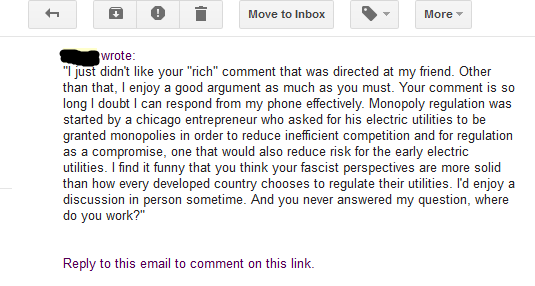
Oh no. He did not bring up Chicago. Yes, he did! Well this is the end for Mr Bureaucrat. He is absolutely clueless.

Before regulation replaced market competition in Chicago, there were FORTY-FIVE electric light companies. Gas prices had fallen 50 percent. The Chicago “entrepreneur” referred to by the NEB bureaucrat did not like all the competition. Instead of fighting it out in the marketplace, he lobbied local and state regulators to grant him monopoly privileges. Like our bureaucrat friend says, the Chicago utility owner wanted to reduce his risk. He wanted to protect his profits. He didn’t want competition raining on his parade. Great for him and his company. Great for bureaucrats with all their new regulatory jobs. Bad for everyone else!

Oh, but one might say: “If there is too much competition it will be impossible to get ‘fair’ return!” Apparently the bureaucrats and those benefiting from the monopoly know what a ‘fair’ return is, but a firm that wishes to risk its capital by competing in a “natural” monopoly doesn’t? Give me a break.

A quick tangent: The fascist reference is pretty hilarious. The guy who opposed to monopolies propped up by state regulators is the fascist. Not the bureaucrat who wants to run the economy his way. Not the firms who capture regulators to preserve their monopolistic advantages.

He finds it incredulous that I could regard the consensus about utility regulation to be totally wrong. All the countries do it like this, so they must be right, and I must be wrong! Again, there is no reason to think that just because it is currently done one way, that way must be good. Again, look at the world financial system. We are in the midst of a global economic catastrophe because that consensus is horribly, profoundly wrong. Mainstream economics, the very stuff the NEB bureaucrat is depending on, has totally failed us. Even Mervyn King said the financial system is a joke, regardless (or because of) of how closely it follows the textbook prescription.

If it’s true in the case of financial regulation, why not in the case of utility regulation? We can apply the same economic principles to public utilities as those we use to determine the financial system is bad, and we are inexorably bound to come to an anti-interventionist position on the issue. What is so inconceivable about thinking mainstream economics has monopoly theory completely screwed up, with its bogus, fantastic models of perfect competition held up as the standard to compare real economic activity?

I’m not sure why he cared about my job so much. Maybe because he was trying to network his way out of the soul-sucking bureaucracy, despite his claims of how awesome the NEB is. Or perhaps he wanted to put me in some category of people with allegedly less credibility than him, as if that were possible. My cat knows more about economics than this guy. If I remember correctly, I told him I worked at McDonalds and was an expert at making Big Mac Combos, so that it would be even more embarrassing for him to be out-matched on an economic debate.

There were a few other less substantive comments exchanged after this, but the damage had been done. The NEB bureaucrat deleted the page with this discussion and then drowned in an ocean of tears.

Carney is off to the Bank of England — Pray for England

Bank of Canada Governor and ex-Goldman bankster Mark Carney was selected to become the next Governor of the Bank of England. He will now be overseeing a central bank with nearly ten times the assets of the Bank of Canada. That is a big promotion in the world of central planners! Carney will now be able to create even larger disturbances in economic systems.

Truly, the worst rise to the top.

Good riddance, I say. Not that I expect him to be replaced with anyone much better. But there is always a chance.

I feel bad for England, though. They have no idea what they are getting themselves into (from Bloomberg):

Carney, who holds an economics degree from Harvard and a doctorate from Oxford University, swaps oversight of an economy which bounced back from the global recession without witnessing a single bank bailout for one which slipped back into recession in the second quarter and required multiple bank rescues.

Did you see what they did there?

Carney … swaps oversight of an economy which bounced back from the global recession without witnessing a single bank bailout for one which slipped back into recession in the second quarter and required multiple bank rescues.

Carney … swaps oversight of an economy which bounced back from the global recession without witnessing a single bank bailout … 

an economy which bounced back from the global recession without witnessing a single bank bailout …

without witnessing a single bank bailout

Excuse me? The banks that pushed for Carney to be their man in England have surely put the shucks on the rubes.

Of all the deleterious myths that persist about the Canadian financial system, none are more harmful or obnoxious than the bogus story that its banks never needed and/or never got a bailout.

Anyone who says this is simply lying or has no idea what they are talking about. Those are the only real possibilities. We have covered this at CMR previously, but let us quickly review.

The mainstream news doesn’t even try to deny it anymore. The Canadian banks got a bailout. Now they simply try to play down the significance of it. Even though it is was much bigger than anyone was led to believe.

So is this “no bailouts in Canada” proposition challenged by anyone in the UK? Carney is being sold on the pretense that there were no bailouts?   

(Side note: We could also mention that Canadian banks received assistance from emergency Federal Reserve lending facilities, which by itself is very interesting. We could also mention that rather material fact that Canadian banks are basically in a state of “perma-bailout” by virtue of the Canadian Deposit Insurance Corporation. The existence of the CDIC amplifies the level of risk banks are willing to engage in — it is classic “moral hazard.”)

So it would seem one is more likely to see bank bailouts with Carney, rather than less. That is precisely why the UK banking cartel wants Carney in this position.

Yet that is not the only reason citizens of the UK should worry.

Mark Carney is not only a believer in bailouts — he is a believer in Keynesianism and mercantilism. This means nothing more than this: he sees a connection between depreciating the currency and growing the economy. This he shares with nearly all central bankers (except, perhaps, those in Singapore): he regards a strong currency as harmful to “the nation”. Because when he talks about “the nation,” he is not talking about the consumers (i.e. everyone) who use their stronger currency to buy and invest in more goods. For men such as Carney, “the nation” instead refers to politically-connected export industries that are benefited by making it cheaper for foreigners to buy their stuff.

That being the case, Carney will tend to increase the money supply by adding assets to the central bank’s balance sheet whenever he thinks it’s a good idea. But this means prices must rise and debts will deepen. Britain already has big problems in these areas.

This should be the last thing someone in the UK should desire. The British pound has plummeted in value the last five years against stronger currencies like the yen. Here in Canada, it seems Carney’s manipulations have been obscured by strong demand for Canadian commodities, yet with the slowdown in Asia, Europe, and soon the US, I doubt this will persist. The Bank of Canada has been growing its balance sheet for nearly two years now, since offloading some of its emergency acquisitions during the financial crisis.

Also, it should be known that Carney likes to troll citizens whose currency he manages by blaming them for behavior that is strongly encouraged by his own central bank policies. What a jerk.

I am happy to see Carney go. While I am happy he no longer oversees the Canadian dollar, I am apprehensive about who his replacement will be. Most of all, I must also bemoan the lack of justice. Carney should be serving a prison sentence for counterfeiting, rather than getting $1 million a year to manipulate huge economies.

Will “tougher mortgage rules” hurt the economy? Don’t listen to the shills for the mortgage industry.

The folks in Canada who sell mortgages are complaining about the federal government reducing the subsidy to its business.

From the Financial Post:

The Canadian Association of Accredited Mortgage Professionals says since new rules went into effect in July, 2012, resale housing activity is 8% lower between August and October than a year earlier. Among the changes instituted by the government was a lowering of allowable amortization from 30 years to 25 years for consumers borrowing with mortgage default insurance which is backed by the federal government.

Let us think about this for a moment. By providing insurance against default, the Federal government provides a huge benefit to the mortgage industry. It insulates them against potential losses. This causes them to extend loans to to submarginal borrowers who would not be otherwise creditworthy. I can tell you I would make much riskier investments if someone would pay me back for any money I lose.

Jim Murphy, chief executive from CMAAP, is not happy:

“My concern is that a policy-induced housing market downturn creates unnecessary risk that directly affects not just housing but job creation and the economy as a whole.”

This guy really is clueless. First of all, what is this about “a policy-induced housing market? The “policy-induced” aspect of the housing market is, clearly, the availability of government backed loans for houses and the inflationary policies of central banks, not the reduction in the subsidy to his friends.

More importantly, it is simply false that reducing this subsidy will hurt the economy.

A great deal of resources are shifted into the housing industry that would otherwise be used in a different way because of federally backed mortgage loans. If you are a mortgage lender, a 30-year amortization increases the amount of interest you will take in. On an $375,000 house, you are talking about an extra $65,000 in interest. If more loans are made, housing prices will be bid up. Money flows into the financial industry and the construction industry. More people will be employed at banks, mortgage brokerages, and home-builders, and related businesses.

As resources shift into some sectors, they are necessarily shifted away from others. Everyone now has to pay more for houses than they would without so many buyers, who are effectively subsidized to a greater or lesser extent. But beyond the price of the home itself, for the guy buying a house, he is paying an extra $65,000 in interest to the bank. Assuming that is about equal to his annual salary, he basically has to devote an extra year of his life to pay the bank. He likes this, because “Pay less now, more later” is the mantra of our age, but he would pay less overall with the shorter amortization. $65,000 is not chump change — it would buy his wife a new car and send his kid through university. More money and jobs goes into housing, but less money and jobs are produced elsewhere as a result.

So we can understand the impact of this sort of intervention in the mortgage market. Resources are allocated not according to how the market would most efficiently allocate them, but rather are diverted to profit from the government’s protection of the financial industry. Therefore, the elimination of this subsidy would represent a favorable change to the overall economy. This means that some people would be unable to get low mortgage rates that are backed by the taxpayers. Housing prices would fall. It means homebuilders would have fewer homes to build. Lenders would make less money.

To some people, these consequences are bad. To the economist, these consequences must be considered good, because they represent the economy re-allocating resources according to efficiency, rather than government intervention. Resources will have a greater tendency to shift to uses consumers actually need.

Unfortunately, the insurance still exists. It has not been eliminated. The government will merely provide less of a subsidy than they did before. Therefore, the market will be distorted relatively less than it was previously. The economy will be slightly better, because fewer resources will be shifted to inefficient uses (i.e. housing and Jim Murphy’s summer home).

The best thing that could happen would be for the Canadian government to eliminate taxpayer backed mortgage insurance completely, which would do a great deal to restore a free market in housing.

Victory for poutine… for now.

Wanna-be social engineers in a small Quebec town tried to ban poutine and other “unhealthy” food at their arena. But you can’t mess with poutine lovers. I mean, I would fight to the death for a good poutine. Wendy McElroy writes:

A headline in the National Post (07/10) announced, “Hot dogs and poutine stage comeback after Quebec rink’s fans revolt.”

The story revolved around the town of Lac-Etchemin, Quebec that prided itself on being the first Canadian municipality to ban ‘unhealthy’ food from its arena. “Now, in an admission that paninis are outmatched against poutine, the town council has lifted the ban and French fries will return before the end of the month.”

You might chortle at the hubris of a Quebec town trying to ban the delicious French Canadian staple of french fries laden with cheese curds, smothered in gravy. You should applaud the victory of rebellious Canadiens against the Nanny State municipality. In doing so, however, it is important to realize that the attempted ban is neither humorous nor trivial. It is merely one instance of government’s creeping encroachment into what goes onto your dinner plate. In the ’80s, people protested under the slogan “Get government out of the bedroom,” meaning that the state had no proper business monitoring or punishing the consenting sexual choices of adults. Today, the protest should read “Get government out of the kitchen.”

FOOD AS SELF EXPRESSION

The governmental censoring of food choice is often viewed as a trivial matter or even a benevolent one. After all, what is one french fry more or less? And the goal, as stated, seems well-intentioned.

There is nothing benevolent, however, about state imposed control over one of the main ways in which human beings express themselves. Food choices are personal; they define our identity as surely as our choices in attire or reading material. “Food is love” is a hackneyed saying that conveys the basic truth that eating is about far, far more than sustaining life.

Food is an integral aspect of transmitting culture and ethnicity. From Italian pastas to Indian curries, from poutine to falafels,  a rich array of dishes form a part of your family’s history and the background of who you are. Often the mere smell of a dish as you walk by a restaurant can elicit a flood of childhood memories, including how recipes or cooking techniques were passed down from one generation to the next.

Food is also a form of cultural exchange through which diverse ethnic groups can automatically appreciate each other’s heritage. The appreciation happens spontaneously, without tax-funding, laws or government programs. It happens every time someone chooses a Chinese restaurant or expresses preference for a Jewish deli. During World War II, sauerkraut was widely banned in North America as “unpatriotic” because of the deep hostility toward anything German. Equally, the approval of ethnic food is a form of acceptance of a culture or, at least, of one significant aspect of it.

Food is also a moral choice as every vegan knows. It is a religious choice as Orthodox Jews will attest. Food is also a political statement as any farmer who produces raw milk will tell you.

One of the most important functions of food choice returns to the saying, “food is love.” When a spouse or mother celebrates your birthday, it is through making “a favorite meal” or baking a cake. When a man proposes, it is over a romantic meal at an expensive restaurant. When you express sympathy at a post-funeral gathering, you do so while holding a casserole that you’ve brought over. It is commonplace for those who are emotionally distressed to seek ‘comfort food’ that allows them to ‘feed themself’ when the world is not. How many women have recovered from a broken heart over tubs of ice cream?

Precisely because of its strong emotional pull and roots in culture, food choice has become one of the most important rituals in our society. From Thanksgiving to Christmas, from Hallowe’en candy to chocolates on Valentine’s Day, food and ritual are inextricably linked.

Ultimately, food is also one of the main forms of self-control you exercise over your own body. Through these choices, you express a personal judgment on what benefits your body and/or fits your lifestyle; for some, the judgment leads to an Atkins diet, for others it is organic lentils. Even people who make allegedly ‘bad’ choices are expressing themselves.

The bounty and diversity of food available in every grocery store and each passing street corners should cause joy because it demonstrates the richness of society itself – not merely in terms of prosperity but also in terms of choice.

Thus, when government dictates what you may or may not eat, it is restricting your heritage, your religious and political choices, the control over your own body; telling you that a choice every bit as personal as freedom of speech or the art you view is not yours to make. That decision is theirs.

Why? For your own good. Even as an adult, you cannot be trusted with choosing the food that goes into your own mouth at your own expense. That’s what government experts are for.

ARE THE EXPERTS CORRECT?

Politically-speaking, it does not matter whether the food ‘experts’ are correct about poutine any more than their opinion on a specific work of literature should matter…at least, politically-speaking. You have an inalienable right to read graphic novels about a dystopian future rather than be force-fed Ibsen’s writings on dysfunctional families. You have a similar right to eat food bought at your own expense.

Nevertheless, almost all discussion of government’s censorship of food choice revolves around whether or not the claims being made are true or false. This would be a fascinating and valuable discussion if it did not always seem to end at the conclusion “there ought to be a law.” Thus, otherwise interesting discussions about the value and risks of raw milk result in farmers being arrested and driven out of business by huge fines. Otherwise interesting discussions about the calorie-count or artery-impact of poutine end in the banning of a cultural choice. This is akin to banning literature because a government book reviewer finds the contents to be ‘unhealthy.’ Society should cease to have discussions that end in such conclusions.

Those who are in the “there ought not to a law” camp often encounter the following argument: we live in a society that offers (to varying degrees) free health care. This means that tax-payers bear the consequences of providing health care to those who are reckless with their bodies through drugs, alcohol, smoking or unhealthy diets. In short, your neighbor has a vested and financial interest in what goes into your body.

This line of reasoning – rather than justifying a Nanny State or a nosy neighbor dictating your personal choices – constitutes a powerful argument against socialized medicine. If socialized medicine had been ‘advertised’ decades ago as a government mandate to control the minutia of your daily life, then it would probably have never been implemented. If socialized medicine had announced itself as the right to usurp parental control over what to feed children, then it would have met the same ‘rink-revolt’ that occurred in Lac-Etchemin.

Tell the government that it is not a welcomed guest in your kitchen. There is no room for bureaucrats at your dinner table.

While this battle has been won, the war is not over. Denmark has passed the first “FAT TAX” which charges 16 kroner per kilogram of saturated fat in food when the saturated fat content exceeds a completely arbitrary number of 2.3%. Mark my words — wanna-be social engineers in Canada are dying to impose this kind of tax in Canada.

First of all, this is incredibly stupid from a health standpoint, as it is not saturated fat that makes you fat. But most importantly, this is terrible for business and the consumer. Making consumers pay more for their goods through government decree is just wrong, especially during a bad economy.  And although this is a form of consumption tax (targeting a certain class of goods), it ultimately taxes production and hurts business. Again, terrible idea anytime but especially when the economy is approaching absolute calamity.

But that’s not all. Once the principle behind these sorts of laws is accepted, nothing can be ruled out. Doug Hornig at Casey Research highlights the absurdity of these kinds of laws:

Why not meter Internet usage, so that addicts who log on more than a certain amount a week are taxed? Same with computer gamers; the number of minutes they play per day could be relayed to a central database in D.C. Obsessive collectors? Just monitor their eBay accounts and if they seem out of control, add a surcharge to PayPal transactions. Those who buy candy bars probably qualify as chocoholics by definition. They should pay extra. And don’t forget Netflix. If you’re ordering more than three movies a week, you’ve got a movie habit that ought to be taxed.

We can allow Hoppe to have the final and most decisive say on this kind of social engineering and its economic consequences:

Once again the effect of such a policy of behavioral controls is, in any case, relative impoverishment. Through the imposition of such controls not only is one group of people hurt by the fact that they are no longer allowed to perform certain nonaggressive forms of behavior but another group benefits from these controls in that they no longer have to tolerate such disliked forms of behavior. More specifically, the losers in this redistribution of property rights are the user-producers of the things whose consumption is now being hampered, and those who gain are nonusers/nonproducers of the consumer goods in question. Thus a new and different incentive structure regarding production or nonproduction is established and applied to a given population. The production of consumer goods has been made more costly since their value has fallen as a consequence of the imposition of controls regarding their use, and mutatis mutandis, the acquisition of consumer satisfaction through nonproductive, noncontractual means has been made relatively less costly. As a consequence, there will be less production, less saving and investing, and a greater tendency instead to gain satisfaction at the expense of others through political, i.e. aggressive, methods. And, in particular, insofar as the restrictions imposed by behavioral controls concern the use that person can make of his own body, the consequence will be a lowered value attached to it, and accordingly, a reduced investment in human capital.


So instead of people taking responsibility for themselves, these kinds of taxes and laws systematically cause people to think that they do not own their own bodies. If you don’t own something, you will take poorer care of it. As always, the way to make people more responsible is to make them free.


Nothing can save Europe.

There is no way that Europe can bail itself out. This guy makes the case with four facts:

FACT #1: Europe’s entire banking system is leveraged at 25 to 1.

This is nearly two times the US’s leverage levels. With this amount of leverage you only need a 4% drop in asset prices to wipe out ALL equity.These are literally borderline-Lehman levels of leverage (Lehman was 30 to 1).

Mind you, these leverage levels are based on asset values the banks claimare accurate. Real leverage levels are in fact likely much MUCH higher.

KA-BOOM.

FACT #2: European Financial Corporations are collectively sitting on debt equal to 148% of TOTAL EU GDP.

Yes, financial firms’ debt levels in Europe exceed Europe’s ENTIRE GDP. These are just the financial firms. We’re not even bothering to mention non-financial corporate debt, household debt, sovereign debt, etc.

Also remember, collectively, the EU is the largest economy in the world (north of $16 trillion). So we’re talking about over $23 TRILLION in debt sitting on European financials’ balance sheets.

Oh, I almost forgot, this data point only includes “on balance sheet” debt. We’re totally ignoring off-balance sheet debt, derivatives, etc. So REAL financial corporate debt is much MUCH higher.

KA-BOOM.

FACT #3: European banks need to roll over between 15% and 50% of their total debt by the end of 2012.

That’s correct, European banks will have to roll over HUGE quantities of their debt before the end of 2012. Mind you, we’re only talking aboutmaturing debt. We’re not even considering NEW debt or equity these banks will have to issue to raise capital.

Considering that even the “rock solid” German banks need to raise over $140 BILLION in new capital alone, we’re talking about a TON of debt issuance coming out of Europe’s banks in the next 14 months.

And this is happening in an environment prone to riots, bank runs, and failed bond auctions (Germany just had a failed bond auction yesterday).

KA-BOOM

FACT #4: In order to meet current unfunded liabilities (pensions, healthcare, etc) without defaulting or cutting benefits, the average EU nation would need to have OVER 400% of its current GDP sitting in a bank account collecting interest.

This last data point comes from Jagadeesh Gokhale, Senior Fellow at the Cato Institute, former consultant to the US Treasury, and former Senior Economic Advisor to the Federal Reserve Bank of Cleveland.

This is a guy who’s worked at a very high level on the inside studying sovereign finance, which makes this fact all the more disturbing. And he knew this as far back as January 2009!!!

Folks, the EFSF, the bailouts, China coming to the rescue… all of that stuff is 100% pointless in the grand scheme of things. Europe’s ENTIRE banking system (with few exceptions) is insolvent. Numerous entire European COUNTRIES are insolvent. Even the more “rock solid” countries such as Germany (who is supposed to save Europe apparently) have REAL Debt to GDP ratios of over 200% and STILL HAVEN’T RECAPITALIZED THEIR BANKS.

If Europe is to get out of this disaster, the answer is not bailouts. The mammoth debt must be liquidated. Big banks who made bad loans to profligate governments need to take their losses and go bankrupt. Anyone who is holding out, expecting some kind of economic voodoo miracle, needs to take their head out of the sand and recognize that solving the European debt crisis with bailouts is impossible.

— Read more at Phoenix Capital Research —