The First Lesson of Economics

Economics is the science that analyzes implications of human choice in the natural world as such.

Economic laws concern the universal form of purposeful behavior, which is always people choosing something rather than something else. Compare it with the law of contradiction, which deals with the universal form of an argument (A and not-A is false). Economic laws are applied to understand real phenomena.

Economics is not the study of what choices people have made, nor is it about why people make the choices that they make. Those are questions for history, psychology, and what German philosophers called verstehen.

Most importantly, economics does not say anything about what choices people should make — that issue must be resolved by ethics.

These Charts Give a Clue About Where the Gold Price is Headed

The price of gold has been going through an anxious bottoming period and now seems resolutely back above $1300. But what’s next?

Look at the following chart:

Basically, this chart shows the difference between commercial long and short positions. The green dots are positioned at intermediate low-points in the price of gold, which are also points where commercial net longs are at relative highs. This is no coincidence. The commercials are major players in the market. They hedge against price fluctuations rather than speculate. They reduce their short positions near significant price bottoms. If you could go back in time, the green dots would be your buy signals. This chart shows commercial short positions at the lowest point in a very long time — more than ten years. Where do you think the newest green dot will appear?

Now look at this chart, which is a little different.

This also illustrates how the falling price and increase in commercial long positions generally foreshadows a meaningful rally for gold. If I were to judge from this chart, I’d say we should expect a significant expansion of commercial longs. The price of gold should correspondingly rise. Here, the red dots are the buy signals. Where do you think the newest red dot would go?

As a conservative estimate, if we saw a rally comparable 2005 and 2008’s moves, the next phase of the gold bull market would approach $2000/oz.

This process is likely to unfold as the current business cycle matures, over the next one or two years  Then when another panic hits, gold will sell-off until central banks accelerate their monetary interventions. They will do this to fight the onset of a crushing economic depression.

— Read more at King World News

BOOK REVIEW: Murray Rothbard – Man, Economy, and State (with Power and Market)

Murray Rothbard’s contribution to economic science cannot be overstated. Following the footsteps of Mises’ Human Action, Rothbard’s own treatise leaves no economic question untouched.

Man, Economy and State presents the entire corpus of economic law, deduced logically from the undeniable fact of human choice. Truly embodying the Austrian methodology, Rothbard was a system-building rationalist, and so this book has little resemblance to mainstream economics. Following Mises’ “praxeologic” approach, Rothbard builds economics not on models or mathematics, but using primordial logical principles to explore the formal implications of purposeful human behavior. (It is interesting that Rothbard was a mathematician before coming to the economics field, so this choice is especially notable.) His treatment gives economic law a vividly real actuality not commonly present in writings on the subject. Unlike most economists, Rothbard never forgets he’s talking about real people.

Rothbard not only presented Austrian economics in a systematic, complete way — he also advanced it considerably. Some examples of his contributions to the hard-“core” of Austrian economics: (1) he refined and improved the theory of marginal utility significantly, (2) he greatly elaborated and developed theories of production (although I believe his theory of interest is not strictly correct), (3) reconstructed the approach to welfare-economics, (4) demolished the illusory free-market monopoly problem.

Also crucial to his economic theory was his in-depth analysis of violent intervention in the market. This was originally relegated to a separate volume because the publisher thought it was too radical to print as part of the main treatise. The Scholar’s Edition of Man, Economy, and State includes Power and Market, as it was meant to be. Here, Rothbard drives the final nail in the coffin for virtually any argument that the government do anything positive for the economy. He exposes all forms of intervention as leading to impoverishment. Power and Market concludes with a critique of anti-market ethics. This section is effective because Rothbard himself relies on no ethical argument, but the simple exposure of logical flaws and erroneous reasoning in traditional complaints about the market.

Rothbard also recognized that economic and ethical problems have the same, fundamental root: scarcity, without which neither discipline would be at all meaningful. This connection was critical for Rothbard as he later developed his political philosophy, which was systematically presented later in The Ethics of Liberty (1982).

Considering Rothbard completed this treatise when he was only 36, his level of scholarship is nothing short of incredible. He tackles the questions of contemporary economic journals along with the classic problems. His footnotes are full of treasures.

This is truly one of the most important works of economic theory ever written. Indeed, it covers everything, and Rothbard’s clear, tempered prose is unrivaled in either philosophy or economics. Anyone who is alive should read this book. If you’re dead and you can read, well… that’s amazing, but still the book won’t be much used to you.

(This review was originally published in 2005.)

Purchase Man, Economy, and State from Amazon for cheap here, or read it for free online here. —

Why the Fed Will Not “Taper”

Is the Fed going to “taper”? In other words, will it slow the rate of monetary expansion? When will the Fed do this?

That’s what everyone wants to know. As the central bank for the world’s biggest consumer, the Fed is especially important. Their actions have a major effect on the actions of other central banks. The Bank of Canada’s policy is in many ways a function of the Fed’s.

Canada’s head central banker Poloz will not rock the boat. He fears price deflation. The central bankers in Europe and Britain are explicitly committed to inflation. More and more central banks are joining to cause of money printing, like Japan and Australia, yet the Fed seems to be a bit of a wild card.

That’s because because of Bernanke’s remarks on June 19, where he appeared to raise the Fed’s unemployment target from 6.5% to 7%. He suggested the Fed might slow its bond purchases sooner than previously indicated.

Bernanke went out on a limb and changed the target numbers for unemployment in his speech from what was written in the FOMC report.

St. Louis Fed President James Bullard was critical of Bernanke’s comments, in a wishy-washy bureaucratic sort of way. He tried to tell us that Bernanke didn’t really mean what he said. Bernanke even later came out and confirmed his position is the same as it’s always been: “When the economy gets better, we’ll stop. Someday. Maybe.”

Which sort of goes without saying. Of course the Fed plans to execute its promised “exit plan” when the economy gets better. That’s the whole idea behind extraordinary measures like quadrupling its monetary base since the 2008 crisis with QE 1-3. So what’s the big deal?

Other than Bernanke’s 7% comment, the FOMC has been very clear about what it plans to do. The position in the June 19 press release was unchanged from their March press release. The March release was the same as the January release. Literally the sameword for word.

In these press releases, the FOMC has been explicit. The Federal Reserve will maintain its current policy of QE if the US unemployment rate remains above 6.5% and price inflation remains below 2.5%.

All this debate over whether the Fed will “taper,” and all because no one seems to read what the FOMC says.

A few FOMC members said maybe they should taper later this year. But unemployment is not falling fast enough. Price inflation is not rising fast enough. The Fed’s policy is unlikely to change.

Even if it does change, and they slow the rate of monetary expansion, they will be forced to intervene again. No one mentions that there was tapering after the previous QE’s. Heck, they didn’t just taper in 2012: they actually deflated slightly.

But these little taper episodes don’t last. They simply led to further expansion later. So why not a little bit of tapering after QE3? But that will eventually necessitate QE4. When central banks begin slowing their monetary expansion, the correction will manifest and they will intervene again in desperation.

Despite this reality, economists, investors, and financial reporters are obsessed with rumors and hypotheticals because they do not understand central bank policy.

The spastic reaction of investors was very interesting. Markets fell. Yields shot up quickly as a massive $80 billion was pulled from bond funds in June. Gold briefly fell below $1200. Clearly this illustrates that this economic error cycle is perpetuated entirely by faith in central bank bureaucrats to keep the money pumping. Which is, by the way, exactly what the Austrian business cycle tells us.

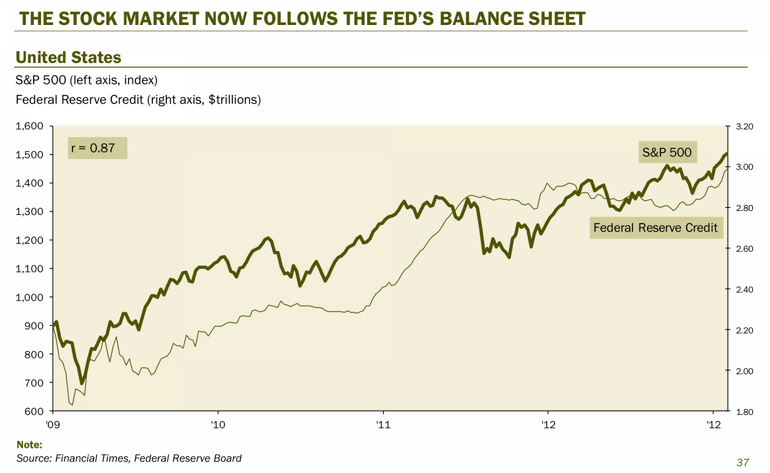
You can quite clearly see how the Fed’s expansion is correlated with stock market performance in the last few years. Any time the markets have been worried, the Bernanke Fed has stepped up to deliver QE.

s&p and fed

I don’t think the Fed is communicating any kind of serious change in policy. And regardless of what they say, they are completely trapped by their own policy.
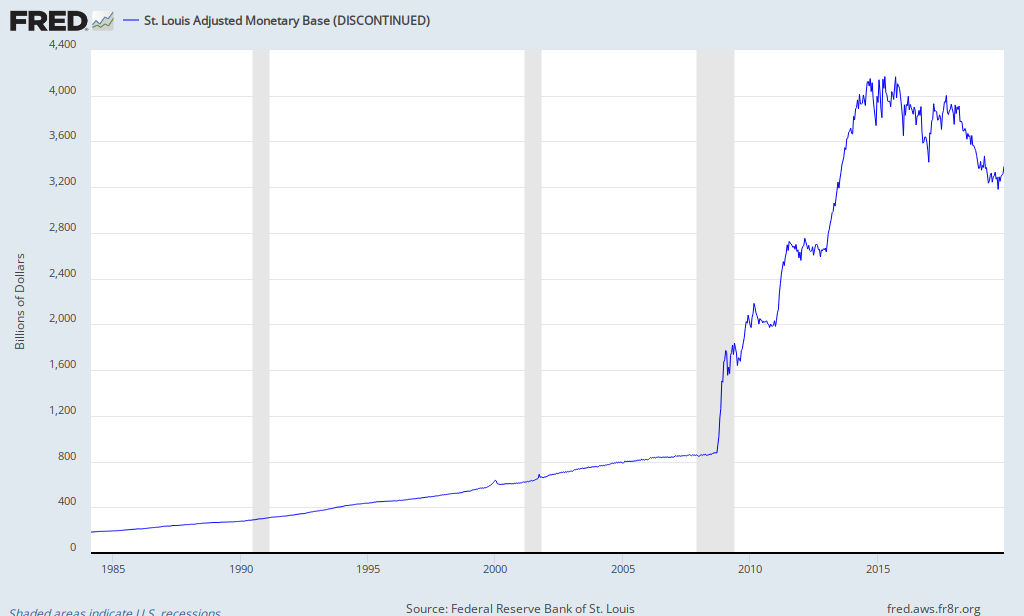
FRED Graph

The Fed cannot pull off a smooth “Exit Plan” with that monster they call a balance sheet without causing a crash far more vicious than 2008.

Is there any way the Federal Reserve could avoid this?

Actually, yes. Their asset sales would have to be offset by the releasing of commercial banks’ excess reserves into the economy. Currently these reserves are massive, corresponding to the Fed’s expansion.

Graph of Excess Reserves of Depository Institutions (DISCONTINUED SERIES)

If the Fed stopped QE entirely and started selling assets, but the banks lent out their excess reserves, you wouldn’t even notice the Fed’s exit. In fact, there would be price inflation. That’s because the fractional reserve process could generate nearly $10 trillion in new money out of those excess reserves.

But this will never happen. This becomes obvious as soon as you ask: “Why would the big banks want to release their excess reserves?”

They are not lending now, so why would they want to lend it when the Fed is selling assets and therefore bringing about a recession? The banks are hoarding their excess reserves now due to extreme uncertainty and impaired balance sheets. They are less likely to lend those funds if the Fed tapers.

But what if the Fed tapers and stops paying interest on excess reserves? Yes, the could do this if they wanted. This is a relatively new policy implemented in 2008. But halting this would have little effect.

The banks earn almost nothing on their deposits at the Fed: close to zero percent. Going from almost-zero to zero will be insufficient motivation to lend, especially when the economy is expected to slowdown. Better to make zero return than risk losing 5% or 10% or more when the economy goes bad.

But what if Bernanke went further? He could charge the banks fees and penalties for having too high a level of reserves. I do not believe he will do this because the banks would not like it. Due to counter-party risk and the danger of short-term creditors doing a bank run on a major institution, it’s least risky for the banks to hold their reserves at the Fed.

Another reason why he and other central banks will not force their big banks to lend: they fear massive inflation would result, and no one wants to deal with that. Bringing it under control would bring about a crippling depression.

An interesting possibility that should be considered is the Fed reducing the rate of QE3 just before Bernanke departs in Feb 2014. They could then safely blame him for any negative effects which follow. If the Fed announces a reduction in QE in September, that would fit with this scenario. However, I do not believe they will do this. Bernanke wants to ride off into the sunset without any additional controversy. He is not even speaking at the Jackson Hole meeting this summer, due to “personal reasons.” He wants to get out his position stealthily rather than in a flurry of disputation. He doesn’t want to push a tapering policy that will reflect badly on him as he leaves his position.

And what’s true of Bernanke is true of all the central bankers — none of them want to look bad in front of their friends. So they will continue to inflate.

CONCLUSION

After the NASDAQ bubble exploded and the US went into recession, Alan Greenspan pumped money into the economy to generate a new boom cycle. Over that time, the economy responded to the resulting misshapen financial markets with the formation of a housing bubble. Greenspan departed and Bernanke began to raise rates. The result was the 2008 crash, during which Bernanke & Friends carried out an unprecedented expansion of the monetary base. Another boom period was generated. The US stock market is again making all-time highs, optimism is much more widespread, and all forecasts and experts seem to agree that the recovery is robust and genuine. This means we are in the economic danger zone.

The Fed’s 100-year pattern of propagating booms and busts will continue either until they crash the economy by selling assets, or a monetary crisis arises that they cannot control.

The Fed may tinker with its money supply here and there, but we are a long way from any “exit plan.” Until then, don’t count on any real tapering for any significant amount of time.

Disney’s 1943 Anti-Nazi Propaganda Cartoon: Public Education in a Nutshell

During World War II, there were a lot of cute propaganda cartoons made for kids.

Here is one from Disney about public education in Nazi Germany. What applies to public education under the National Socialists applies in principle to public education everywhere.

Public education is one of the most dangerous of all government programs.

Alberta Floods 2013: RCMP Invades High River Homes, Seizes Guns

The RCMP is acting like an occupying army in High River.

RCMP officers working in High River, Alta., on June 25, wear protective masks to prevent toxic dust from entering their lungs. The RCMP took some guns from homes they searched that they said were not stored safely and the Prime Minister's Office issued a statement Friday saying it wants them returned.

Governments invariably use emergencies to extend their powers and subject the citizenry to greater abuse. Natural disasters are no exception.

High River was devastated by the flood. The entire town was evacuated.

It has been eight days since residents were forced from their home. As the waters recede, people want to return home and see the status of their property.

“No way,” says the RCMP.

High River is effectively under a state of martial law so intense the citizens cannot even enter the town at all. The RCMP set up a roadblock with 30 officers to prevent residents from entering. Dozens of police cars with flashing lights lined the streets menacingly. A spike strip was deployed to cripple the vehicle of any outlaw who dared to enter the town.

But it is not enough for the RCMP to use threats of violence to keep out residents. Some High River residents have firearms in their home, you see. So those homes had to be invaded, and the firearms had to be confiscated.

“People have a significant amount of money invested in firearms … so we put them in a place that we control and that they’re safe,” said one RCMP sergeant.

Oh. They are taking guns to do those owners a favor. See? No problem.

“It’s like Nazi Germany,” says a resident. Yes, it is sort of like that. It’s also sort of like New Orleans and Hurricane Katrina. FEMA confiscated civilian firearms during that disaster in the name of “safety.” That’s the real template for what’s going on here.

This kind of behavior by the RCMP was entirely predictable because of the lessons of Katrina. Memories of the scandals surrounding FEMA’s gross incompetence during Hurricane Katrina’s aftermath informed us how big, bureaucratic government agencies with police powers behave during emergencies. The RCMP is not particularly less malevolent just because they have funny uniforms.

Based on their actions, every level of government involved in the Alberta floods seems desperate to be as incompetent and harmful as FEMA.

The RCMP says they will return the guns to owners “after residents are allowed back in town and they provide proof of ownership.” Something tells me the occupying forces will make it difficult for the gun owners to provide such proof. “Oh, your proof of ownership was destroyed in the flood? That’s a real shame. No gun for you.”

Lorraine Hjalte / Postmedia News

Premier Redford defended the actions of the RCMP. “I really hope that we can focus on more important matters at hand, like getting 12,000 people back into High River than continue to circulate this story,” she said. She seems to overlook that the government has utterly failed in High River. The more they focus on getting High River residents back to their homes, the longer it is likely to take.

When will residents be able to return home? The RCMP tells us: “People much higher up are going to make those decisions.” That sounds efficient. The mayor of High River says no one can return home until Home Hardware and Shoppers Drug Mart are  open. 

In a rare moment of sanity, the Prime Minister’s Office said the RCMP should return the guns. By this I think they mean, “Make it possible in theory for the owners to get the guns back.” Since the Minister of Public Safety is in charge of the RCMP, the Prime Minister can essentially just order the RCMP to return the guns immediately. Yet this has not been done.

But the RCMP never claimed it would keep the guns forever. They’ve maintained the pretense that the guns will be returned. But it’s unlikely that process will be easy.

Will every owner get their guns back?

These are the guys the RCMP is so afraid of?

— Read more at the Calgary Herald, the Globe and Mail, and CBC — 

Alberta Flood 2013: Redford Promises “Whatever It Takes.” Uh Oh.

Premier Redford will help Alberta “no matter the cost.” How generous. But the Alberta government has no money. It’s all spent.

So what her promises really mean is the people who have already suffered enough from flooding will suffer further when Redford taxes them more and grows a bigger debt to dump on them. She would never in a million years cut any spending to free up cash because of unforeseen circumstances.

She will probably use this opportunity to push her darling PST for which she desperately yearns. Of course, it will be promoted as merely a “temporary measure,” but nothing is more permanent than a temporary tax.

Government policy is going to turn this “state of emergency” into a permanently worse Alberta.

Alberta Floods 2013: Calgary Flood Fascism

A crisis always brings out the best in people.

And it always brings out the worst in government.

20130624-155226.jpg

Alberta Floods 2013: Zero Connection to “Climate Change”

(Updated! See below)

Various manipulators with socialistic agendas have emerged in the aftermath of the epic Alberta floods to make unscientific declarations about how these floods were caused by “climate change.”

What kind of climate change? Probably global warming, but they don’t actually say so. Global warming ended about 17 years ago.

Global warming propaganda suffered a devastating blow in November 2009 when hackers released emails from the UK’s Climate Research Unit. These emails revealed the depths of deception on the global warming issue. These emails turned the subsequent  Copenhagen meeting on global warming into a big joke and the movement has never recovered. Now propagandists rely on the phrase “climate change” to try and deflect attention from the fact that there is basically no evidence for global warming.

Back in 1975, scientists blamed heavy rain and flooding on global cooling. So who knows?

In any case, it is unlikely that the epic Alberta floods have any connection whatsoever to “climate change”. Downtown Calgary is built right between two rivers — we’re lucky this kind of thing doesn’t happen more often.

Evidence suggests that it used to happen more often. Here are some historical cases of extreme Calgary flooding:

CALGARY (June 1897) Bow River rises about five metres turning downtown into a lake, washing out bridges, short-circuiting electricity and cutting Canadian Pacific’s line to Vancouver.

CALGARY (June 1915) The Bow washes away Centre Street Bridge, nearly drowning two city officials. Sheep Creek floods Okotoks and cuts gas mains, leaving Calgarians without cooking fuel.

CALGARY (June 1923) The Elbow River breaks the 1915 record by 20 centimetres when it rises to 2.9 metres. The Bow River, though it rises 1.5 metres above normal, is still about .6 metres under the 1915 record height.

CALGARY (June 1929) Bow, Elbow and Highwood rivers overflow to submerge High River as well as southwest and northwest city districts under a metre of muddy water. It takes a heavy toll on zoo animals.

CALGARY (June 1932) On June 1, 1932, Calgary receives 79.2 mm over a 24-hour period, just .6 mm less than the average rainfall for the whole month. The empty reservoir of the recently completed Glenmore Dam prevents major damage.

It might seem obvious, but High River’s name didn’t come from nowhere:

HIGH RIVER (May 1942) The town lies under two metres of water after rains swell the Highwood River, forcing evacuation of homes.

And here is a picture of the 1932 Calgary flood. Looks a bit familiar, doesn’t it (note the water level relative to the Centre Street bridge)?

flood

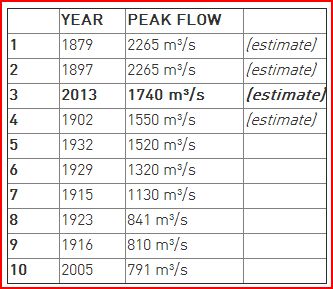
UPDATE: A crushing blow to the climate change propagandists: We are informed by the Weather Network that before the 2013 flood, the eight worst recorded floods in Alberta history occurred before 1933. In 1879 and 1897, the floods were about 35% worse.

floods 

Read more at the Calgary Herald