Bank of Canada’s Balance Sheet: Still Trending Higher

The Bank of Canada has somewhat arrested the rate of growth on its balance sheet. The monetary base has reached a bit of a “plateau” for now, very close to all-time highs from December 2013 ($91.045 billion on the books as of April 30 2014).

It seems Poloz is trying to follow along with the general “tapering” strategy of the Fed. In order to maintain the “boom” of this business cycle (as lame a boom as it might be), the balance sheet’s size must continue to trend higher. But the flattening of the curve means that the BoC’s purchases are slowing. This will tend to push down asset prices.

boc april14

Is the Taper a Big Lie?

(NOTE TO READER: There was a considerable time lag between the beginning of the QE3 taper’s declared beginning and when it actually started. This article was written during the lag, suggesting that the taper was all hype and no reality. Since then, the taper did become real and QE3 ended.)

The much-talked-about taper could be nothing more than a big joke. Where is the statistical evidence of the taper?

Let’s look at the last 10 years of the Federal Reserve’s balance sheet.

taper1

Here you can see all three QEs laid out nicely.

Let’s “zoom in” and look at just the last year.

taper2

The rate of growth briefly slowed then picked right back up. Other purchases appear to be offsetting the taper, at least so far. On net, no taper. Watch what they do, don’t fret too much over what they say (central bankers lie all the time).

Meanwhile, despite media reports and promises from European central bankers that they will inflate to prevent recession, the ECB is engaged in a deflationary policy, and has been for nearly a year.

Sometimes the official central bank statistics don’t match their words.

The Fed has been saying it will not let interest rates rise, yet at the same time it will slow its rate of purchasing assets. I don’t know how that is supposed to work, since regardless of the Federal Funds target rate, the market sets the real Federal Funds rate. Yet it almost makes sense if you assume while they might buy less crap via QE3, they will balance that with more purchases of different crap.

Did Canada’s Housing Bubble Just Get Popped?

Canada’s housing market has soared while the US market crashed.

Canada has the most overvalued housing market in the world:

The WSJ recently commented:

Canada, for example, is very open to foreign investors, which means that in an age of unprecedented global liquidity cash-rich wealthy individuals who are looking for places to park their excess funds can do so in its housing market far more easily than in Japan, with its closed system.

Now, the Canadian government is eliminating “its controversial investor Visa scheme, which has allowed waves of rich Hongkongers and mainland Chinese to immigrate since 1986.”

The story continues in The South China Morning Post:

Canada’s government has announced that it is scrapping its controversial investor visa scheme, which has allowed waves of rich Hongkongers and mainland Chinese to immigrate since 1986.

The surprise announcement was made in Finance Minister Jim Flaherty’s budget, which was delivered to parliament in Ottawa on Tuesday afternoon local time. Tens of thousands of Chinese millionaires in the queue will reportedly have their applications scrapped and their application fees returned.

The decision came less than a week after the South China Morning Post published a series of investigative reports into the controversial 28-year-old scheme.

The Post revealed how the scheme spun out of control when Canada’s Hong Kong consulate was overwhelmed by a massive influx of applications from mainland millionaires. Applications to the scheme were frozen in 2012 as a result, as immigration staff struggled to clear the backlog.

In recent years, significant progress has been made to better align the immigration system with Canada’s economic needs. The current immigrant investor program stands out as an exception to this success,” Flaherty’s budget papers said.

For decades, it has significantly undervalued Canadian permanent residence, providing a pathway to Canadian citizenship in exchange for a guaranteed loan that is significantly less than our peer countries require,” it read.

Under the scheme, would-be migrants worth a minimum of C$1.6 million (HK$11.3 million) loaned the government C$800,000 interest free for a period of five years. The simplicity and low relative cost of the risk-free scheme made it the world’s most popular wealth migration program.

A parallel investor migration scheme run by Quebec still remains open. Many Chinese migrants use the alternative scheme to get into Canada via the French-speaking province and then move elsewhere in Canada. The federal government has previously pledged to crack down on what it said was a fraudulent practice.

Flaherty also announced yesterday the scrapping of a smaller economic migration scheme for entrepreneurs.

All told, 59,000 investor applicants and 7,000 entrepreneurs will have their applications returned, Postmedia News reported. Seventy per cent of the backlog, as of last January, was Chinese, suggesting more than 46,000 mainlanders will be affected by yesterday’s announcements.

The Immigrant Investor Program, which has brought about 185,000 migrants to Canada, was instrumental in facilitating an exodus of rich Hongkongers in the wake of the 1989 Tiananmen massacre and in the run-up to the handover. More than 30,000 Hongkongers immigrated using the scheme, though SAR applications have dwindled since 1997.

The investor visa plan is truly stupid and should be eliminated. The idea of requiring loans to the government in exchange for citizenship is incredibly perverse. All money lent to the government is wasted and hurts the economy. The Chinese and Hongkongers who participated in this program could have really invested that money in productive endeavors instead. But this is a double-whammy to the Canadian economy, because to pay back those loans the Canadian state must tax its citizens, which hurts the economy even more.

But what effect will this have on Canada’s housing bubble? It will reduce demand for Canadian real estate. That obviously doesn’t help keep prices high.

Yet the really critical factor is central bank policy. The Bank of Canada is not up to date on its financial statements, but as of November it held more assets than ever. I am interested to see whether Poloz will “taper” with his American counterparts.

My intuition says that he won’t. Poloz wants to keep down the Canadian dollar and subsidize exports.  The Bank of Canada has been expanding its balance sheet since mid-2010. Canada’s M1 money supply has grown dramatically. Canada’s housing prices are high. Canada’s interest rates are low. Yield on Canadian government bonds have fallen below American bonds. Yet consumer prices are not rising quickly, so the Bank of Canada sees its policy as an epic success so far.

— Read more at zerohedge

Why They Never See It Coming

Mainstream economists fail to see why crises occur.

Financial Crises Don’t Happen by Accident

By Marc Faber

As a distant but interested observer of history and investment markets I am fascinated how major events that arose from longer-term trends are often explained by short-term causes. The First World War is explained as a consequence of the assassination of Archduke Franz Ferdinand, heir to the Austrian-Hungarian throne; the Depression in the 1930s as a result of the tight monetary policies of the Fed; the Second World War as having been caused by Hitler; and the Vietnam War as a result of the communist threat.

Similarly, the disinflation that followed after 1980 is attributed to Paul Volcker’s tight monetary policies. The 1987 stock market crash is blamed on portfolio insurance. And the Asian Crisis and the stock market crash of 1997 are attributed to foreigners attacking the Thai Baht (Thailand’s currency). A closer analysis of all these events, however, shows that their causes were far more complex and that there was always some “inevitability” at play.

Simply put, a financial crisis doesn’t happen accidentally, but follows after a prolonged period of excesses…

Take the 1987 stock market crash. By the summer of 1987, the stock market had become extremely overbought and a correction was due regardless of how bright the future looked. Between the August 1987 high and the October 1987 low, the Dow Jones declined by 41%. As we all know, the Dow rose for another 20 years, to reach a high of 14,198 in October of 2007.

These swings remind us that we can have huge corrections within longer term trends. The Asian Crisis of 1997-98 is also interesting because it occurred long after Asian macroeconomic fundamentals had begun to deteriorate. Not surprisingly, the eternally optimistic Asian analysts, fund managers , and strategists remained positive about the Asian markets right up until disaster struck in 1997.

But even to the most casual observer it should have been obvious that something wasn’t quite right. The Nikkei Index and the Taiwan stock market had peaked out in 1990 and thereafter trended down or sidewards, while most other stock markets in Asia topped out in 1994. In fact, the Thailand SET Index was already down by 60% from its 1994 high when the Asian financial crisis sent the Thai Baht tumbling by 50% within a few months. That waked the perpetually over-confident bullish analyst and media crowd from their slumber of complacency.

I agree with the late Charles Kindleberger, who commented that “financial crises are associated with the peaks of business cycles”, and that financial crisis “is the culmination of a period of expansion and leads to downturn”. However, I also side with J.R. Hicks, who maintained that “really catastrophic depression” is likely to occur “when there is profound monetary instability — when the rot in the monetary system goes very deep”.

Simply put, a financial crisis doesn’t happen accidentally, but follows after a prolonged period of excesses (expansionary monetary policies and/or fiscal policies leading to excessive credit growth and excessive speculation). The problem lies in timing the onset of the crisis. Usually, as was the case in Asia in the 1990s, macroeconomic conditions deteriorate long before the onset of the crisis. However, expansionary monetary policies and excessive debt growth can extend the life of the business expansion for a very long time.

In the case of Asia, macroeconomic conditions began to deteriorate in 1988 when Asian countries’ trade and current account surpluses turned down. They then went negative in 1990. The economic expansion, however, continued — financed largely by excessive foreign borrowings. As a result, by the late 1990s, dead ahead of the 1997-98 crisis, the Asian bears were being totally discredited by the bullish crowd and their views were largely ignored.

While Asians were not quite so gullible as to believe that “the overall level of debt makes no difference … one person’s liability is another person’s asset” (as Paul Krugman has said), they advanced numerous other arguments in favour of Asia’s continuous economic expansion and to explain why Asia would never experience the kind of “tequila crisis” Mexico had encountered at the end of 1994, when the Mexican Peso collapsed by more than 50% within a few months.

In 1994, the Fed increased the Fed Fund Rate from 3% to nearly 6%. This led to a rout in the bond market. Ten-Year Treasury Note yields rose from less than 5.5% at the end of 1993 to over 8% in November 1994. In turn, the emerging market bond and stock markets collapsed. In 1994, it became obvious that the emerging economies were cooling down and that the world was headed towards a major economic slowdown, or even a recession.

But when President Clinton decided to bail out Mexico, over Congress’s opposition but with the support of Republican leaders Newt Gingrich and Bob Dole, and tapped an obscure Treasury fund to lend Mexico more than$20 billion, the markets stabilized. Loans made by the US Treasury, the International Monetary Fund and the Bank for International Settlements totalled almost $50 billion.

However, the bailout attracted criticism. Former co-chairman of Goldman Sachs, US Treasury Secretary Robert Rubin used funds to bail out Mexican bonds of which Goldman Sachs was an underwriter and in which it owned positions valued at about $5 billion.

At this point I am not interested in discussing the merits or failures of the Mexican bailout of 1994. (Regular readers will know my critical stance on any form of bailout.) However, the consequences of the bailout were that bonds and equities soared. In particular, after 1994, emerging market bonds and loans performed superbly — that is, until the Asian Crisis in 1997. Clearly, the cost to the global economy was in the form of moral hazard because investors were emboldened by the bailout and piled into emerging market credits of even lower quality.

…because of the bailout of Mexico, Asia’s expansion was prolonged through the availability of foreign credits.

Above, I mentioned that, by 1994, it had become obvious that the emerging economies were cooling down and that the world was headed towards a meaningful economic slowdown or even a recession. But the bailout of Mexico prolonged the economic expansion in emerging economies by making available foreign capital with which to finance their trade and current account deficits. At the same time, it led to a far more serious crisis in Asia in 1997 and in Russia and the U.S. (LTCM) in 1998.

So, the lesson I learned from the Asian Crisis was that it was devastating because, given the natural business cycle, Asia should already have turned down in 1994. But because of the bailout of Mexico, Asia’s expansion was prolonged through the availability of foreign credits.

This debt financing in foreign currencies created a colossal mismatch of assets and liabilities. Assets that served as collateral for loans were in local currencies, whereas liabilities were denominated in foreign currencies. This mismatch exacerbated the Asian Crisis when the currencies began to weaken, because it induced local businesses to convert local currencies into dollars as fast as they could for the purpose of hedging their foreign exchange risks.

In turn, the weakening of the Asian currencies reduced the value of the collateral, because local assets fall in value not only in local currency terms but even more so in US dollar terms. This led locals and foreigners to liquidate their foreign loans, bonds and local equities. So, whereas the Indonesian stock market declined by “only” 65% between its 1997 high and 1998 low, it fell by 92% in US dollar terms because of the collapse of their currency, the Rupiah.

As an aside, the US enjoys a huge advantage by having the ability to borrow in US dollars against US dollar assets, which doesn’t lead to a mismatch of assets and liabilities. So, maybe Krugman’s economic painkillers, which provided only temporary relief of the symptoms of economic illness, worked for a while in the case of Mexico, but they created a huge problem for Asia in 1997.

Similarly, the housing bubble that Krugman advocated in 2001 relieved temporarily some of the symptoms of the economic malaise but then led to the vicious 2008 crisis. Therefore, it would appear that, more often than not, bailouts create larger problems down the road, and that the authorities should use them only very rarely and with great caution.

Fed Could Delay Tapering Until After December

Frank Shostak, Mises Institute

Most economists surveyed by Bloomberg News are now of the view that the Federal Reserve will begin tapering asset purchases in December. Contrary to expectations on the 18-19 of September, Federal Reserve policymakers have decided to continue with a very loose monetary stance and postpone the tapering of asset purchases.

Most policymakers are of the view that the U.S. economy is not strong enough to generate self-sustained economic growth. Hence it is held the economy still requires support from the Fed.

If Fed policymakers were to decide to taper bond purchases, most experts are of the view Fed policymakers are likely to announce that the U.S. central bank is going to keep its near-zero interest rate policy for a prolonged period of time. This, it is held, should prevent negative side effects coming from the reduction in bond purchases.

For instance, in 1994 when the Fed started a tightening cycle the federal funds rate rose from 3.05 percent in January 1994 to 6.04 percent in April 1995. This, it is argued, caused a sharp fall in the pace of economic activity. The yearly rate of growth of industrial production fell from 7 percent in December 1994 to 2.7 percent by December 1995.


We suggest that it is changes in money supply rather than changes in interest rates that drive economic activity as such. Interest rates are just an indicator, as it were.

A fall in the growth momentum of industrial production during December 1994 to December 1995 occurred on account of a sharp decline in the yearly rate of growth of AMS (our measure of money supply) from 13.7 percent in September 1992 to minus 0.3 percent in April 1995.

This sharp fall in the growth momentum of AMS has weakened the support for various bubble activities that sprang up on the back of the previous rising growth momentum of AMS.

(Even if the Fed would have kept the fed funds rate at a very low level, what would have dictated the pace of economic activity is the growth momentum of AMS.)

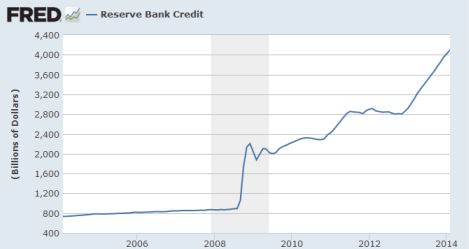
Note that a fall in the growth momentum of AMS was in line with the fall in the growth momentum of the Fed’s balance sheet — the yearly rate of growth of the balance sheet fell from 12.7 percent in June 1993 to 4.4 percent by December 1995.


Whilst in the 1993 to 1995 period, changes in the Fed’s balance sheet were positively associated with changes in the growth momentum of money supply. This time around this is not the case. (Changes in money supply are not responding to changes in the Fed’s balance sheet.) The key reason for that is bank reluctance to aggressively expand lending notwithstanding the aggressive pumping by the Fed.

So far in September, the growth momentum of the Fed’s balance sheet climbed to 30.6 percent from 28 percent in August. (Despite this massive pumping banks remain reluctant to aggressively expand lending.) In September banks were sitting on massive cash reserves of $2.2 trillion against $2.17 trillion in August and $2.4 billion in January 2008.


Consequently, the growth momentum of our measure of money supply AMS has visibly weakened. The yearly rate of growth stood at in September at 6.7 percent against 7.7 percent in August.

We suggest that irrespective of what the Fed is currently doing it will have very little effect on the economy at present and in the immediate future. Given a decline in the yearly rate of growth of AMS from 14.8 percent in October 2011 to 6.7 percent in September this year, we suggest this likely to depress economic activity going forward.

Again, this is likely to happen irrespective of the decision the Fed is going to take with respect to the tapering of assets purchases.

Based on the lagged growth momentum of AMS we expect that the yearly rate of growth of industrial production to fall to minus 1 percent by October from 2.7 percent in August.


Given the possibility of a sharp decline in economic activity on account of the fall in the growth momentum of AMS it is quite likely that Fed policymakers will decide to postpone the tapering of asset purchases also in December.

We need to add to all of this the possibility that the pool of real wealth might be currently in difficulties on account of the Fed’s reckless policies.

(The near zero interest rate policy has caused a severe misallocation of scarce real savings — it has weakened the wealth generation process and thus the economy’s ability to support stronger real economic growth.)

If our assessment is valid on this, we can suggest that a stagnant or declining pool of real wealth is likely to put more pressure on banks’ lending. Remember that it is the state of the pool of real wealth that dictates banks’ ability to lend without going belly up.

Conclusion

We can conclude that regardless of changes in the Fed’s balance sheet, it is a fall in the growth momentum of AMS since October 2011 that will determine the pace of economic activity irrespective of the planned actions by the Fed. Given the possibility that the pool of real wealth might be in trouble this could put further pressure on the growth momentum of bank lending and thus the growth momentum of money supply.

Bank of Canada’s Balance Sheet Continues to Swell

The Bank of Canada’s balance sheet shed about a billion dollars in August, but remains at record high levels.

Governor Poloz, like everyone else, is watching the Fed. With no taper in September (as we predicted), he is unlikely to do much to change BoC policy. To keep the Canadian dollar from appreciating too greatly against the US dollar, the BoC must maintain a level of quantitative easing consistent with the Fed’s own. Poloz is a mercantilist, and is therefore opposed to having a strong Canadian currency.

BoC as of October

Capital Is Flowing Out of the U.S. Faster Than Ever

The US Treasury Department reports that Japan and China — the biggest holders of America’s debt by far — has dumped $40.8 billion in US bonds.

Interestingly, government bonds were not the only products being sold. Foreigners sold:

  • $5.2 billion in Freddie Mac, Fannie Mae, and Ginnie Mae bonds.
  • $5 billion in corporate bonds
  • $116 million in bonds composed of packaged US mortgages.

And they also sold $26.8 billion in US stocks.

All counted, this withdrawal of foreign capital is greater than during the 2008 crisis. It is greater than any time in history.

The Fed’s QE3 program, which creates $85 billion per month to suppress interest rates, is rapidly losing its effectiveness.

It prompts the worrying question: How big is QE4 going to be?

Read more at Money and Markets

Fed Discontinues “Excess Reserves” Chart

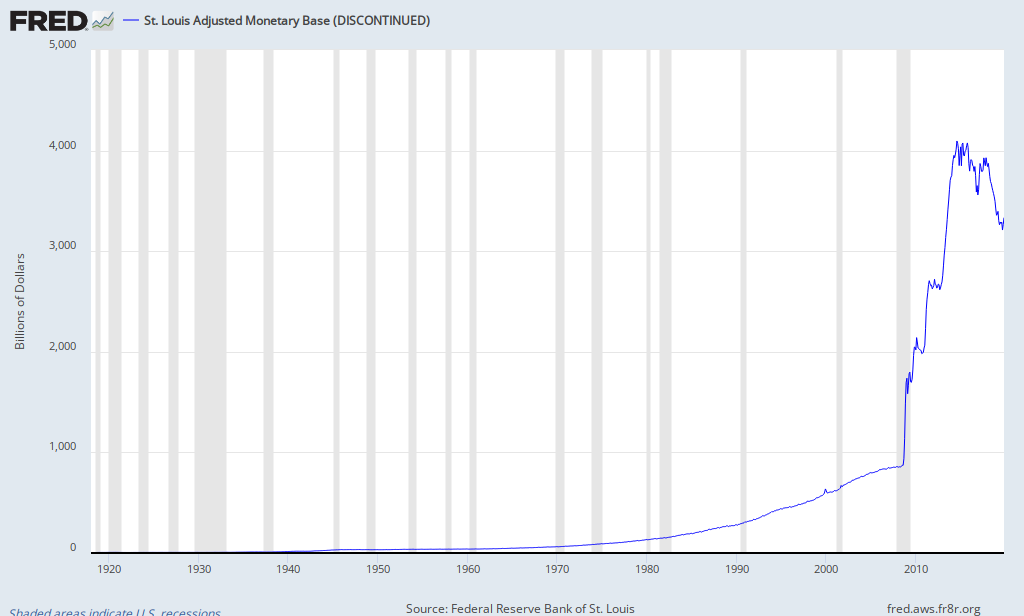
The St. Louis Federal Reserve Bank will no longer publish the chart showing excess reserves of commercial banks.

I can say little about why this decision was made. I suspect the Fed wants to draw minimal attention to the fact that most QE money goes into excess reserves.

The charts unequivocally show that the increase in excess reserves has corresponded almost exactly to the increase in the Fed’s monetary base. Observe:

MONETARY BASE

FRED Graph

EXCESS RESERVES

Graph of Excess Reserves of Depository Institutions

Why is this important? It shows to what extent the Fed’s different batches of QE are stockpiled by the commercial banks rather than pumped into the economy in the forms of loans.

When the Fed increases its balance sheet, the general rule is that the money will cause the money supply to increase because of fractional reserve banking.

However, after in the 2008 crisis, the M1 Multiplier tanked, meaning that each dollar added to the monetary base added much less to the money supply (M1). 

Graph of M1 Money Multiplier

The Fed has expanded its monetary base dramatically, but the M1 Multiplier makes us wonder where all that money went. The excess reserves chart shows us where most of the QE money goes.

As QE continues, we will have to assume excess reserves are rising if the M1 Multiplier remains extremely low. If the multiplier begins to rise, then more new money is entering the economy, not being added excess reserves. If M1 begins to skyrocket, then that means excess reserves are being loaned out.

— No more excess reserves charts — 


Windsor and Detroit: What’s the Difference?

Detroit has declared bankruptcy. The images and descriptions of the city evoke a wretched ghetto. Meanwhile, if you cross the border to Windsor, Ontario you find a relatively nice place.

Both cities have economies heavily invested in automobile manufacturing. Both cities also have various welfare systems available. They are both rife with municipal regulations. Canadian and American cultures are fairly similar.

So what’s the big difference?

Detroit’s bankruptcy filing lists about $18-20 billion worth of debt. Even if you low-ball it, this amounts to debt of about $26,000 for everyone in Detroit. This is a city where the average per capita income is a pathetic $14,700 per year.

Windsor’s debt is around $115 million. They have about a third of Detroit’s population. Windsor’s debt per capita is $545 only.

Debt is not bad. The key is to use the debt for something productive. Since all government spending is inherently wasteful, cities should spend as little as possible and minimize their debts. Otherwise they will become Detroit.