Lessons in Secession for the Quebec Election

Separatism was a hot topic for the latest Quebec election. Quebec’s separatist party was defeated, but regardless of the outcome secession will remain one of the most important controversies underlying Canadian confederacy.

Hoppe writes:

Secession increases ethnic, linguistic, religious, and cultural diversity, while in the course of centuries of centralization hundreds of distinct cultures were stamped out.

There are also economic reasons to favor secession. Although Quebec receives transfer payments from Ottawa, these ultimately make Quebec’s economy weaker. This kind of provincial welfare creates an environment where people have stronger incentives to get money from the government (because there is more loot up for grabs), either through welfare or cronyism, rather than serving one’s fellow man in the market and truly benefiting society.

Furthermore, smaller countries have a stronger incentive to favor free trade, and reject protectionism. It is surely correct that if Quebec maintained its same economic policies post-separation, it would be a disaster for the citizens. But there would be far greater pressure to actually liberalize the economy if there was less subsidization available. Additionally, any of Quebec’s wealth that is currently sucked into the black hole of Ottawa would remain in Quebec.

It would be an advance in Canadian civilization for the country to split. But it would not be enough to stop there — there should be hundreds, or thousands of Canadas, which would create a land of amazing prosperity and happy coexistence. There can still be a “Canada” — but Canada should be a coalition of cooperating territories, not a exploitative system where some groups use Ottawa to rip off other groups.

Is the Taper a Big Lie?

(NOTE TO READER: There was a considerable time lag between the beginning of the QE3 taper’s declared beginning and when it actually started. This article was written during the lag, suggesting that the taper was all hype and no reality. Since then, the taper did become real and QE3 ended.)

The much-talked-about taper could be nothing more than a big joke. Where is the statistical evidence of the taper?

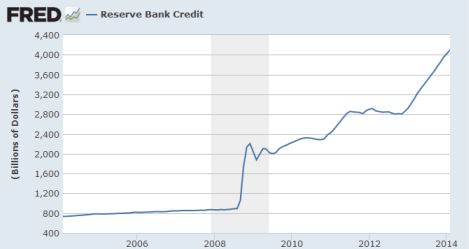
Let’s look at the last 10 years of the Federal Reserve’s balance sheet.

taper1

Here you can see all three QEs laid out nicely.

Let’s “zoom in” and look at just the last year.

taper2

The rate of growth briefly slowed then picked right back up. Other purchases appear to be offsetting the taper, at least so far. On net, no taper. Watch what they do, don’t fret too much over what they say (central bankers lie all the time).

Meanwhile, despite media reports and promises from European central bankers that they will inflate to prevent recession, the ECB is engaged in a deflationary policy, and has been for nearly a year.

Sometimes the official central bank statistics don’t match their words.

The Fed has been saying it will not let interest rates rise, yet at the same time it will slow its rate of purchasing assets. I don’t know how that is supposed to work, since regardless of the Federal Funds target rate, the market sets the real Federal Funds rate. Yet it almost makes sense if you assume while they might buy less crap via QE3, they will balance that with more purchases of different crap.

Did Canada’s Housing Bubble Just Get Popped?

Canada’s housing market has soared while the US market crashed.

Canada has the most overvalued housing market in the world:

The WSJ recently commented:

Canada, for example, is very open to foreign investors, which means that in an age of unprecedented global liquidity cash-rich wealthy individuals who are looking for places to park their excess funds can do so in its housing market far more easily than in Japan, with its closed system.

Now, the Canadian government is eliminating “its controversial investor Visa scheme, which has allowed waves of rich Hongkongers and mainland Chinese to immigrate since 1986.”

The story continues in The South China Morning Post:

Canada’s government has announced that it is scrapping its controversial investor visa scheme, which has allowed waves of rich Hongkongers and mainland Chinese to immigrate since 1986.

The surprise announcement was made in Finance Minister Jim Flaherty’s budget, which was delivered to parliament in Ottawa on Tuesday afternoon local time. Tens of thousands of Chinese millionaires in the queue will reportedly have their applications scrapped and their application fees returned.

The decision came less than a week after the South China Morning Post published a series of investigative reports into the controversial 28-year-old scheme.

The Post revealed how the scheme spun out of control when Canada’s Hong Kong consulate was overwhelmed by a massive influx of applications from mainland millionaires. Applications to the scheme were frozen in 2012 as a result, as immigration staff struggled to clear the backlog.

In recent years, significant progress has been made to better align the immigration system with Canada’s economic needs. The current immigrant investor program stands out as an exception to this success,” Flaherty’s budget papers said.

For decades, it has significantly undervalued Canadian permanent residence, providing a pathway to Canadian citizenship in exchange for a guaranteed loan that is significantly less than our peer countries require,” it read.

Under the scheme, would-be migrants worth a minimum of C$1.6 million (HK$11.3 million) loaned the government C$800,000 interest free for a period of five years. The simplicity and low relative cost of the risk-free scheme made it the world’s most popular wealth migration program.

A parallel investor migration scheme run by Quebec still remains open. Many Chinese migrants use the alternative scheme to get into Canada via the French-speaking province and then move elsewhere in Canada. The federal government has previously pledged to crack down on what it said was a fraudulent practice.

Flaherty also announced yesterday the scrapping of a smaller economic migration scheme for entrepreneurs.

All told, 59,000 investor applicants and 7,000 entrepreneurs will have their applications returned, Postmedia News reported. Seventy per cent of the backlog, as of last January, was Chinese, suggesting more than 46,000 mainlanders will be affected by yesterday’s announcements.

The Immigrant Investor Program, which has brought about 185,000 migrants to Canada, was instrumental in facilitating an exodus of rich Hongkongers in the wake of the 1989 Tiananmen massacre and in the run-up to the handover. More than 30,000 Hongkongers immigrated using the scheme, though SAR applications have dwindled since 1997.

The investor visa plan is truly stupid and should be eliminated. The idea of requiring loans to the government in exchange for citizenship is incredibly perverse. All money lent to the government is wasted and hurts the economy. The Chinese and Hongkongers who participated in this program could have really invested that money in productive endeavors instead. But this is a double-whammy to the Canadian economy, because to pay back those loans the Canadian state must tax its citizens, which hurts the economy even more.

But what effect will this have on Canada’s housing bubble? It will reduce demand for Canadian real estate. That obviously doesn’t help keep prices high.

Yet the really critical factor is central bank policy. The Bank of Canada is not up to date on its financial statements, but as of November it held more assets than ever. I am interested to see whether Poloz will “taper” with his American counterparts.

My intuition says that he won’t. Poloz wants to keep down the Canadian dollar and subsidize exports.  The Bank of Canada has been expanding its balance sheet since mid-2010. Canada’s M1 money supply has grown dramatically. Canada’s housing prices are high. Canada’s interest rates are low. Yield on Canadian government bonds have fallen below American bonds. Yet consumer prices are not rising quickly, so the Bank of Canada sees its policy as an epic success so far.

— Read more at zerohedge

Why They Never See It Coming

Mainstream economists fail to see why crises occur.

Financial Crises Don’t Happen by Accident

By Marc Faber

As a distant but interested observer of history and investment markets I am fascinated how major events that arose from longer-term trends are often explained by short-term causes. The First World War is explained as a consequence of the assassination of Archduke Franz Ferdinand, heir to the Austrian-Hungarian throne; the Depression in the 1930s as a result of the tight monetary policies of the Fed; the Second World War as having been caused by Hitler; and the Vietnam War as a result of the communist threat.

Similarly, the disinflation that followed after 1980 is attributed to Paul Volcker’s tight monetary policies. The 1987 stock market crash is blamed on portfolio insurance. And the Asian Crisis and the stock market crash of 1997 are attributed to foreigners attacking the Thai Baht (Thailand’s currency). A closer analysis of all these events, however, shows that their causes were far more complex and that there was always some “inevitability” at play.

Simply put, a financial crisis doesn’t happen accidentally, but follows after a prolonged period of excesses…

Take the 1987 stock market crash. By the summer of 1987, the stock market had become extremely overbought and a correction was due regardless of how bright the future looked. Between the August 1987 high and the October 1987 low, the Dow Jones declined by 41%. As we all know, the Dow rose for another 20 years, to reach a high of 14,198 in October of 2007.

These swings remind us that we can have huge corrections within longer term trends. The Asian Crisis of 1997-98 is also interesting because it occurred long after Asian macroeconomic fundamentals had begun to deteriorate. Not surprisingly, the eternally optimistic Asian analysts, fund managers , and strategists remained positive about the Asian markets right up until disaster struck in 1997.

But even to the most casual observer it should have been obvious that something wasn’t quite right. The Nikkei Index and the Taiwan stock market had peaked out in 1990 and thereafter trended down or sidewards, while most other stock markets in Asia topped out in 1994. In fact, the Thailand SET Index was already down by 60% from its 1994 high when the Asian financial crisis sent the Thai Baht tumbling by 50% within a few months. That waked the perpetually over-confident bullish analyst and media crowd from their slumber of complacency.

I agree with the late Charles Kindleberger, who commented that “financial crises are associated with the peaks of business cycles”, and that financial crisis “is the culmination of a period of expansion and leads to downturn”. However, I also side with J.R. Hicks, who maintained that “really catastrophic depression” is likely to occur “when there is profound monetary instability — when the rot in the monetary system goes very deep”.

Simply put, a financial crisis doesn’t happen accidentally, but follows after a prolonged period of excesses (expansionary monetary policies and/or fiscal policies leading to excessive credit growth and excessive speculation). The problem lies in timing the onset of the crisis. Usually, as was the case in Asia in the 1990s, macroeconomic conditions deteriorate long before the onset of the crisis. However, expansionary monetary policies and excessive debt growth can extend the life of the business expansion for a very long time.

In the case of Asia, macroeconomic conditions began to deteriorate in 1988 when Asian countries’ trade and current account surpluses turned down. They then went negative in 1990. The economic expansion, however, continued — financed largely by excessive foreign borrowings. As a result, by the late 1990s, dead ahead of the 1997-98 crisis, the Asian bears were being totally discredited by the bullish crowd and their views were largely ignored.

While Asians were not quite so gullible as to believe that “the overall level of debt makes no difference … one person’s liability is another person’s asset” (as Paul Krugman has said), they advanced numerous other arguments in favour of Asia’s continuous economic expansion and to explain why Asia would never experience the kind of “tequila crisis” Mexico had encountered at the end of 1994, when the Mexican Peso collapsed by more than 50% within a few months.

In 1994, the Fed increased the Fed Fund Rate from 3% to nearly 6%. This led to a rout in the bond market. Ten-Year Treasury Note yields rose from less than 5.5% at the end of 1993 to over 8% in November 1994. In turn, the emerging market bond and stock markets collapsed. In 1994, it became obvious that the emerging economies were cooling down and that the world was headed towards a major economic slowdown, or even a recession.

But when President Clinton decided to bail out Mexico, over Congress’s opposition but with the support of Republican leaders Newt Gingrich and Bob Dole, and tapped an obscure Treasury fund to lend Mexico more than$20 billion, the markets stabilized. Loans made by the US Treasury, the International Monetary Fund and the Bank for International Settlements totalled almost $50 billion.

However, the bailout attracted criticism. Former co-chairman of Goldman Sachs, US Treasury Secretary Robert Rubin used funds to bail out Mexican bonds of which Goldman Sachs was an underwriter and in which it owned positions valued at about $5 billion.

At this point I am not interested in discussing the merits or failures of the Mexican bailout of 1994. (Regular readers will know my critical stance on any form of bailout.) However, the consequences of the bailout were that bonds and equities soared. In particular, after 1994, emerging market bonds and loans performed superbly — that is, until the Asian Crisis in 1997. Clearly, the cost to the global economy was in the form of moral hazard because investors were emboldened by the bailout and piled into emerging market credits of even lower quality.

…because of the bailout of Mexico, Asia’s expansion was prolonged through the availability of foreign credits.

Above, I mentioned that, by 1994, it had become obvious that the emerging economies were cooling down and that the world was headed towards a meaningful economic slowdown or even a recession. But the bailout of Mexico prolonged the economic expansion in emerging economies by making available foreign capital with which to finance their trade and current account deficits. At the same time, it led to a far more serious crisis in Asia in 1997 and in Russia and the U.S. (LTCM) in 1998.

So, the lesson I learned from the Asian Crisis was that it was devastating because, given the natural business cycle, Asia should already have turned down in 1994. But because of the bailout of Mexico, Asia’s expansion was prolonged through the availability of foreign credits.

This debt financing in foreign currencies created a colossal mismatch of assets and liabilities. Assets that served as collateral for loans were in local currencies, whereas liabilities were denominated in foreign currencies. This mismatch exacerbated the Asian Crisis when the currencies began to weaken, because it induced local businesses to convert local currencies into dollars as fast as they could for the purpose of hedging their foreign exchange risks.

In turn, the weakening of the Asian currencies reduced the value of the collateral, because local assets fall in value not only in local currency terms but even more so in US dollar terms. This led locals and foreigners to liquidate their foreign loans, bonds and local equities. So, whereas the Indonesian stock market declined by “only” 65% between its 1997 high and 1998 low, it fell by 92% in US dollar terms because of the collapse of their currency, the Rupiah.

As an aside, the US enjoys a huge advantage by having the ability to borrow in US dollars against US dollar assets, which doesn’t lead to a mismatch of assets and liabilities. So, maybe Krugman’s economic painkillers, which provided only temporary relief of the symptoms of economic illness, worked for a while in the case of Mexico, but they created a huge problem for Asia in 1997.

Similarly, the housing bubble that Krugman advocated in 2001 relieved temporarily some of the symptoms of the economic malaise but then led to the vicious 2008 crisis. Therefore, it would appear that, more often than not, bailouts create larger problems down the road, and that the authorities should use them only very rarely and with great caution.

In Manitoba, Feed Your Children Ritz Crackers for Lunch or Be Charged $10

To run a child care facility in Manitoba, one must be licensed by the Manitoba Government’s “Early Learning and Child Care” department. In order to be licensed, the care center must enforce certain requirements about what food the children eat for lunch on site.

One woman, obviously an uncaring and incompetent mother, sent her children to daycare with packed lunches consisting of meat, carrots, potatoes, milk, and an orange.  Mmm… that actually sounds really good… ::drool::

Uh. Pardon me.

So anyway. Guess what happens? The daycare must ensure that all children receive a “balanced meal” according to the Canadian Food Guide, otherwise it violates its licensing requirements. If a child has an unbalanced meal, then the facility must “supplement” their lunch with the appropriate item.

So these children’s lunch lacked a grain item. So what did the facility provide to fulfill that requirement? A piece of bread or something?

Don’t worry, we’ll make sure your children get their Ritz Crackers.

RITZ CRACKERS? Are you kidding me? When your body breaks those down, they are basically just sugar. A perfectly healthy lunch, like the mother gave her children originally, becomes less healthy when you add Ritz Crackers to it.  Ritz Crackers are snack foods.

Government regulation always produces inanity such as this.

No government should regulate what parents feed their children, either directly or through intermediaries like regulated daycare centers. The consequence is less healthy children.

— Read more at LRC

A Different Take on the Rob Ford “Crack Mayor” Story

Rob Ford should resign, but not for the reasons that are very popular right now.

Claim #1: Rob Ford smoked crack, so he should resign.

The tendency of government is always to grow. It is an insatiable beast that becomes bloated by feeding upon the wealth of its subjects. Anything that distracts politicians from trying to pass new laws, new taxes, and new regulations should be welcomed.

Weirdly, that includes smoking crack. The more time a politician spends smoking crack, the less time they can spend trying to do “serious work” like using the law to take more of the peoples’ wealth.

If the entire city council of Toronto was high on crack all the time, they would be high on crack all the time. So they would be pulsing with inflated confidence and sensory stimulation, but they would be unable to do their normal job — which is exercising power over their subjects, generally making their lives worse.

Look at how much energy is being expended to deal with a mayor who apparently smoked crack one time. Instead, they would be working on “fixing problems” in Toronto (read: making Toronto worse).

Normally, crackheads don’t have jobs because they can’t keep a schedule, they can’t concentrate on anything, and they are always desperate to smoke more crack. That would be a far less threatening politician.

Wouldn’t you rather have politicians smoking drugs instead of raising property taxes or creating exploitative regulations that make life difficult?

Claim #2: Rob Ford lied, so he should resign.

I am sure you’ve heard this joke before:

Q: How do you know a politician is lying?

A: His lips are moving.

The term “lying politician” is completely redundant. Politicians lie all the time. If they were actually elected, it is guaranteed that they lied profusely to achieve office. The best politicians are the best liars. The entire premise of democratic politics is people competing against others with one outlandish deception after another.

Mencken said of politicians:

They will all promise every man, woman and child in the country whatever he, she or it wants. …. They will all be curing warts by saying words over them, and paying off the national debt with money that no one will have to earn. When one of them demonstrates that twice two is five, another will prove that it is six, and six and a half, ten, twenty, n. In brief, they will divest themselves from their character as sensible, candid, and truthful men and becomes simply candidates for office, bent only on collaring votes. They will all know by then, even supposing that some of them don’t know it now, that nonsense, and they will apply themselves to the job with a heart yo-heave-ho. Most of them, before the uproar is over, will actually convince themselves. The winner will be whoever promises the most with the least probability of delivering anything.

If people were less selective with their outrage and instead demanded that all politicians resign if they lie, they would seriously require all politicians to pack up their stuff and retreat from public office immediately.

Which would probably make the world a much better place. But people aren’t demanding anything like that at all. So their whining about how Rob Ford lied to them seems extremely contrived and arbitrary.

Read more at CTV.ca —

Politicians are “Obsessive Megalomaniacal Do-gooders”

The following interview with Hans-Hermann Hoppe first appeared in the German weekly Junge Freiheit on November 2, 2012, and was conducted by Moritz Schwarz. It has been translated here into English by Robert Groezinger.

—————–

Are taxes nothing but protection money? The state a kind of mafia? Democracy a fraud? Philosopher Hans-Hermann Hoppe is not only considered one of the most prominent pioneering intellectuals of the libertarian movement, but also perhaps the sharpest critic of the Western political system.

Professor Hoppe, in your essay collection “Der Wettbewerb der Gauner” (“The Competition of Crooks“) you write that “99 percent of citizens, asked if the state was necessary, would answer yes.” Me too! Why am I wrong?

Hoppe : All of us, from childhood, have been moulded by state or state-licensed institutions—preschools, schools, universities. So the result you quoted is not surprising. However, if I asked you whether you said yes to an institution having the last word in each conflict, even in those it is itself involved in, you would certainly say no—unless you hoped to be in charge of this institution yourself.

Er … correct .

Hoppe : Of course, because you know that such an institution cannot only mediate in conflicts but also cause them, you can recognize that it can then resolve them to its own advantage. In the face of this I, for one, would live in fear of my life and property. However, it is precisely this, the ultimate power of judicial decision-making, that is the specific characteristic of the institution known as the state.

Correct, but on the other hand the state is based on a social contract, which provides the individual with protection and space for personal fulfilment, which without the state he would not have—in a struggle of all against all.

Hoppe : No, the state is anything but the result of a contract! No one with even just an ounce of common sense would agree to such a contract. I have a lot of contracts in my files, but nowhere is there one like this. The state is the result of aggressive force and subjugation. It has evolved without contractual foundation, just like a gang of protection racketeers. And concerning the struggle of all against all: that is a myth. Of course the racketeer protects his victims on “his” territory from other racketeers, but only so he can conduct his own racket more successfully. Moreover, it is states that are responsible for the deaths of hundreds of millions of people and immeasurable destruction in the 20th century alone. Compared to that, the victims of private crimes are almost negligible. And do you seriously believe that conflicts between the inhabitants of the tri-border region [of France, Germany and Switzerland] near Basle, who are living together in a condition of anarchy, are more numerous than conflicts between the inhabitants of Dortmund and Düsseldorf, who are citizens of one and the same state [Germany]? Not that I know of.

Why in your view is democracy just a “competition of crooks”?

Hoppe : All highly-developed forms of religion forbid the coveting of someone else’s property. This prohibition is the foundation of peaceful cooperation. In a democracy, on the other hand, anyone can covet anybody else’s property and act according to his desire—the only precondition being that he can gain access to the corridors of power. Thus, under democratic conditions, everybody becomes a potential threat. And during mass elections what tends to happen is that the members of society who attempt to access the corridors of power and rise to the highest positions are those who have no moral inhibitions about misappropriating other people’s property: habitual amoralists who are particularly talented in forging majorities out of a multitude of unbridled and mutually exclusive demands.

“Politicians: lazy and spongers!” Aren’t you afraid you might be reproached for complaining on the level of the “Bild” tabloid newspaper?

Hoppe: So what? Up until the 20th century there was hardly an important political thinker who didn’t speak disparagingly about democracy. The key word was: “mob rule.” The populist criticism of democracy, as can be found in Bild or at the water cooler, is all very well. But it is not fundamental enough, nor does it go far enough—to date Bild hasn’t asked me for an interview either. Of course politicians are spongers; they live off money extorted from other people with the threat of violence—which is called “taxation.” But unfortunately, politicians are not lazy. It would be nice if all they did was squander their booty. Instead they are obsessive megalomaniacal do-gooders, who in addition make life difficult for their victims with thousands of laws and regulations.

Democracy is only one possible variety of statehood. Would a different form of state be more acceptable to you?

Hoppe: In a monarchist state everyone knows who the ruler is and who the ruled are, and accordingly there is resistance against any attempt to increase state power. In a democratic state this distinction becomes blurred, and it becomes all the easier to expand state power.

Just a moment: that’s what courts, laws and the constitution are for, to limit and control the state—government as well as parliament.

Hoppe : The mafia also has “executive”, “legislative” and “judicial” branches. Just go and watch the movie “The Godfather” again!

Another objection: What about the new internet-based detractors of the state, such as “Occupy” or the “Pirates,” who demand transparency and participation, without immediately condemning the state and democracy in their entirety?

Hoppe : The “Occupy” movement consists of economic ignoramuses who fail to understand that the banks’ dirty tricks, which they rightly deplore, are possible only because there is a state-licensed central bank that acts as a “lender of last resort,” and that the current financial crisis therefore is not a crisis of capitalism but a crisis of statism. The “Pirates,” with their demand for an unconditional basic income, are well on the way to becoming another “free beer for all” party. They have a single issue: criticism of “intellectual property rights” (IP rights), which could make them very popular—and earn them the enmity in particular of the music, film and pharmaceutical industries. But even there they are clueless wimps. They just need to google Stephan Kinsella. Then they’d see that IP has nothing to do with property, but rather with state privileges. IP allows the inventor (I) or ‘first maker’ of a product—a text, picture, song or whatever—to forbid all other people to replicate this product, or to charge them license fees, even if the replicator (R) thereby uses his own property only (and does not take away any of I’s property). This way, I is elevated to the status of co-owner of R’s property. This shows: IP rights are not property but, on the contrary, are an attack on property and therefore completely illegitimate.

In “The Competition of Crooks” you outline as an alternative the model of a “private law society.” How does it work?

Hoppe: The basic concept is simple. The idea of a monopolistic property protector and law keeper is self-contradictory. This monopolist, whether king or president, will always be an expropriating property protector and a law-breaking law keeper—who will characterize his actions as being in “the public interest.” In order to guarantee the protection of property and safeguard the law there has to be free competition in the area of law as well. Other institutions apart from the state must be allowed to provide property and law protection services. The state then becomes a normal subject of private law, on an equal footing with all other people. It can’t raise taxes any more or unilaterally enact laws. Its employees will have to finance themselves just the same as everybody else does: by producing and offering something that freely engaging customers consider value for money.

Wouldn’t that quickly lead to a war between these “providers?”

Hoppe: War and aggression are costly. States go to war because they can, via taxes, pass on the cost to third parties who are not directly involved. By contrast, for voluntarily-financed companies, war is economic suicide. As a private law subject the state too will, like all other security providers, have to offer its customers contracts that can only be changed by mutual agreement, and which in particular regulate what is to be done in the case of a conflict between itself and its customers, or between itself and the customers of other, competing security providers. And for that there is only one solution acceptable to everyone: that in these sorts of conflicts not the state, but an independent third party decides—arbitrators and judges who in turn compete with each other, whose most important asset is their reputation as keepers of the law, and whose actions and judgments can be challenged and, if need be, revised, just as anyone else’s can be.

Who should be such a “third party?” And with what instruments of power should it assert the interests of an individual citizen against his contractual partner—the private state, which of course is much more powerful?

Hoppe: In local conflicts, in a village or a small town, these will very often be universally respected “natural aristocrats.” Or else, arbitrating organisations and courts of appeal, which insurers and insured have contractually agreed on from the start. Whoever then does not abide by the judgments will not only be defaulting, he will become a pariah in the world of business. Nobody will want to have anything to do with him, and he will immediately lose all his customers. This is no utopian idea. This is already the usual practice in international—anarchical—business transactions today. And another question for you: How should the individual citizen assert his interests in the face of a monopolistic tax-state? It is much more powerful—and always has the last word!

Do you understand the continuing scepticism with regard to your proposition?

Hoppe : Of course, as most people have never heard of this idea, let alone thought about it seriously. I am only unsympathetic towards those who yell out at the top of their voices when they hear this idea and demand the condemnation of its representatives, without having the least knowledge of economics and political philosophy.

It is hardly likely that a majority of citizens will ever support such an unfamiliar model. But what parts of it at least could be adopted, in order to achieve at least partial improvements of our current system, without a complete abandonment of state and democracy?

Hoppe : There is an interim solution. It’s called secession and political decentralization. Small states must be libertarian, otherwise the productive people will desert them. Desirable therefore is a world made up of thousands of Liechtensteins, Singapores and Hong Kongs. In contrast, a European central government—and even more so a world government—with a “harmonized” tax and regulation policy, is the gravest threat to freedom.

For that too you will probably not find a majority. Therefore how will state and democracy develop in future? Where will we finally end up?

Hoppe : The Western “welfare state model,” “socialism light,” will collapse just like “classical” socialism—of course, I can’t say whether in five, ten or 15 years. The key words are: state bankruptcy, hyperinflation, currency reform and violent distribution battles. Then it will either come to a call for a “strong man” or—hopefully—a massive secession movement.

— From Mises.org

Canadian Healthcare: As Little Care As Possible

Few people realize what is implied with public healthcare. Government services are funded through taxation. They receive money irrespective of their service to the customer. This is why the public sector is so frequently characterized by incompetence, waste, carelessness, laziness, mistreatment, and delusion (“we serve the public good”).

Unlike a normal business, which is rewarded based on how much its output satisfies the consumer, the government services regard the consumer as a burden that consumes resources that it has already taken. Why should it be encouraged to provide good service? Hence, the tendency will always be for public services to maximize the cost, and minimize the actual service provided.

Some recent stories out of B.C. provide classic illustrations. Delta Hospital recently sent home a blind 90-year-old lady home by herself in the middle of the night with a bleeding arm and wrapped in a bed sheet.

In another case, a 76-year-old lady was at Mount St. Joseph for two weeks with pneumonia and anemia. She was sent home, when her condition was obviously still delicate. At home she kept drifting in and out of consciousness, so her son returned her to the hospital, where she collapsed on arrival.

After six hours, the hospital declared she should stay overnight. The son went home to gather some things for his mother. When he returned less than three hours later, he was informed his mother had been sent home.

2012 hospital discharge complaint

Seniors are treated especially poorly by public hospitals

She was sent home in a taxi, alone and afraid, with no ID, no money, no keys to her home, and hospital staff had dressed her in someone else’s clothes.

For government services, the consumer is a burden that needs to be sent home as soon as possible, with or without proper care having been administered. This is especially reprehensible in the healthcare system, where our seniors are systematically mistreated by contemptuous staff.

— Read more at CBC.ca —

Fed Could Delay Tapering Until After December

Frank Shostak, Mises Institute

Most economists surveyed by Bloomberg News are now of the view that the Federal Reserve will begin tapering asset purchases in December. Contrary to expectations on the 18-19 of September, Federal Reserve policymakers have decided to continue with a very loose monetary stance and postpone the tapering of asset purchases.

Most policymakers are of the view that the U.S. economy is not strong enough to generate self-sustained economic growth. Hence it is held the economy still requires support from the Fed.

If Fed policymakers were to decide to taper bond purchases, most experts are of the view Fed policymakers are likely to announce that the U.S. central bank is going to keep its near-zero interest rate policy for a prolonged period of time. This, it is held, should prevent negative side effects coming from the reduction in bond purchases.

For instance, in 1994 when the Fed started a tightening cycle the federal funds rate rose from 3.05 percent in January 1994 to 6.04 percent in April 1995. This, it is argued, caused a sharp fall in the pace of economic activity. The yearly rate of growth of industrial production fell from 7 percent in December 1994 to 2.7 percent by December 1995.


We suggest that it is changes in money supply rather than changes in interest rates that drive economic activity as such. Interest rates are just an indicator, as it were.

A fall in the growth momentum of industrial production during December 1994 to December 1995 occurred on account of a sharp decline in the yearly rate of growth of AMS (our measure of money supply) from 13.7 percent in September 1992 to minus 0.3 percent in April 1995.

This sharp fall in the growth momentum of AMS has weakened the support for various bubble activities that sprang up on the back of the previous rising growth momentum of AMS.

(Even if the Fed would have kept the fed funds rate at a very low level, what would have dictated the pace of economic activity is the growth momentum of AMS.)

Note that a fall in the growth momentum of AMS was in line with the fall in the growth momentum of the Fed’s balance sheet — the yearly rate of growth of the balance sheet fell from 12.7 percent in June 1993 to 4.4 percent by December 1995.


Whilst in the 1993 to 1995 period, changes in the Fed’s balance sheet were positively associated with changes in the growth momentum of money supply. This time around this is not the case. (Changes in money supply are not responding to changes in the Fed’s balance sheet.) The key reason for that is bank reluctance to aggressively expand lending notwithstanding the aggressive pumping by the Fed.

So far in September, the growth momentum of the Fed’s balance sheet climbed to 30.6 percent from 28 percent in August. (Despite this massive pumping banks remain reluctant to aggressively expand lending.) In September banks were sitting on massive cash reserves of $2.2 trillion against $2.17 trillion in August and $2.4 billion in January 2008.


Consequently, the growth momentum of our measure of money supply AMS has visibly weakened. The yearly rate of growth stood at in September at 6.7 percent against 7.7 percent in August.

We suggest that irrespective of what the Fed is currently doing it will have very little effect on the economy at present and in the immediate future. Given a decline in the yearly rate of growth of AMS from 14.8 percent in October 2011 to 6.7 percent in September this year, we suggest this likely to depress economic activity going forward.

Again, this is likely to happen irrespective of the decision the Fed is going to take with respect to the tapering of assets purchases.

Based on the lagged growth momentum of AMS we expect that the yearly rate of growth of industrial production to fall to minus 1 percent by October from 2.7 percent in August.


Given the possibility of a sharp decline in economic activity on account of the fall in the growth momentum of AMS it is quite likely that Fed policymakers will decide to postpone the tapering of asset purchases also in December.

We need to add to all of this the possibility that the pool of real wealth might be currently in difficulties on account of the Fed’s reckless policies.

(The near zero interest rate policy has caused a severe misallocation of scarce real savings — it has weakened the wealth generation process and thus the economy’s ability to support stronger real economic growth.)

If our assessment is valid on this, we can suggest that a stagnant or declining pool of real wealth is likely to put more pressure on banks’ lending. Remember that it is the state of the pool of real wealth that dictates banks’ ability to lend without going belly up.

Conclusion

We can conclude that regardless of changes in the Fed’s balance sheet, it is a fall in the growth momentum of AMS since October 2011 that will determine the pace of economic activity irrespective of the planned actions by the Fed. Given the possibility that the pool of real wealth might be in trouble this could put further pressure on the growth momentum of bank lending and thus the growth momentum of money supply.