Alberta Floods 2013: Putting Fresh Perspective on Foreign Aid

The Premier Redford and Prime Minister Harper have pledged “full support” to victims of the devastating Alberta floods.

What they do not mention is that both Alberta and Ottawa are broke. There is no special fund for disaster relief. They can only provide help by taking more of other people’s money — either through taxation or borrowing. They will probably borrow money from countries like China.

At a time like this, giving money to corrupt foreign governments seems even worse than it does normally.

Last year, Canada gave almost $6 billion away in foreign aid (MS Excel). That might seem small, but it is a very significant amount of money for Canada’s small population. That money would definitely be useful to help Canadians during times of disaster.

The biggest recipient of our foreign aid was Ethiopia —  an American puppet state that takes money from the West to fight brutal wars against the Somalis. Another big recipient of Canadian aid is Afghanistan — where we help NATO inflict man-made disasters with missiles, then we pay up to rebuild what we destroyed.

Southern Alberta is underwater, thousands are homeless, and our governments have no money. But aren’t you glad the Canadian governments gives millions to evil regimes in Jordan, Burma, and North Korea?

Alberta Floods 2013: Government’s Absurd Water Usage Restrictions

Don’t wash wash your cars… unless you go to a commercial car wash.

• Limit toilet flushing.
• Limit showers to five minutes or less and keep baths shallow.
• Hold off on doing laundry.
• Only use your dishwasher if absolutely necessary and you have a full load.
• Turn off taps when brushing teeth or shaving.
Don’t wash your vehicle.

Effective immediately and until further notice, the use of tap water outdoors is suspended….

There are exceptions to the Water Utility Bylaw. They include:
• Washing outdoor surfaces for health and safety reasons for childcare facilities, food and beverage establishments and kennel and animal care facilities.
• Washing of vehicles to follow health and safety regulations.
• Watering of plants, shrubs and trees offered for sale.
Businesses that have a license to operate exterior window washing services and car washes.

— Read more at Calgary City News Blog

Chinese Demand for Gold Is the Real Deal, Long Term

You have to see these images from China.

During the Dragon Boat Festival, ten thousand Chinese demonstrated the depth of their gold fever by lining up to buy that “stupid” investment. This is despite the relative respite from inflation, according to official Chinese statistics.

All these people want gold:

Gold Line 1_0

Gold Line 2_0

Gold Line 3_0

Gold Line 5_0

Gold Line 6_0

Gold Line 4_0

China is a source of demand for gold that will be significant in the long term.

Read more at Mises.ca

David Rosenberg on Canada vs. the US

Debate rages on about how sustainable or even real the economic recovery is in the US.

David Rosenberg, former chief economist at Merrill Lynch, showed a presentation at one of John Mauldin’s recent conferences. It is entitled: “The Fed Is Trying Like Crazy, But Nothing It Does Can Save The Economy.”

The presentation consists of 60 slides that collectively devastate the case for expecting serious economic recovery in the US. The charts are extremely convincing. The argument he builds with his evidence seems irrefutable.

You can see the entire presentation here. It is worth your time.

While Rosenberg is very bearish on the US, he seems optimistic about Canada. He thinks the “short Canada” trade is a huge mistake.

He draws his conclusion about Canada mostly by looking at 2013 Q1 data, but overall he underestimates Canada’s problems. Canada’s housing sector is more distorted by intervention than he realizes, and our employment data is terrible.

He also downplays the interventions of the Bank of Canada. He says Canada has performed better than the US “without nearly as much … expansion of the central bank balance sheet.”

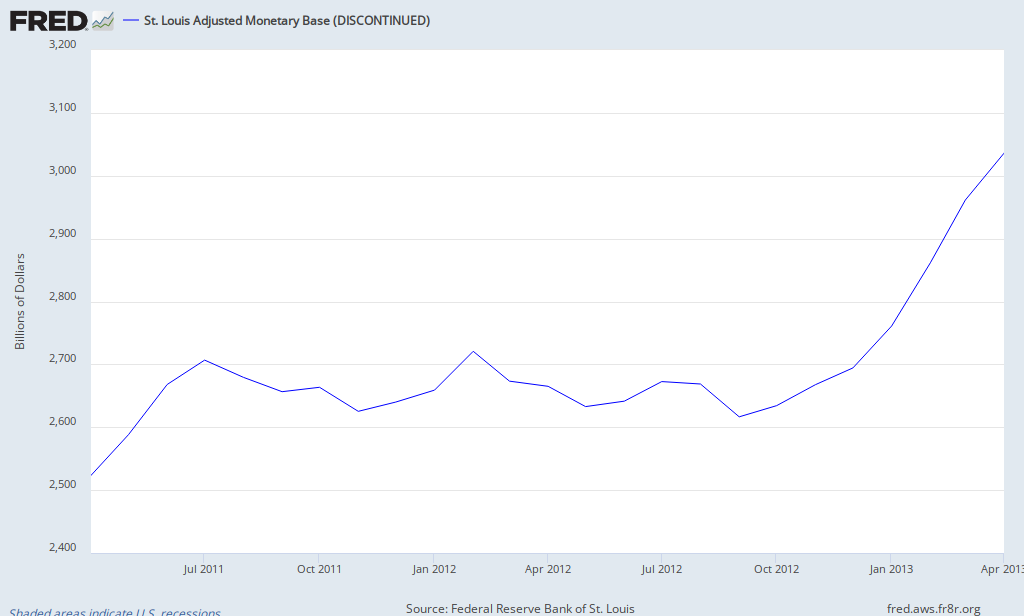
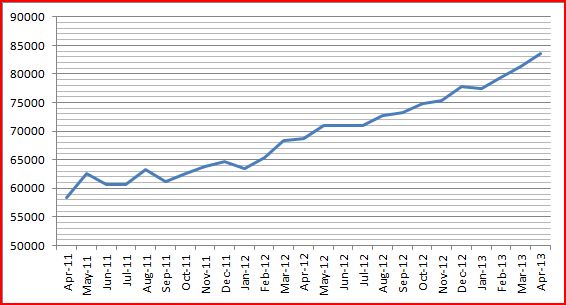
Is this actually true? The BoC deflated in the immediate aftermath of the financial crisis, but it has been busy making acquisitions in the last couple years. In two years, the BoC has expanded its balance sheet by about 30%, whereas the Fed has expanded by about 20% in the same time.

The Fed:

FRED Graph

Here is the BoC monetary base (this chart uses data from here):

boc chart

I think Rosenberg is right on the US and a bit off-base for Canada.

What Three Billionaires Are Doing with Their Money

It is interesting to contrast what the “irrationally exuberant” average investor has been doing vs. the recent activity of a few high-profile billionaires.

Richard Russell, editor of Dow Theory Letters, says that if we judge them by their recent activity, Warren Buffett, John  Paulson, and George Soros are pessimistic about American consumers. They are selling consumer-oriented stocks. This is interesting particularly from Buffett, who has been a “cheerleader for US stocks” all along.

In the last quarter, Buffett sold off a large share of consumer stocks. Berkshire’s overall stake in such investments as dropped by 21%, including significant sales of Kraft and Proctor & Gamble. He dumped his entire position of Intel. He also sold 10,000 shares of GM and 597,000 shares of IBM.

John Paulson liquidated 14 million shares of JP Morgan, and sold off his full stake of consumer-oriented Family Dollar and Sara Lee.

George Soros also unloaded JP Morgan shares, and almost all his other bank stocks as well, including Citigroup and Goldman Sachs.

These billionaires — right or wrong — are shifting to greater cash holdings and away from American consumers. In America, consumption is 70% of the economy. The billionaires seem to anticipate a hit to consumption as the economic strain on American consumers grows.

The US is Canada’s biggest trading partner. It is the world’s largest consumer. Most of the world is structured around selling stuff to Americans. If the US consumer’s situation is worsening, it creates challenges for the Canadian economy.

A nearly universal bullish sentiment is driving average investors into the American stock market. This could certainly drive the American stock market higher for some time yet. Eventually, however, the offers will start coming in with no bids, and the system will violently recoil.

Read more at King World News Blog

Carney vs. the British Pound

UK citizens are running out of time before Mark Carney takes over their central bank.

Carney got the Bank of England job because he was a friend of bank bailouts and has shown no reluctance when it comes to printing money.

Mike Amey, head of sterling bonds at PIMCO, believe that’s what Carney plans to do when he takes over the BoE. He predicts Carney will devalue the pound by as much as 15%. That’s because Britain is desperate, and central bankers don’t really have any solutions other than “MOAR PRINTING.”

I’m so glad Carney’s going to be gone, not that I expect Stephen Poloz to be any better. But we should feel bad for the citizens of the UK. The pound has already lost significant value in recent years.

— Read more at The Telegraph —


Mark Carney - HERE I COME BRITAIN YOU SHOULD SELL YOUR POUNDS BEFORE I GET THERE

Another Reason for Protectionists to Hate China

Protectionists hate China because their wages are “too low,” and that’s “not fair.”

(Mostly it’s not fair for the Chinese, whose wages would rise if their government would not print so much of its currency to prop up the US dollar.)

Prime Minister Harper wants more tariffs on Chinese goods.

Wait until the protectionists see this video. “Child labor! Child abuse!” they will cry. They will plead for more tariffs.

Apparently the boy makes a salary of 4000 RMB, which is about $675 in Canadian dollars. Not bad.

Yield on Canadian Government Bonds Rising

About three weeks ago, I speculated that the bottom on interest rates had come and gone, and interest rates were rising.

This now seems more and more certain. Because of Abenomics, yields on Japanese government bonds have shot up and set off an ugly chain reaction. Bond prices are falling and yields are rising. Rather quickly, I might add.

Take a look at these charts of yields for selected Canadian government bonds. Pay extra attention to the longer-term bonds.

First, marketable bonds. The average yield on 1-3 year bonds:

Government of Canada marketable bonds - average yield - 1 to 3 year

Now 3-to-5 year bonds:

Government of Canada marketable bonds - average yield - 3 to 5 year

5-10 year:

Government of Canada marketable bonds - average yield - 5 to 10 year

Here’s the average for 10+ year bonds:

Government of Canada marketable bonds - average yield - over 10 years

Now the benchmark bonds.

First, the 2-year:

Government of Canada benchmark bond yields - 2 year

The 3-year:

Government of Canada benchmark bond yields - 3 year

The 5-year:

Government of Canada benchmark bond yields - 5 year

The 7-year:

Government of Canada benchmark bond yields - 7 year

The 10-year:

Government of Canada benchmark bond yields - 10 year

Long-term benchmark bonds:

Government of Canada benchmark bond yields - long-term

Here’s the long-term real return bond yield:

Real return bond - long term

You can draw your own conclusions from this data, I’m sure.

Trouble in the Workers’ Paradise

Sweden is regarded by many as the ideal balance between capitalism and socialism.

A lot of people genuinely believe it is a “Workers’ Paradise.” They worship the “Nordic model” as something all Western democracies should emulate.

Recent events show that the model of a lavish welfare statism cannot erase deeper economic and cultural divisions. Right now, Sweden is seeing the worst riots in years as immigrant youths trash everything in sight, and clash with mobs of immigrant-haters. Cars are torched. Rocks are thrown at police and firefighters. Schools have been set ablaze.
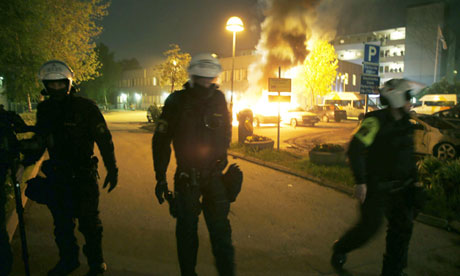
Riots in Stockholm, Sweden - 22 May 2013

Sweden has experienced various riots in the last few years. Usually these cool off after a day.

The latest riots have gone on for a week. The situation evokes memories of the 2005 Paris riots, or the 2011 London riots.

But why should anyone want to riot in Sweden? Isn’t everything perfect?

The disturbances erupted in Husby last weekend, after police shot dead an elderly man brandishing a machete inside his house. Angered at what they saw as police heavyhandedness, youths torched cars and buildings and stoned police and firefighters. Police were then forced to draft in extra manpower from outside Stockholm as the trouble spread to other immigrant-dominated suburbs of the capital and towns such as Orebro in central Sweden, where 25 masked youths set fire to a school on Friday night.

According to one rioter:

“In the beginning it was just a bit of fun,” said one young man in his early 20s who did not wish to be named. He was one of a Husby group of 30-40 youths that battled with police.

“But then when I saw the police charging through here with batons, pushing women and children out of the way and swinging their batons, I got so damned angry.”

The Swedes just can’t understand why this is happening.

“We have tried harder than any other European country to integrate, spending billions on a welfare system that is designed to help jobless immigrants and guarantee them a good quality of life,” said Marc Abramsson, leader of the National Democrats Party. “Yet we have areas where there are ethnic groups that just don’t identify with Swedish society. They see the police and even the fire brigade as part of the state, and they attack them. We have tried everything, anything, to improve things, but it hasn’t worked. It’s not about racism, it’s just that multi-culturalism doesn’t recognise how humans actually function.”

It’s fair to wonder, if this can happen in Sweden, why not everywhere?

(Maybe not Canada. Instead, we riot over god damn hockey games.)

Multiculturalism has never worked anywhere, ever, in all of human history. It’s not because different groups of people can’t get along. Trade and peace is natural, even between people of different religion, race, culture, or ethnicity. The blame instead rests on the institution of the state itself.

Rather than erase conflict between different groups, as many like to believe, welfare statism aggravates the conflict between them. This happens because the state encourages not cooperation and respect between people, but rather dependence on its ability to transfer property from one group to another. This always breeds resentment between people who are more or less on the dole than other people.

The state cannot create harmony between people. It creates only discord.

— Read more at The Telegraph and Yahoo News

Chinese Slowdown Puts a Drag on Energy Markets

Oil is the world’s most important commodity. Its market provides a good indication of where the economy is going.

The price of oil fell for five days before jumping today because of strong consumer confidence numbers in the US. The push down had been largely due to news from China.

Chinese manufacturing activity fell in May after months of slower growth. Its PMI hit a seven-month low of 49.6. A value below 50 indicates a contraction.

Oil consumption in OECD countries has fallen the last few years. In the rest of the world, it is has grown. The biggest of these consumers is China.

China is the world’s major exporter of manufactured goods. The decline in manufacturing activity implies the world’s slowing demand. This in turn will result in a reduced demand for energy.

China is a major factor in the marginal demand for oil. The oil price is not set by speculators, but supply and demand. Producers pump as much as they can. Chinese demand — in no small part driven by radical monetary expansion — is largely responsible for the boom in oil prices, from $20 a barrel in 2001 to current levels.

Chinese slowdown will cause oil prices to fall. When the economy is growing, oil prices rise because there is greater demand for energy. Prices fall when demand falls. This is elementary economics. The price of oil will decline.

— Read more at Marketwatch